Updated on November 12th, 2026 by Nikolaos Sismanis
High dividend stocks are attractive for income investors.
With the S&P 500 average yield at just ~1.0%, it has gotten harder to find suitable yields in the stock market.
Fortunately, there are still plenty of quality high dividend stocks to choose from.
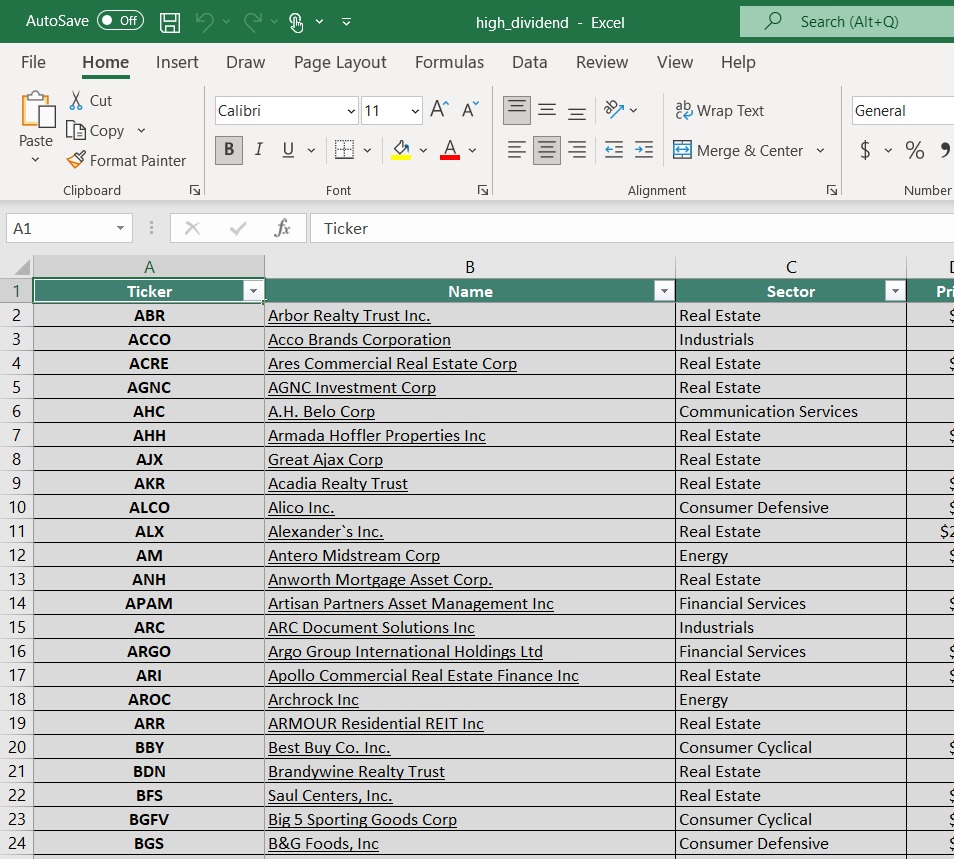
With that in mind, we have created a free list of over 100 high dividend stocks with dividend yields above 4% that we cover in the Sure Analysis Research Database, along with metrics that matter like:
- % Fair Value
- Dividend Yield
- Dividend Risk Score
- Buy/Hold/Sell Recommendation
- And many more
You can download your copy of the high dividend stocks list below:
However, investors should remember that extremely high yields can be deceiving.
There are many examples of high dividend stocks reducing or eliminating their dividends.
As a result, investors should look for high dividend stocks that also have sustainable payouts.
This means investors will receive the benefits of high income for many years.
The 10 high dividend stocks below were found based on a qualitative assessment of their individual business models and future growth prospects.
Dividend yields are based on the November 12th, 2026 Sure Analysis Research Database spreadsheet.
Table of Contents
- High Dividend Stock For The Long Run: Kimberly-Clark Corporation (KMB)
- High Dividend Stock For The Long Run: T. Rowe Price Group, Inc. (TROW)
- High Dividend Stock For The Long Run: Hormel Foods Corporation (HRL)
- High Dividend Stock For The Long Run: Fidelity National Financial, Inc. (FNF)
- High Dividend Stock For The Long Run: PepsiCo, Inc. (PEP)
- High Dividend Stock For The Long Run: Sonoco Products Company (SON)
- High Dividend Stock For The Long Run: Portland General Electric Company (POR)
- High Dividend Stock For The Long Run: Eastman Chemical Company (EMN)
- High Dividend Stock For The Long Run: Eversource Energy (ES)
- High Dividend Stock For The Long Run: The Clorox Company (CLX)
- Final Thoughts
High Dividend Stock For The Long Run: Kimberly-Clark Corporation (KMB)
- Dividend Yield: 4.7%
Kimberly-Clark Corporation sells essential personal-care and tissue products under brands including Huggies, Kleenex, Scott, Cottonelle, and Kotex, creating repeat demand across economic cycles.
On November 5th, 2026, Kimberly-Clark reported third-quarter results for the period ending September 30th. Continuing-operations sales declined 0.4% to $4.1 billion, while organic sales fell 1.3% as disruption in China and retailer inventory movements weighed on demand.
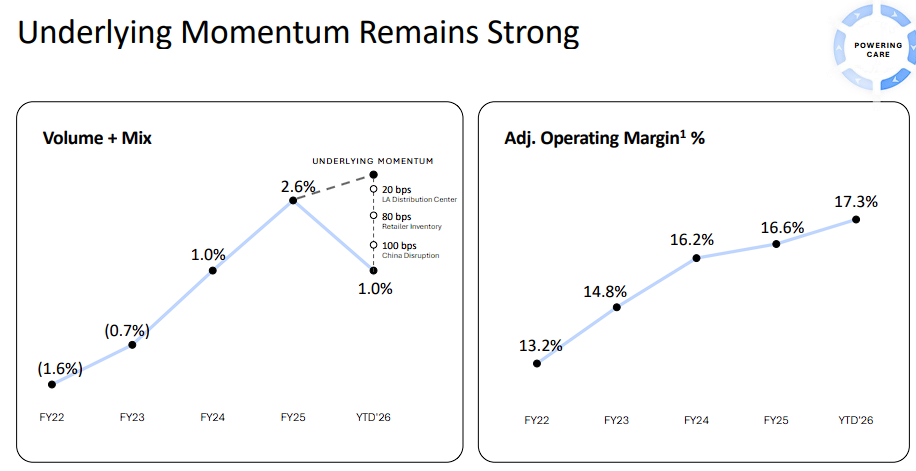
Adjusted operating profit declined 0.9% to $677 million. Adjusted earnings per share from continuing operations increased 17.2% to $1.70, helped by lower interest expense and a lower tax rate; total adjusted EPS declined 6.6% following the international tissue-business transaction.
Kimberly-Clark completed the Kenvue acquisition on November 2nd, adding consumer-health brands including Tylenol, Listerine, and Neutrogena. Management reiterated approximately $2.1 billion of anticipated net run-rate synergies.
The 2026 standalone outlook remains unchanged, but it excludes Kenvue. The company has not provided a combined-company fourth-quarter or full-year 2026 outlook.
Kimberly-Clark has increased its dividend for 54 consecutive years and pays $5.12 annually, yielding 4.7%.
Essential brands and productivity gains support the long-term income case. Integrating Kenvue, realizing synergies, and managing the enlarged balance sheet will shape future earnings and dividend growth.
High Dividend Stock For The Long Run: T. Rowe Price Group, Inc. (TROW)
- Dividend Yield: 4.7%
T. Rowe Price Group, Inc. is a global asset manager offering mutual funds, exchange-traded funds, subadvisory services, separate accounts, and retirement solutions to individuals and institutions.
On October 29th, 2026, T. Rowe Price reported third-quarter results for the period ending September 30th. Net revenue increased 5.9% to $2.00 billion, and adjusted earnings per share rose 1.8% to $2.86 from $2.81 a year earlier.
Adjusted operating income increased 4.5% to $809.2 million. GAAP earnings per share declined to $2.79 from $2.87, reflecting weaker non-operating income despite higher operating profit.
Quarter-end assets under management were $1.863 trillion, up 5.4% year over year but down 1.6% sequentially. Net client outflows totaled $28.3 billion, including a large target-date retirement withdrawal.
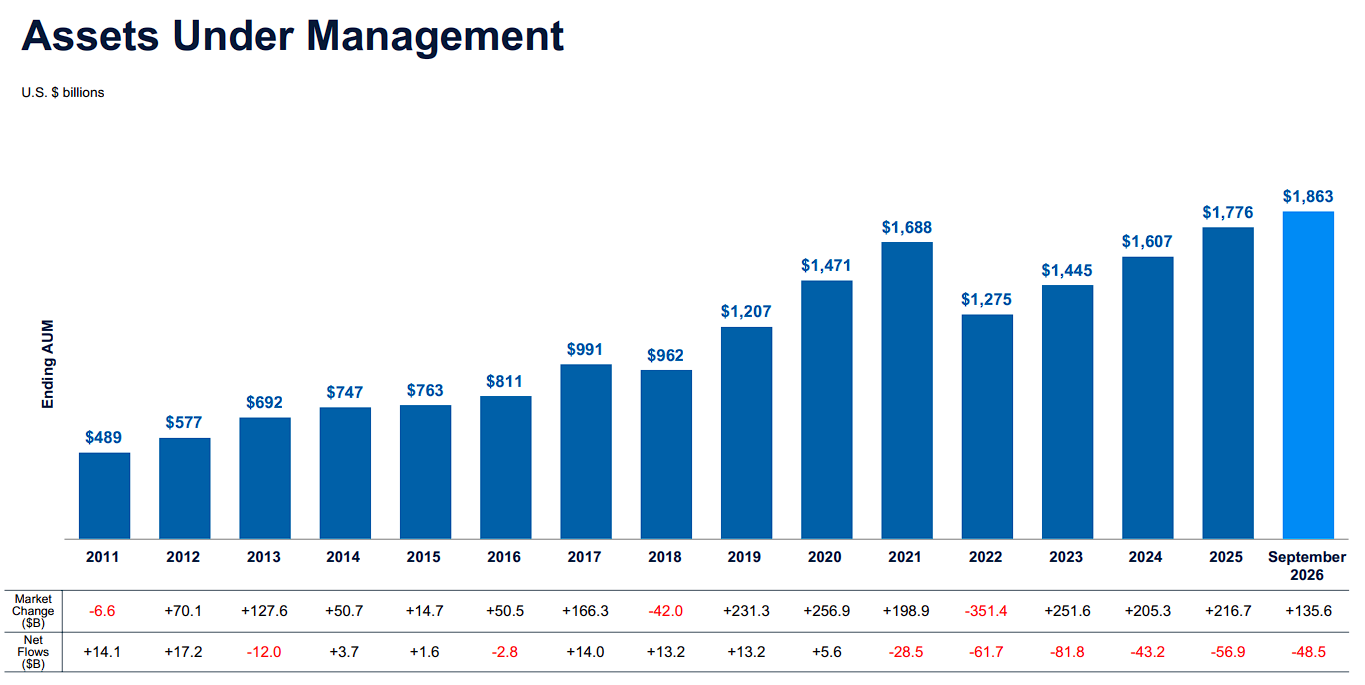
On November 11th, T. Rowe Price reported October-end assets under management of $1.834 trillion, down from $1.863 trillion at September-end, with $10.8 billion of net outflows during October.
The company continues expanding active ETFs, separately managed accounts, and model portfolios to meet changing investor preferences. These initiatives need to translate into better client flows over time.
Its quarterly dividend is $1.30, or $5.20 annualized, following February’s 2.4% increase and extending its dividend-growth streak to 40 years.
The shares yield 4.7%, and the dividend consumes approximately 51% of our earnings forecast. A strong balance sheet provides an additional cushion.
Persistent outflows, fee competition, investment performance, and equity-market declines remain the main risks to long-term earnings and dividend growth.
High Dividend Stock For The Long Run: Hormel Foods Corporation (HRL)
- Dividend Yield: 5.3%
Hormel Foods Corporation owns branded foods including SPAM, Skippy, Applegate, Jennie-O, and Planters, with products sold through retail and foodservice channels in the United States and abroad.
On August 27th, 2026, Hormel reported fiscal third-quarter results for the period ending July 26th. Sales declined 2.3% to $2.96 billion, while adjusted earnings per share were $0.37.
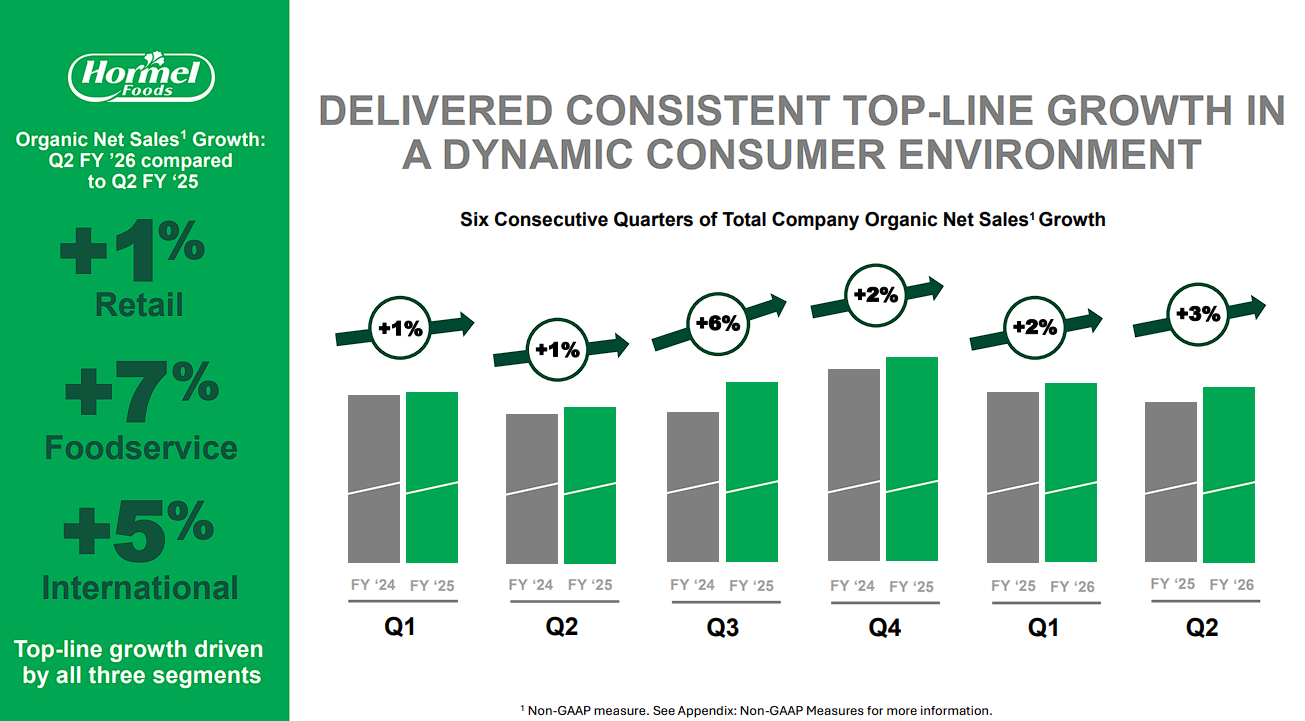
Adjusted operating margin improved 60 basis points to 9.0%, and operating cash flow increased 54% to $241 million. Foodservice recorded its twelfth consecutive quarter of organic sales growth.
Management raised the lower end of adjusted fiscal 2026 earnings guidance to $1.45 per share, with the upper end unchanged at $1.51. The Ceratti disposal closed early in the fourth quarter as Hormel continued simplifying its portfolio.
On September 30th, Hormel agreed to acquire Brakebush Brothers for approximately $1.055 billion. The value-added chicken business would expand Foodservice, with closing expected in fiscal first-quarter 2027, subject to approvals and other conditions.
The planned acquisition would be funded with cash and long-term debt and is expected to become accretive to adjusted EPS beginning in fiscal 2028.
Hormel pays $0.2925 quarterly, or $1.17 annually, yielding 5.3%, and has increased its dividend for 60 consecutive years.
Branded demand and improving profitability support the income case, but the approximately 78% projected payout ratio leaves less room for setbacks. Brakebush financing and integration add to the need for disciplined capital allocation.
High Dividend Stock For The Long Run: Fidelity National Financial, Inc. (FNF)
- Dividend Yield: 4.9%
Fidelity National Financial, Inc. is the largest U.S. title insurer and owns a controlling interest in F&G Annuities & Life, providing exposure to housing transactions, annuities, and investment income.
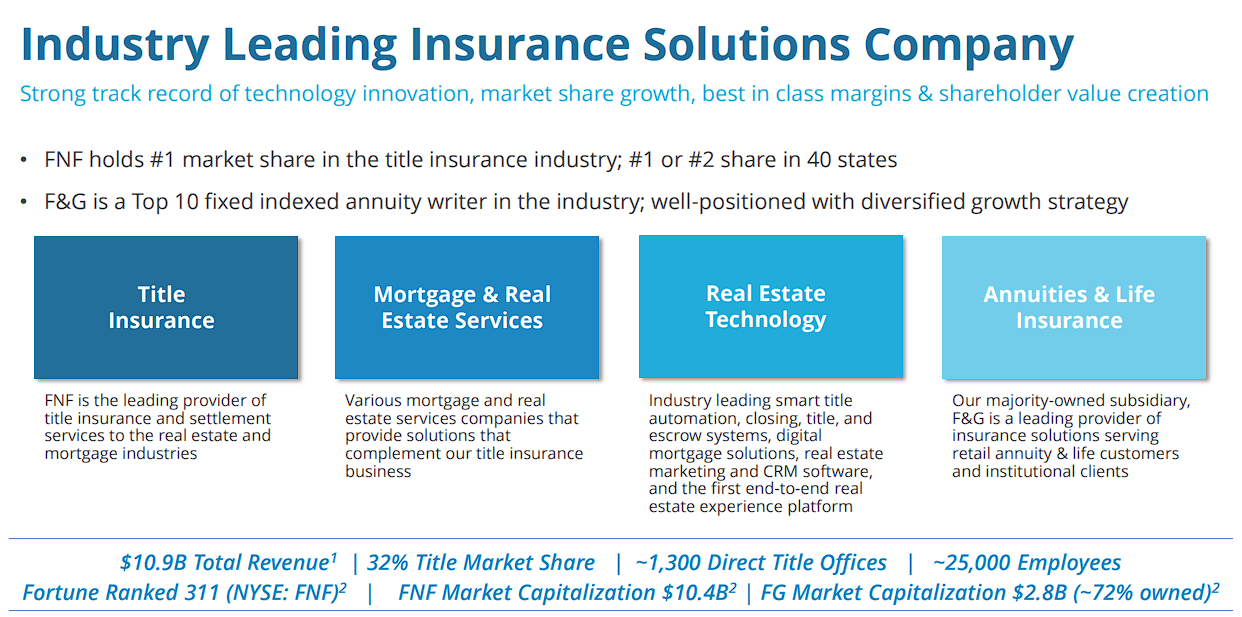
On November 5th, 2026, Fidelity National reported third-quarter results for the period ending September 30th. GAAP net earnings increased to $633 million, or $2.37 per share, from $358 million, or $1.33 per share, a year earlier.
Adjusted net earnings declined to $352 million, or $1.32 per share, from $439 million, or $1.63 per share. The difference highlights the effects of investment marks and other items on reported earnings.
Title revenue excluding recognized gains and losses rose 7% to approximately $2.5 billion, with an adjusted pretax title margin of 17.1%. F&G ended the quarter with $76.2 billion of assets under management before reinsurance and $3.0 billion of gross sales.
Fidelity National returned approximately $143 million through dividends and repurchases during the quarter.
On November 6th, the company announced a quarterly dividend increase to $0.54 from $0.52, equivalent to $2.16 annually. The new payout represents about 44% of our $4.89 earnings forecast for 2026, and the dividend-growth streak now stands at 15 years.
Housing activity remains cyclical, but market leadership, title margins, dividend coverage, and F&G diversification support the longer-term income case. Mortgage activity and insurance-investment returns remain important risks.
High Dividend Stock For The Long Run: PepsiCo, Inc. (PEP)
- Dividend Yield: 4.1%
PepsiCo, Inc. is a global food-and-beverage leader whose portfolio includes Pepsi, Gatorade, Mountain Dew, Lay’s, Doritos, Quaker, and many other billion-dollar brands.
Its combination of convenient foods and beverages, extensive distribution, and international scale has historically produced resilient cash flow across economic cycles.
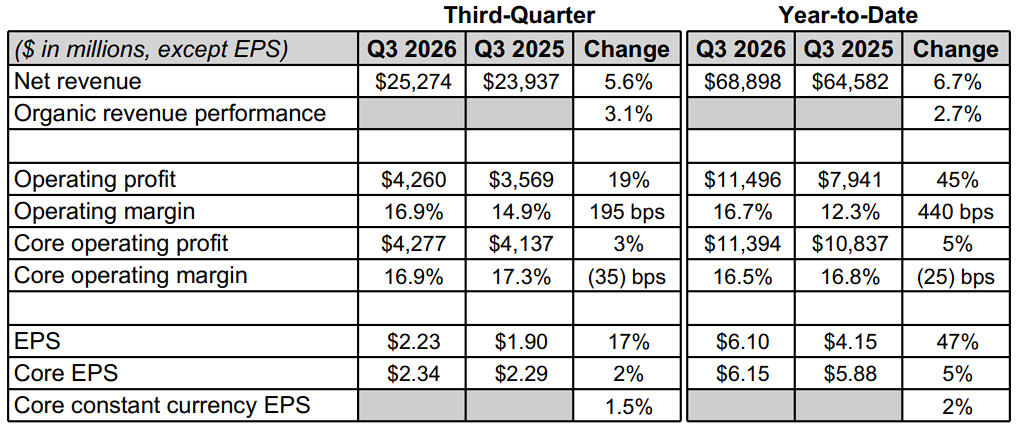
On October 8th, 2026, PepsiCo reported third-quarter results for the period ending September 5th. Net revenue increased 5.6% to $25.27 billion, organic revenue rose 3.1%, and core earnings per share advanced 2% to $2.34.
International operations remained strong. North American beverage volume declined 2%, while convenient-food trends improved sequentially, leaving recovery in these large businesses an important growth opportunity.
Core operating margin declined 35 basis points to 16.9% as higher costs and reinvestment offset some of the benefits from productivity savings.
Management expects approximately 6% revenue growth and 2.5% to 3.5% core earnings-per-share growth for 2026, following a reduction in its earnings-growth outlook.
Additional structural cost reductions are intended to fund innovation and brand investment while offsetting input-cost inflation.
PepsiCo raised its annualized dividend 4% to $5.92 in 2026, extending its dividend-growth streak to 54 consecutive years.
The shares yield 4.1%, and the payout consumes approximately 71% of our $8.38 earnings estimate. Strong brands and distribution support long-term income, but North American execution and cash-flow growth remain important to strengthening dividend coverage.
Deep Dive: Click here to download (for free) our most recent 3-Page Sure Analysis PDF report on PepsiCo, Inc. (PEP).
High Dividend Stock For The Long Run: Sonoco Products Company (SON)
- Dividend Yield: 4.4%
Sonoco Products Company supplies consumer and industrial packaging across food, beverage, household, construction, and other end markets, creating a diversified base of demand.
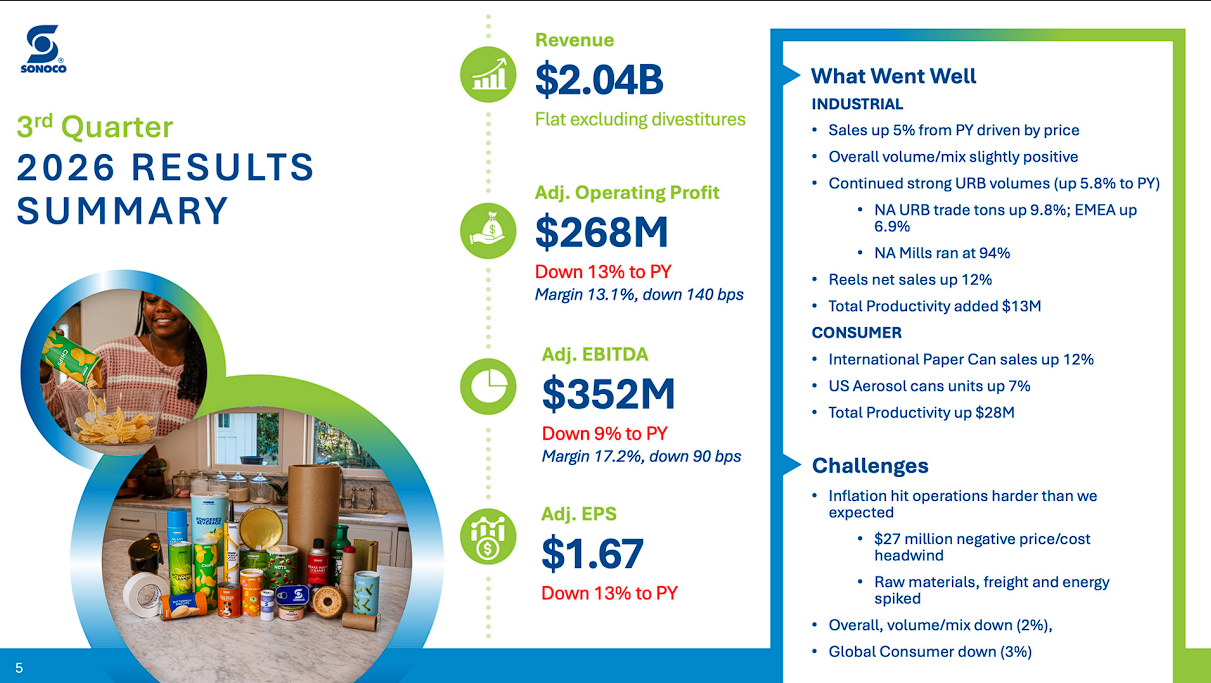
On October 21st, 2026, Sonoco reported third-quarter results for the period ending September 27th. Sales declined 4.2% to $2.04 billion, while adjusted earnings per share fell to $1.67 from $1.92 a year earlier.
The GAAP net loss was $732 million, or $7.36 per share, including an $829 million non-cash goodwill impairment. This charge should be distinguished from the decline in adjusted operating performance.
Consumer Packaging sales declined 2.9% as weaker harvest-related can demand offset pricing. Industrial Paper Packaging sales increased 5.2%, although higher costs pressured profitability in both segments.
Management reduced 2026 adjusted earnings guidance to $5.30 to $5.50 per share from $5.80 to $6.20 and now expects operating cash flow of $600 million to $650 million.
Sonoco also announced a $40 million Richmond paperboard-mill modernization over the next two years, supporting capacity and operating efficiency.
On November 9th, Sonoco announced a CEO succession plan. Howard Coker will retire on December 31st, 2026, with Ernest Haynes III appointed to succeed him.
The quarterly dividend is $0.54, or $2.16 annualized, after April’s increase extended its dividend-growth streak to 50 years. The 4.4% yield and approximately 40% projected payout ratio support the income case.
Eviosys integration, debt reduction, inflation recovery, and packaging demand remain important. The dividend’s coverage should be assessed using sustainable earnings and cash generation alongside the impairment-driven GAAP loss.
High Dividend Stock For The Long Run: Portland General Electric Company (POR)
- Dividend Yield: 4.8%
Portland General Electric Company is a regulated electric utility serving Oregon, where electrification and data-center development are supporting power demand and infrastructure investment.
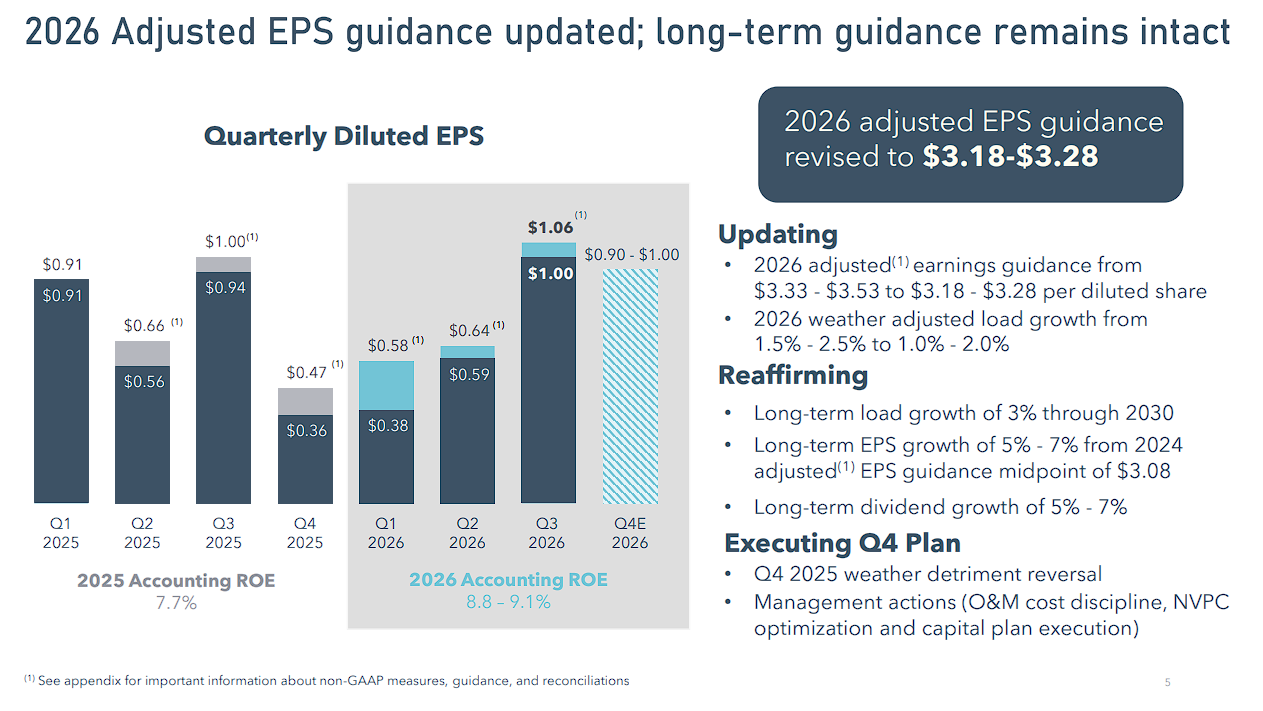
On October 29th, 2026, Portland General reported third-quarter results for the period ending September 30th. GAAP net income was $119 million, or $1.00 per diluted share, while adjusted net income was $125 million, or $1.06 per share.
Historically mild weather reduced residential and commercial demand. Industrial energy deliveries increased 6%, supported by high-tech and data-center customers.
Management reduced 2026 adjusted earnings guidance to $3.18 to $3.28 per share from $3.33 to $3.53. The long-term growth outlook remains intact.
A large-load tariff introduced in July is designed to allocate more infrastructure costs and risks to the customers creating them.
Portland General also signed build-transfer agreements for the Biglow and Salmonfly solar-and-battery projects, representing approximately $1.75 billion of combined anticipated investment. Regulatory processes and funding remain important to these growth plans.
The proposed $1.9 billion acquisition of PacifiCorp’s Washington operations remains expected to close in 2027, subject to regulatory approvals. Portland General is partnering with Manulife Infrastructure and its affiliates, which would hold minority interests.
The quarterly dividend is $0.55125 per share, or $2.205 annually. The shares yield 4.8%, and the company has increased its dividend for 20 consecutive years.
The dividend represents approximately 68% of our revised $3.23 earnings forecast. Regulated investment and demand growth support the long-term income thesis, while weather, wildfire exposure, financing needs, dilution, and regulatory outcomes remain key risks.
High Dividend Stock For The Long Run: Eastman Chemical Company (EMN)
- Dividend Yield: 5.1%
Eastman Chemical Company produces specialty materials, additives, fibers, and chemical intermediates used in transportation, packaging, construction, consumer products, and other markets. Its technology and customer relationships support differentiated products, although earnings remain sensitive to industrial demand and input costs.
On October 29th, 2026, Eastman reported third-quarter results for the period ending September 30th. Sales increased 8% to $2.39 billion, reflecting 7% higher selling prices and 1% higher volume/mix. Adjusted earnings per share increased to $1.84 from $1.14 a year earlier.
Improved pricing and operating performance supported earnings, while quarterly operating cash flow declined to $290 million from $402 million.
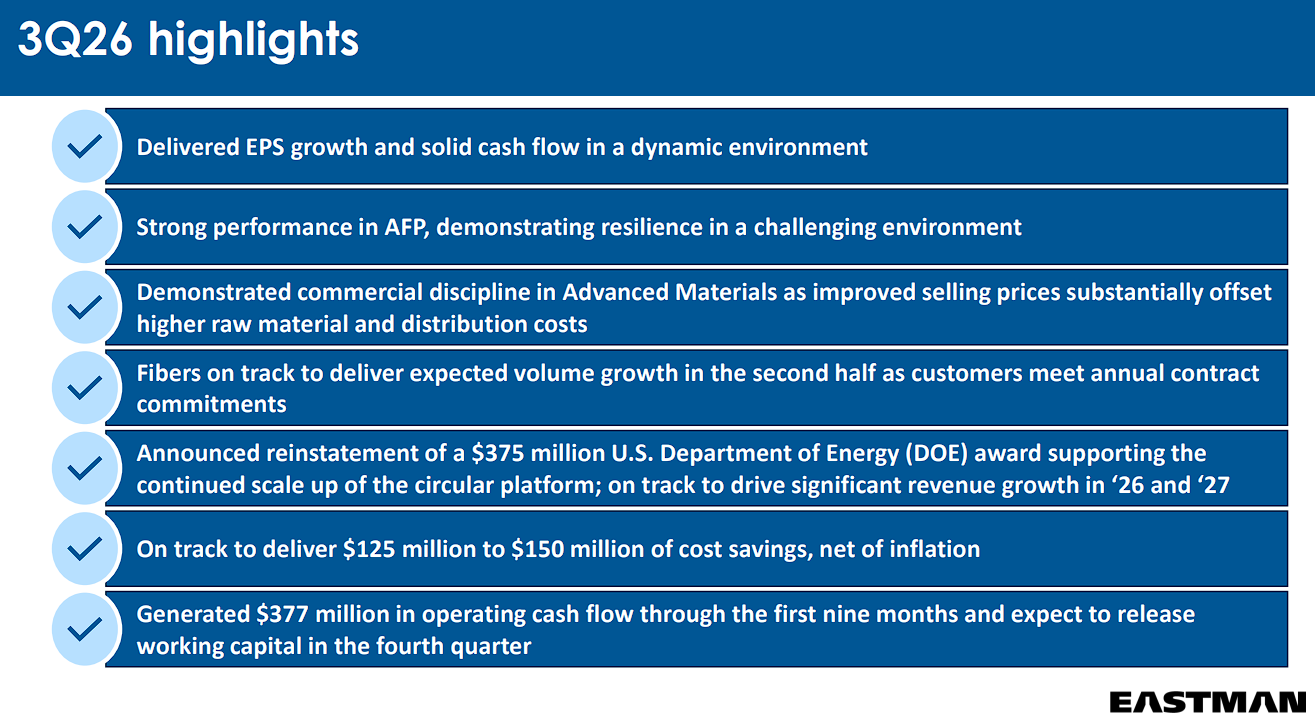
Management expects full-year adjusted EPS of $6.00 to $6.20 and operating cash flow of approximately $850 million. Cost-saving initiatives target $125 million to $150 million net of inflation, while a reinstated $375 million Department of Energy award supports expansion of the circular-recycling platform.
Eastman pays $0.84 quarterly, or $3.36 annually, yielding 5.1%. It has increased its dividend for 16 consecutive years, and the payout represents approximately 55% of our $6.10 earnings estimate.
Specialty-product innovation, recycling investment, and cost discipline provide paths to long-term growth. Higher raw-material costs, softer automotive and consumer-durables demand, capital requirements, and debt remain important risks to cash flow and dividend growth.
High Dividend Stock For The Long Run: Eversource Energy (ES)
- Dividend Yield: 4.5%
Eversource Energy is a regulated utility serving electric and natural-gas customers across New England, with earnings supported by investment in transmission and distribution infrastructure.
On November 4th, 2026, Eversource reported third-quarter results for the period ending September 30th. GAAP and recurring earnings were $346.0 million, or $0.92 per share, compared with prior-year recurring earnings of $442.5 million, or $1.19 per share.
There were no non-GAAP adjustments in the latest quarter. Higher financing and operating costs, storm-cost disallowances, and changes in seasonal gas-rate recovery pressured results.
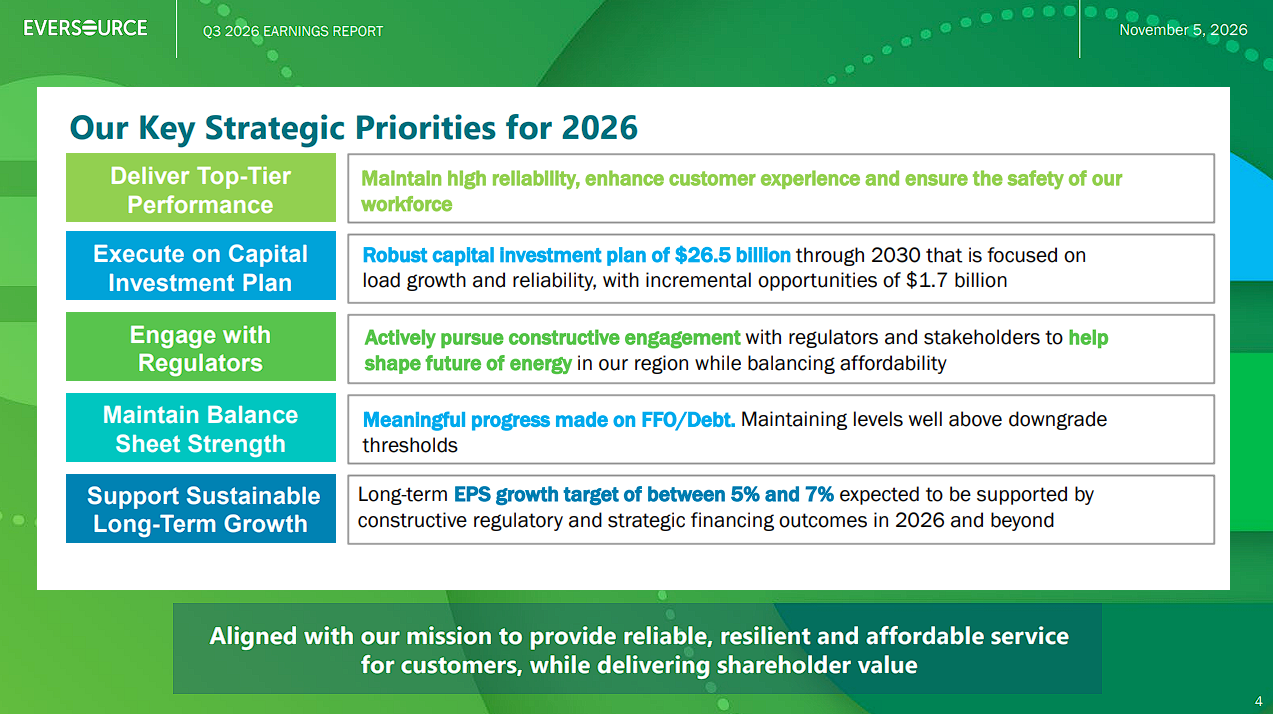
Management narrowed and raised the midpoint of 2026 recurring earnings guidance to $4.62 to $4.70 per share. It reaffirmed 5% to 7% annual earnings growth through 2030, using the revised $4.66 midpoint as the base.
The Aquarion Water sale, completed in June, generated approximately $1.7 billion of net equity proceeds and supported a more focused regulated electric-and-gas business.
ISO New England’s selection of the joint TIDE transmission project creates another potential infrastructure opportunity, although engineering, permitting, and regulatory approvals remain necessary.
Eversource pays $3.15 annually, yields 4.5%, and has increased its dividend for 28 consecutive years. The dividend represents approximately 68% of our current earnings forecast.
Regulated infrastructure investment supports the income thesis, while financing costs, allowed returns, storm-cost recovery, remaining offshore-wind obligations, and capital-plan execution remain central to future dividend growth.
Deep Dive: Click here to download (for free) our most recent 3-Page Sure Analysis PDF report on Eversource Energy (ES).
High Dividend Stock For The Long Run: The Clorox Company (CLX)
- Dividend Yield: 4.7%
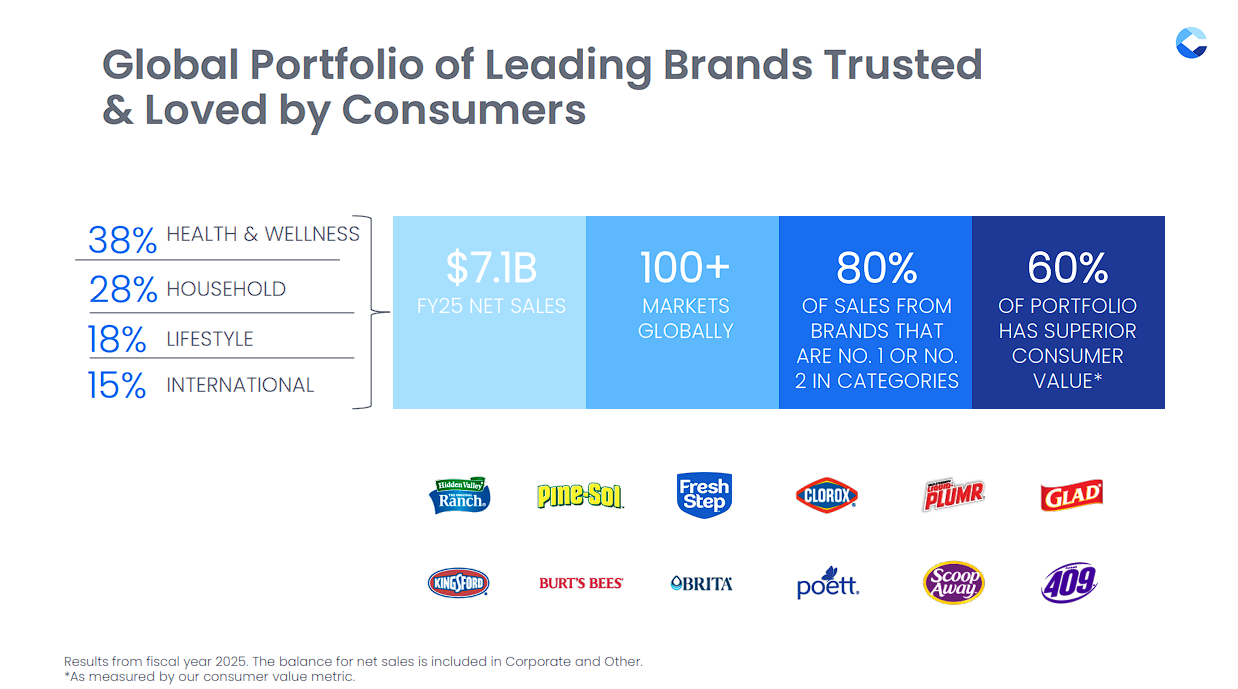
The Clorox Company owns a portfolio of household and professional brands, including Clorox, Pine-Sol, Glad, Kingsford, Brita, Hidden Valley, Burt’s Bees, and Purell.
On November 2nd, 2026, Clorox reported fiscal first-quarter 2027 results for the period ending September 30th. Sales increased 33% to $1.91 billion, and organic sales rose 18%.
The rebound benefited substantially from comparison with last year’s ERP-related inventory drawdown, while the GOJO acquisition added about 15 percentage points to sales growth. These effects should be separated from underlying demand trends.
Adjusted earnings per share increased 82% to $1.55. Gross margin nevertheless declined 130 basis points to 40.4% as higher commodity, manufacturing, and logistics costs outweighed some of the benefits from volume and cost savings.
Clorox has launched Clorox Purell ProCare, combining GOJO and CloroxPro for professional and healthcare customers.
Management maintained fiscal 2027 sales-growth guidance of 13% to 14% and adjusted EPS guidance of $5.70 to $6.00, but now expects earnings nearer the low end because of higher input costs.
Clorox also appointed Fabian Garcia as its next CEO, effective January 5th, 2027. He will succeed Linda Rendle.
The quarterly dividend is $1.25, or $5.00 annually, following its 49th consecutive annual increase. The shares yield 4.7%.
Defensive brands support recurring demand, but an approximately 86% projected payout ratio leaves earnings recovery, GOJO integration, cost control, and cash generation especially important to dividend durability.
Final Thoughts
These 10 companies offer yields between 4.1% and 5.3%, but their long-term appeal rests on more than today’s income.
PepsiCo, Kimberly-Clark, Hormel, Sonoco, and Clorox have dividend records spanning roughly five decades or more.
Meanwhile, Portland General Electric and Eversource provide regulated-utility exposure, while T. Rowe Price and Fidelity National Financial add financial-services exposure. Eastman Chemical and Sonoco provide exposure to specialty materials and packaging demand.
The list also shows why company-specific risks still matter, as Kimberly-Clark must integrate Kenvue, Eastman faces cyclical demand and input-cost pressures, Sonoco is addressing weaker earnings and a major impairment, and Hormel and Clorox are working through earnings-recovery periods.
At reasonable valuations, businesses that can protect their competitive positions, cover their payouts, and keep earnings moving higher have a better chance of turning an elevated starting yield into attractive income and total returns over the next decade.
Additional Reading
If you are interested in finding high-quality dividend growth stocks and/or other high-yield securities and income securities, the following Sure Dividend resources will be useful:
Other Sure Dividend Resources
- Dividend Kings: 50+ years of rising dividends
- Dividend Champions: 25+ years of rising dividends
- Dividend Aristocrats: 25+ years of rising dividends and in the S&P 500
- High Dividend Stocks: 4%+ dividend yields
- Monthly Dividend Stocks: Individual securities that pay out every month
- Royalty Stocks: Detailed royalty stocks list
- MLPs: Detailed MLP list
- REITs: Detailed REIT list
- BDCs: Detailed BDC list