Updated on September 21st, 2026 by Nikolaos Sismanis
Royalty stocks give investors a way to participate when another business sells a product, extracts a resource, or uses intellectual property.
The royalty universe extends well beyond oil and gas, including precious-metals streams, biotechnology licensing, restaurant and service franchises, music rights, and patented technology.
Our full royalty stocks list contains 95 names, including operating companies with royalty exposure and royalty trusts.
We cover 16 of these securities through our Sure Analysis research and have expected total return estimates for each of them.
You can download the full list of royalty stocks and trusts using the link below:

This article looks at why investors might consider royalty stocks, how their tax treatment can differ, and the five we believe offer the highest expected total returns among the names we cover.
Table of Contents
- Why Invest In Royalty Stocks?
- Tax Consequences Of Royalty Stocks
- The 5 Best Royalty Stocks Now
- #5: Permianville Royalty Trust (PVL)
- #4: Diversified Royalty (BEVFF)
- #3: Royal Gold (RGLD)
- #2: PermRock Royalty Trust (PRT)
- #1: Dolby Laboratories (DLB)
- Final Thoughts
- Additional Reading
Why Invest In Royalty Stocks?
Many royalty businesses receive a percentage of sales, production, or licensing revenue while someone else operates the store, mine, well, or product.
That can produce attractive margins and reduce the royalty owner’s direct need to fund equipment or day-to-day operations.
Royalty and streaming companies can add new contracts over time, while a trust may offer high cash distributions from a fixed pool of assets.
Yet royalty income does not eliminate business risk, as weak customers, lower commodity prices, contract changes, declining reserves, or higher expenses can all reduce future cash available for distribution to investors.
Before comparing yields, check what produces the royalty, whether the owner can replace expiring assets, and how much of its cash flows it already pays out.
Tax Consequences Of Royalty Stocks
Tax treatment follows the security’s legal structure, not the fact that its business earns royalties.
Shares in corporations generally deliver ordinary or qualified dividends, with distributions typically reported to U.S. investors on Form 1099-DIV.
U.S. oil and gas grantor trusts can work differently. PermRock, for example, which holds the #2 spot on our list below, explains that its holders receive Forms 1099 and may need to account for depletion deductions and adjustments to their unit cost basis.
Partnerships may instead issue a Schedule K-1, and the IRS notes that a partner can owe tax on allocated income even when the partnership makes no cash distribution.
Foreign corporations may also involve withholding taxes and currency conversion for U.S. and international investors alike.
We recommend you review the issuer’s tax materials and your brokerage statement before assuming a quoted yield equals after-tax income.
The 5 Best Royalty Stocks Now
This research report analyzes the top 5 royalty stocks now based on expected annualized total returns.
The top five are ranked strictly by expected annualized total return among the 16 covered royalties we cover in Sure Analysis, rather than by current yield, risk score, or consistency of distributions.
Remember that royalty trust distributions can change from month to month, so a high current yield does not necessarily represent the yield you can expect on your cost basis going forward.
Royalty Stock #5: Permianville Royalty Trust (PVL)
- Expected Total Return: 8.4%
- Dividend Yield: 9.1%
- Dividend Risk Score: F
Permianville Royalty Trust owns an 80% net-profits interest in oil and gas properties across Texas, Louisiana, and New Mexico.
Cash receipts after operating and development costs depend on energy prices and operator spending.
Unlike a growing royalty corporation, the trust generally cannot add new properties to replace declining production.
In second-quarter 2026, oil volumes fell 30% year over year, while gas volumes more than doubled.
Lower operating expenses helped quarterly distributions recover from zero in the year-earlier period to roughly four cents per unit.
The September announcement declared $0.016 per unit, payable October 14th.
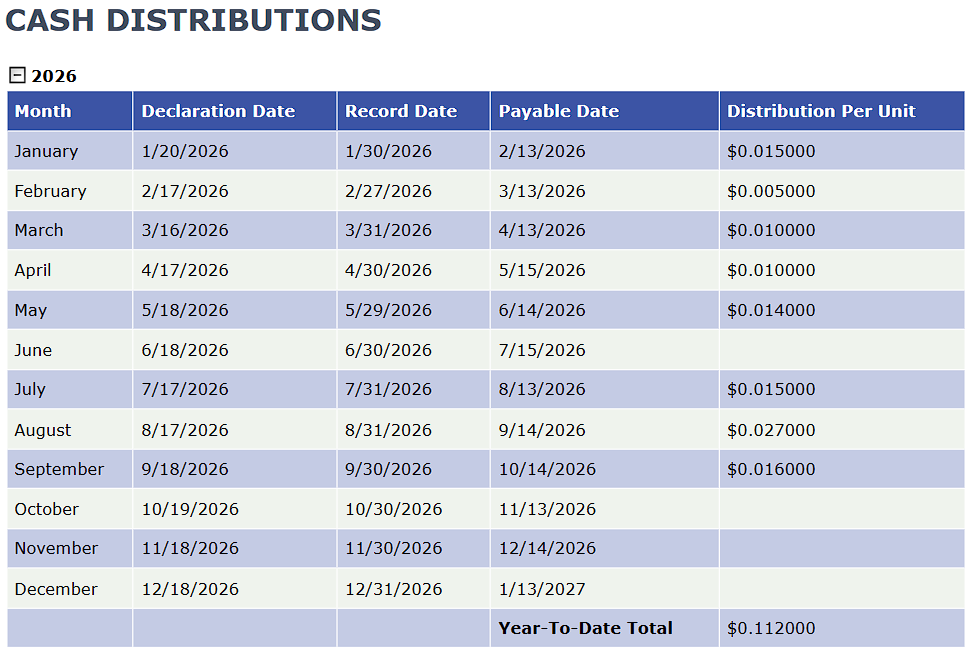
Reported oil and gas receipts increased from the preceding calculation, but accrued operating costs and capital spending also climbed.
The sponsor reserved $1.8 million for development expenses, potentially reducing future payments.
A September acreage sale may add one-time proceeds to a future distribution.
Permianville resumed monthly distributions in August 2025 after a seven-month interruption and previously suspended payments during other weak periods.
That uneven history is a stronger guide to risk than a single annualized yield figure.
We estimate an 8.4% annualized five-year return, with significant uncertainty around production, costs, and commodity prices.
Its variable payments and F Dividend Risk Score merit caution from investors seeking reliable dividends.
Royalty Stock #4: Diversified Royalty (BEVFF)
- Expected Total Return: 8.5%
- Dividend Yield: 7.2%
- Dividend Risk Score: F
Diversified Royalty collects royalties from franchise and service brands such as Oxford Learning, BarBurrito, Nurse Next Door, and Cheba Hut.
The Canadian company also owns the Mr. Lube + Tires franchisor business, which it acquired in June 2026 for about C$228 million.
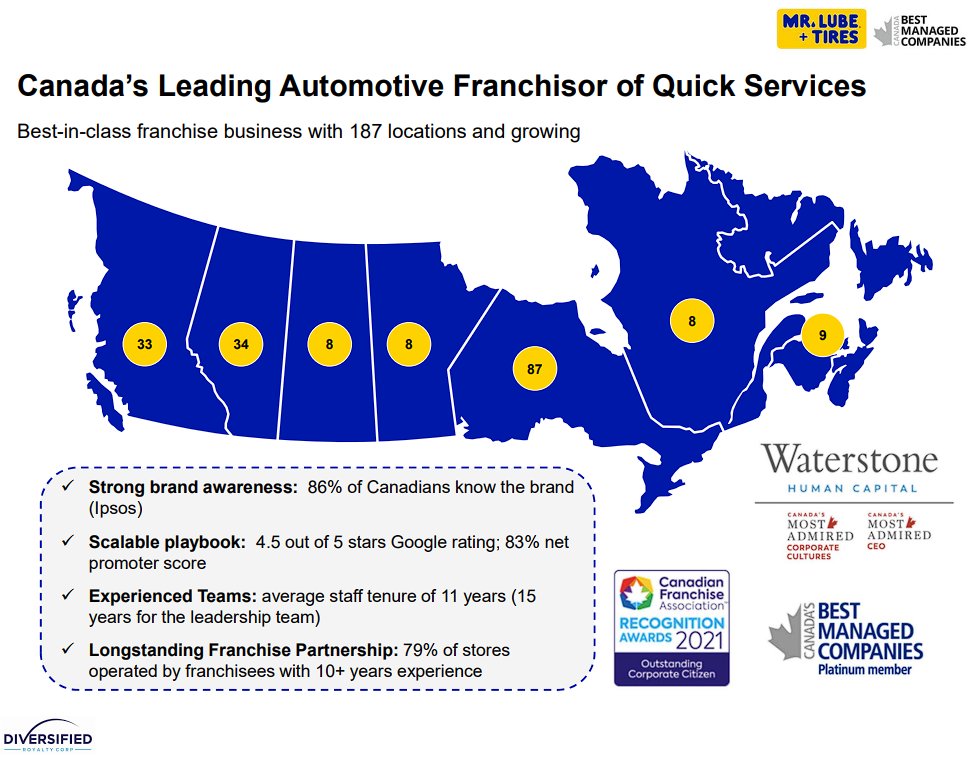
That acquisition broadens the business but introduces operating exposure alongside its more traditional royalty contracts.
Its second-quarter release reported C$21.7 million in revenue, up from C$17.8 million a year earlier.
Combined contribution rose 13.2%, while distributable cash increased 4.8% to C$13.1 million.
The dividend payout consumed 93.7% of quarterly distributable cash, leaving limited room if partners weaken or financing costs rise.
Sutton remains a concern: the company recorded a C$7.2 million noncash impairment and discussed a possible change to that royalty agreement.
Diversified also issued C$57.5 million of common shares in July and used proceeds to repay acquisition borrowing.
Its September dividend declaration maintained a monthly payment of C$0.02375 per share, or C$0.285 annualized.
The payout has grown in recent years, but the F Dividend Risk Score signals that its high current yield carries material risk.
We estimate an 8.5% annualized five-year total return, driven mostly by the starting dividend and only modest expected growth.
Currency moves also affect the U.S.-dollar value of dividends on the over-the-counter shares.
Royalty Stock #3: Royal Gold (RGLD)
- Expected Total Return: 8.7%
- Dividend Yield: 0.8%
- Dividend Risk Score: B
Royal Gold finances mines in exchange for precious-metal streams and royalties, giving investors exposure to production without operating mines itself.
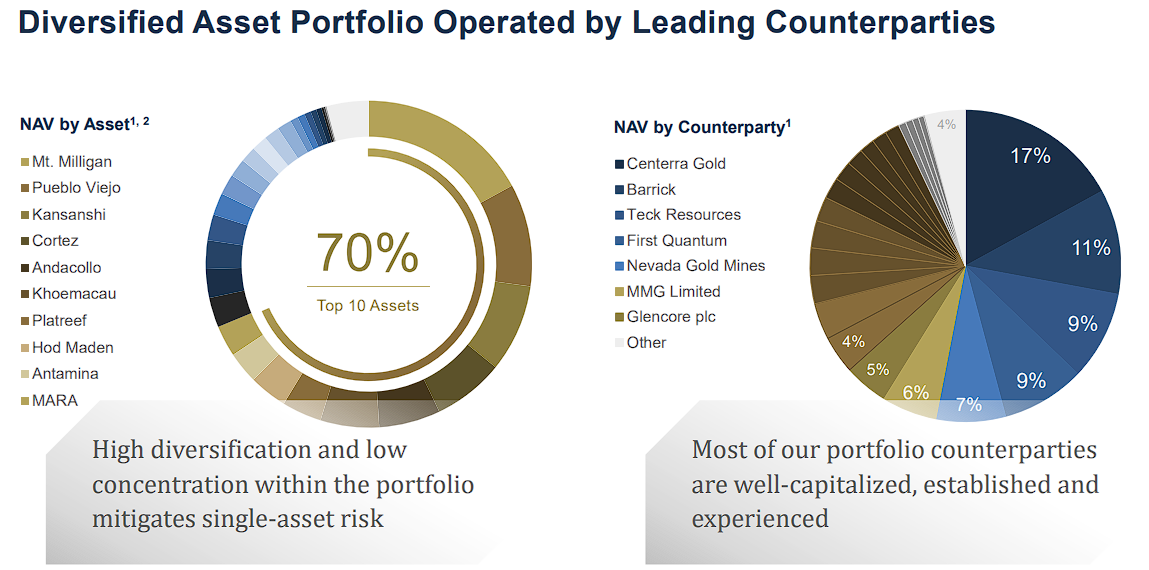
The model avoids many direct mine operating costs, although output and cash receipts still depend on the companies running those properties.
Its 2025 acquisitions of Sandstorm Gold and Horizon Copper expanded the portfolio and increased the share count.
In the second quarter of 2026, revenue rose to $450.5 million from $209.6 million a year earlier.
Operating cash flow reached a record $335.2 million, and adjusted net income was $2.56 per diluted share.
Higher metal prices and an enlarged portfolio supported those figures; 76% of quarterly revenue came from gold.
Royal Gold repaid $200 million of borrowing during the quarter and bought back $30 million of stock.
It advanced Warintza and restructured its interest in Hod Maden, adding a royalty there.
The company paid a quarterly dividend of $0.475 per share, 6% more than the comparable payment a year before.
Its 25 consecutive years of dividend increases and B Dividend Risk Score distinguish it from the higher-yielding trusts in this ranking.
We estimate an 8.7% annualized total return over five years, with expected earnings growth and valuation recovery providing most of the upside.
A low starting yield, metal-price volatility, and execution at underlying mines remain important risks.
Deep Dive: Click here to download (for free) our most recent 3-Page Sure Analysis PDF report on Royal Gold (RGLD).
Royalty Stock #2: PermRock Royalty Trust (PRT)
- Expected Total Return: 12.3%
- Dividend Yield: 10.0%
- Dividend Risk Score: F
PermRock Royalty Trust holds an 80% net-profits interest in oil and gas properties in the Permian Basin of West Texas.
Its monthly payments depend on production revenue after the property owner’s expenses, rather than on a conventional corporate dividend policy.
The underlying properties changed hands in 2025 when T2S Permian Acquisition II bought them from Boaz Energy.
For the second quarter of 2026, distributable income fell to $409,050 from $1.20 million a year earlier.
That translated to roughly $0.0336 per unit for the quarter, compared with about $0.0987 in the prior-year period.
The trust’s September 18th declaration set its next monthly payment at $0.0196242 per unit, down from $0.021782 in August.
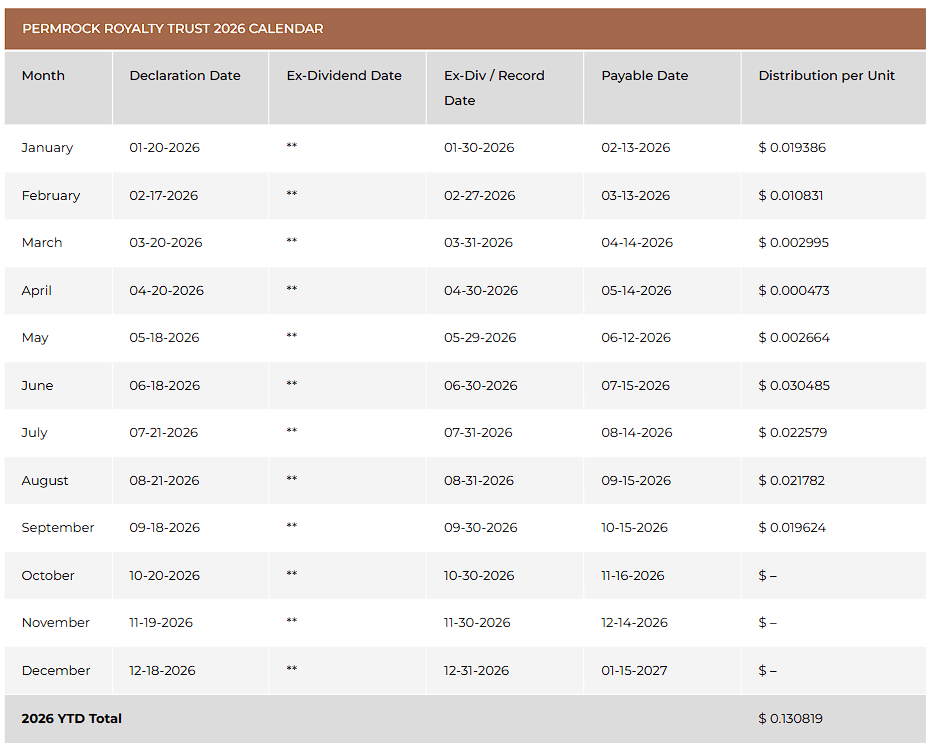
The newer calculation reflected lower oil prices and volumes and $116,596 of capital expenditures.
Oil prices and operator costs can move monthly cash receipts sharply, even when the trust owns the same assets.
PermRock paid distributions after earlier pandemic-era interruptions, but it has no sustained annual dividend-growth streak.
Its F Dividend Risk Score therefore deserves attention despite a nearly double-digit snapshot yield.
We estimate a 12.3% annualized total return over five years.
That projection relies on a recovery in per-unit cash flow and could miss badly if production disappoints or development spending rises.
Royalty Stock #1: Dolby Laboratories (DLB)
- Expected Total Return: 15.5%
- Dividend Yield: 2.5%
- Dividend Risk Score: C
Dolby Laboratories licenses audio and video technologies to electronics makers and entertainment platforms.
Its royalty revenue comes from intellectual property used in products and services, making this a different opportunity from mineral or energy trusts.
Dolby Atmos and Dolby Vision remain important products, while its video distribution program and OptiView broaden the addressable market.
The fiscal third-quarter results showed revenue of $305 million, down from $316 million a year earlier.
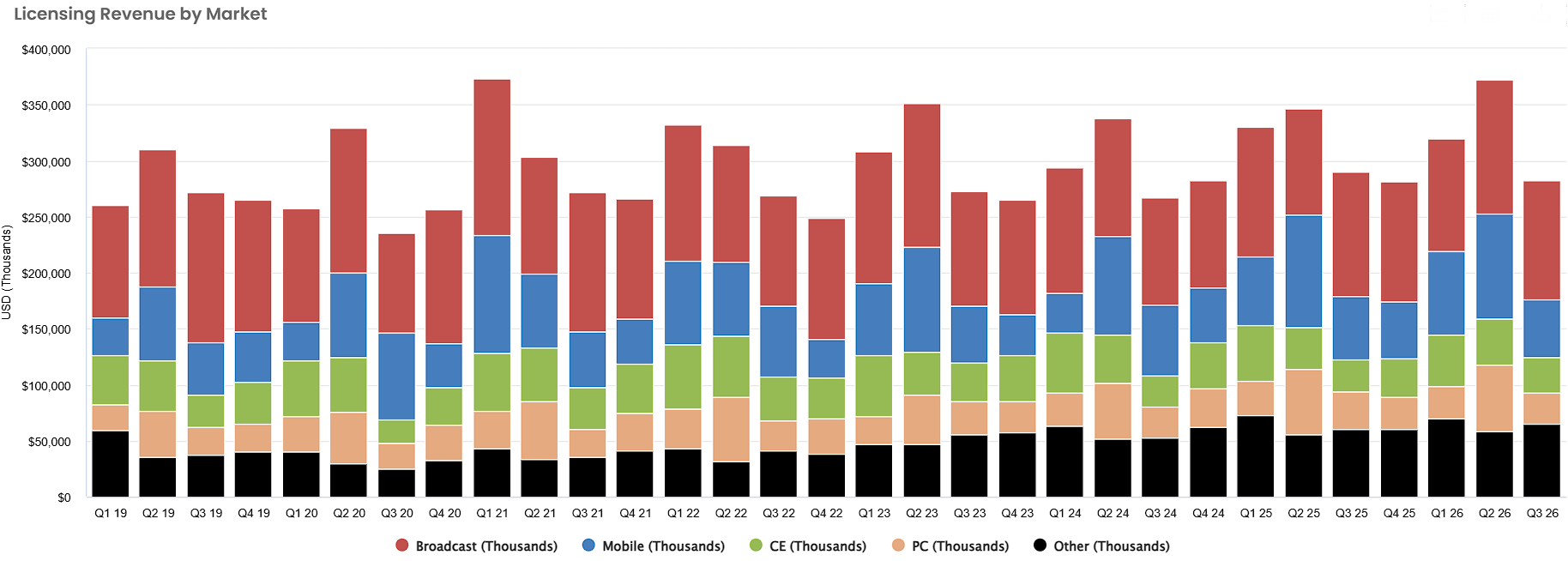
Adjusted earnings declined to $0.69 per share from $0.78, as spending on consumer electronics remained uneven.
Management nevertheless projected full-year fiscal 2026 revenue between $1.41 billion and $1.44 billion.
It also reported deployments of Dolby Vision 2 in televisions and additional automotive and video partnerships.
Dolby repurchased $65 million of stock and authorized another $350 million for buybacks.
Dolby declared a $0.36 quarterly dividend in July, following a 9% increase to that rate in November 2025.
It has raised its dividend for 11 consecutive years, with a moderate payout ratio and substantial cash reserves.
We estimate a 15.5% annualized total return over five years, the highest among the royalty names we cover.
Much of that case depends on the shares moving toward our fair-value estimate; licensing growth and patent relevance still matter.
Its C Dividend Risk Score and lower yield distinguish it from the higher-yielding trusts.
Final Thoughts
Royalty investments come in very different forms, so the strongest projected return does not necessarily come with the safest payout.
Dolby offers exposure to technology licensing and dividend growth; Royal Gold combines precious-metal royalties with a 25-year record of increases; and Diversified Royalty offers a higher monthly corporate dividend supported by several consumer-facing brands.
PermRock and Permianville may appeal to investors seeking substantial monthly income, but their F Dividend Risk Scores, variable distributions, and sensitivity to oil prices and spending make them less predictable.
The top five are ranked strictly by expected annualized total return among the 16 covered names, rather than by current yield, risk score, or consistency of distributions.
When evaluating a royalty stock, consider the royalty contract, the underlying asset or customer, the legal structure, and the price paid for its cash flows.
If you would prefer companies with longer records of annual dividend increases, that is a core focus of our research at Sure Dividend.
The resources below are a good place to continue.
Additional Reading
Explore these Sure Dividend lists for more dividend growth ideas:
- Dividend Kings: Companies with at least 50 consecutive years of dividend increases.
- Dividend Champions: Companies with at least 25 consecutive years of dividend increases.
- Dividend Aristocrats: S&P 500 companies with at least 25 consecutive years of dividend increases.
- High Dividend Stocks: 4%+ dividend yields
- Monthly Dividend Stocks: Individual securities that pay out every month
- MLPs: List of MLPs and more
- REITs: List of REITs and more
- BDCs: List of BDCs and more