Updated on February 3rd, 2026 by Bob Ciura
The Dividend Aristocrats are an elite group of stocks in the S&P 500 Index, that have increased their dividends for at least 25 consecutive years.
Every year, we individually review each of the Dividend Aristocrats.
W.W. Grainger, Inc. (GWW) is a Dividend Aristocrat that has increased its dividend for 53 years in a row.
You can see our full list of all 69 Dividend Aristocrats, along with important metrics like dividend yields and P/E ratios, by clicking on the link below:
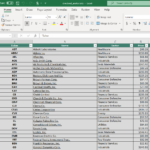
Disclaimer: Sure Dividend is not affiliated with S&P Global in any way. S&P Global owns and maintains The Dividend Aristocrats Index. The information in this article and downloadable spreadsheet is based on Sure Dividend’s own review, summary, and analysis of the S&P 500 Dividend Aristocrats ETF (NOBL) and other sources, and is meant to help individual investors better understand this ETF and the index upon which it is based. None of the information in this article or spreadsheet is official data from S&P Global. Consult S&P Global for official information.
Grainger’s financial health is closely tied to the broader economy as a manufacturer of industrial products. The company has a leading position in its core markets.
And, it has deployed multiple initiatives to continue growing earnings in the future.
This article will discuss Grainger’s business, growth potential, and valuation.
Business Overview
Grainger was founded in 1927. Today, it is a large supplier of maintenance, operating, and repair products, or “MRO” for short.
These are products like safety gloves, power tools, ladders, test instruments, and motors. It also offers services such as inventory management.
Sales span a wide range of both customers and categories without a reliance on any one industry in particular.
On February 3rd, 2026, W.W. Grainger reported its fourth-quarter and full year financial results. For the fourth quarter, revenue of $4.425 billion rose 4.5% from the same quarter the previous year.
Revenue beat the average analyst estimates of $4.40 billion. Adjusted earnings per share came in at $9.44, slightly below the consensus estimate of $9.46. Adjusted EPS fell by 2.8% year-over-year.
Operating margin declined 70 basis points to 14.3%, which the company attributed to higher expenses and slower growth in its North American high-touch business.
For the full year, Grainger generated sales of $17.9 billion, up 4.5% from 2024. Earnings per share declined 8.6% to $35.40 for the year.
Grainger returned $1.5 billion to shareholders through dividends and share repurchases in 2025.
Growth Prospects
Grainger lays out a number of growth initiatives in the U.S., as a mix between “foundational” and “incremental” initiatives.
In other words, between what the company is already doing to keep market share and what it can do to make further gains.
For fiscal 2026, the company updated its guidance and now expects net sales of $18.7 billion to $19.1 billion, on organic sales growth of 6.5% to 9.0% for the full year.
Earnings-per-share are expected in a range of $42.25 to $44.75. At the midpoint, EPS is expected to be $43.50 for 2026.
The company sees multiple avenues to generate future growth, the most important of which is that Granger operates in a highly fragmented market.
Therefore, the company sees a large and untapped market opportunity to fuel its long-term growth. Another growth catalyst for Grainger is e-commerce. It has various e-commerce platforms, including MonotaRO in Japan, and Zoro in the United States.
Grainger’s strategic shift of lowering its pricing, thereby creating higher demand, and growing its revenues, seems to have worked well.
EPS growth will be driven by rising revenue and a reduction in the company’s share count.
Grainger’s revenue is growing, margins are improving over time, and share repurchases will continue to boost earnings-per-share growth over the long term.
We are forecasting 10% earnings-per-share growth over the next five years.
Competitive Advantages & Recession Performance
Grainger’s competitive advantage is its vast distribution network. It has the ability to offer services such as next-day ground delivery, which help it retain its competitive position.
In addition, the business’s scale allows it to price its products competitively.
Grainger is not active in a high-tech industry, but the company’s services are essential for other businesses. This makes Grainger’s business relatively resilient during recessions, allowing it to continue raising its dividend each year.
These competitive advantages helped Grainger stay highly profitable during the Great Recession.
Earnings-per-share during the economic downturn are as follows:
- 2007 earnings-per-share of $4.94
- 2008 earnings-per-share of $6.09 (23% increase)
- 2009 earnings-per-share of $5.25 (-14% decline)
- 2010 earnings-per-share of $6.81 (30% increase)
Grainger only had one year of earnings decline during the Great Recession, in between two very strong years. Moreover, the company continued to grow after 2010.
This indicates a high-quality business model that can withstand recessions relatively well.
Valuation & Expected Returns
Based on the expected earnings-per-share of $43.50 for 2026 and a current share price of ~$1,155, the stock has a price-to-earnings ratio of 26.5x.
While shares have traded hands with an average P/E ratio of 19 during the last decade, we are taking a more aggressive view, using 24 times earnings as a fair value baseline.
Still, GWW appears to be overvalued, implying the potential for a -2.0% annual reduction in shareholder returns.
Weighing this potential decline in valuation multiple against estimated EPS growth of 10% and the 0.8% dividend yield, investors could anticipate a total expected return of ~8.8% per year for the next five years.
Final Thoughts
W.W. Grainger is a Dividend Aristocrat managed for the long term. It has encountered difficulties at times, but the business continues to persevere, just as it has done for decades.
Moreover, the company remains profitable in good times and has an exceptional record of paying and increasing its dividend for 53 years.
As a result, Grainger has joined the even more exclusive list of Dividend Kings.
While the business strength and potential growth are enviable, the dividend yield and the valuation are not particularly compelling at this time. As such, we view Grainger as a hold right now.
Additional Reading
Additionally, the following Sure Dividend databases contain the most reliable dividend growers in our investment universe:
- The Dividend Champions: Dividend stocks with 25+ years of dividend increases, including those that may not qualify as Dividend Aristocrats.
- The Dividend Kings: considered to be the ultimate dividend growth stocks, the Dividend Kings list is comprised of stocks with 50+ years of consecutive dividend increases
If you’re looking for stocks with unique dividend characteristics, consider the following Sure Dividend databases:
- The Complete List of Monthly Dividend Stocks: stocks that pay dividends each month, for 12 payments over the year.
- The Blue Chip Stocks List: this database contains stocks that qualify as either Dividend Achievers, Dividend Aristocrats, or Dividend Kings.