Published on Ocotber 17th, 2025 by Felix Martinez
ARMOUR Residential REIT Inc. (ARR) is a mortgage Real Estate Investment Trust (mREIT) that offers an appealing 18% dividend yield, making it a high dividend stock.
ARMOUR Residential also pays its dividends monthly, which is rare. The vast majority of companies that pay dividends pay them quarterly or semi-annually.
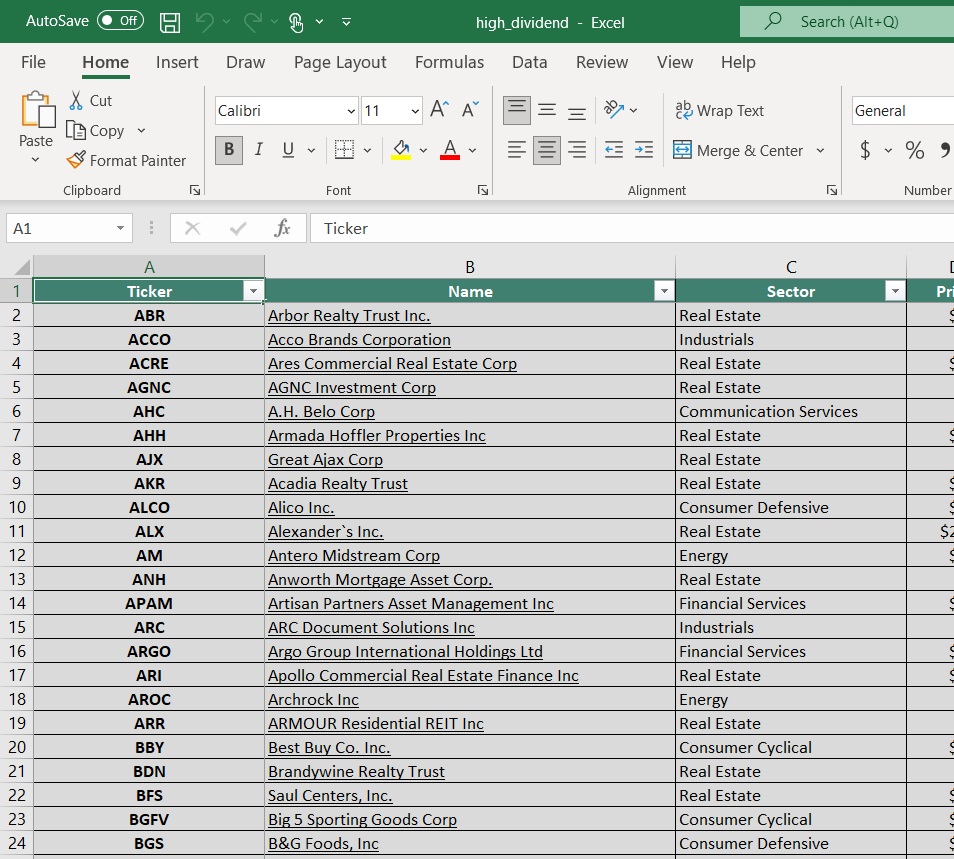
You can download your free full list of all high dividend stocks with 4%+ yields (along with important financial metrics such as dividend yield and payout ratio) by clicking on the link below:
In this article, we will analyze ARMOUR Residential REIT.
Business Overview
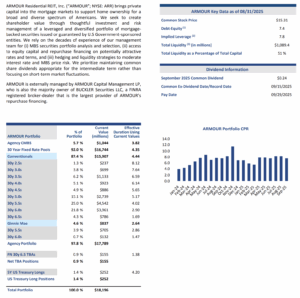
As an mREIT, ARMOUR Residential invests in residential mortgage-backed securities, including those issued or guaranteed by U.S. Government-sponsored entities (GSEs) such as Fannie Mae and Freddie Mac. It also includes Ginnie Mae, the Government National Mortgage Administration’s issued or guaranteed securities backed by fixed-rate, hybrid adjustable-rate, and adjustable-rate home loans.
It also includes unsecured notes and bonds issued by the GSE and the United States Treasury, money market instruments, and non-GSE or government agency-backed securities.
The mortgage REIT, founded in 2008 and based in Vero Beach, Florida, aims to generate shareholder value through prudent investment and risk management practices that yield current income and superior risk-adjusted returns over the long term.
With a market cap of approximately $1.8 billion and annual revenue of $225 million, it is a significant national player in residential investment.
Source: Investor presentation
The trust makes money by raising capital by issuing debt, preferred equity, and common equity, and then reinvesting the proceeds into higher-yielding debt instruments.
The spread (i.e., the difference between the cost of capital and the return on capital) is then largely returned to common shareholders via dividend payments. However, the trust often retains a little bit of the profits to reinvest in the business.
Growth Prospects
Recent results at ARMOUR have been mixed. The COVID-19 pandemic severely impacted the trust, but it could meet all of its margin calls and maintain access to repurchase financing.
ARMOUR Residential REIT, Inc. reported a GAAP net loss of $78.6 million ($0.94 per share) for Q2 2025, primarily driven by losses on derivatives and futures contracts amid volatile interest rate movements. However, distributable earnings remained strong at $64.9 million ($0.77 per share), comfortably covering the quarterly dividend of $0.72 per share. Net interest income totaled $33.1 million, supported by an average asset yield of 4.90% and a funding cost of 4.54%, resulting in an economic net interest spread of 1.82%.
During the quarter, ARMOUR raised $104.6 million through an at-the-market offering, enhancing liquidity and flexibility. The company’s book value per common share fell to $16.90 from $18.59 in Q1, reflecting higher hedging losses and spread widening, while maintaining a liquidity position of $772.9 million and a $15.4 billion portfolio primarily composed of Agency MBS.
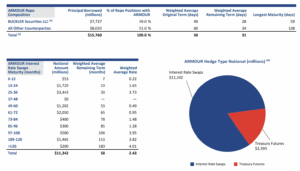
Looking ahead, ARMOUR remains focused on capital preservation, maintaining attractive dividend income, and optimizing its portfolio composition amid a shifting interest rate landscape. Management highlighted continued strength in distributable earnings and disciplined leverage management, with a debt-to-equity ratio of 7.7x and $10.3 billion in interest rate swap contracts to hedge against rate volatility.
As the Federal Reserve moves closer to potentially more rate cuts in late 2025, ARMOUR expects improved book value stability and lower funding costs, which could help strengthen earnings power in the coming quarters. The company’s proactive capital raises and strong liquidity position provide flexibility to navigate near-term market uncertainty while maintaining a sustainable dividend yield for shareholders.
Source: Investor presentation
ARMOUR’s cash flow has been volatile since its inception in 2008, which is to be expected for all mREITs. Recently, declining spreads have hurt earnings, while the economic disruption caused by the coronavirus outbreak has disrupted the business model, leading to a sharp decline in cash flow per share, as well as a steep dividend cut. Fortunately, ARMOUR is now experiencing a measure of recovery and is expected to continue this trend in the coming quarters and years. Moving forward, we expect the company to grow slowly, although it will likely take a considerable amount of time to rebuild to its previous levels of book value and earnings power.
Competitive Advantages & Recession Performance
While there have certainly been some positive developments at work for ARMOUR, there are still several risks to be concerned about. ARMOUR’s quality metrics have been volatile, given the trust’s performance as rates have moved around over the years. Gross margins have declined since short-term rates began to rise significantly a couple of years ago, although it appears that most of the damage has been done.
Balance sheet leverage had been moving down slightly, but it saw an uptick again this past quarter. However, we do not forecast a significant movement in either direction from this point. Interest coverage has declined with spreads but also appears to have stabilized, so we are somewhat optimistic moving forward while keeping in mind the significant potential for volatility.
ARMOUR was facing headwinds from the coronavirus outbreak and an overall economic downturn. As a result, a steep dividend cut was necessary to preserve the balance sheet and allow the REIT to reposition itself for survival and future growth.
The annualized dividend payout of $2.88 per share will represent 91% of the company’s EPS (we estimate 2025 EPS of $3.18). This is a concern as the payout ratio is high, and the dividend could be at risk of further reduction if EPS falls or stays at this level for too long.
For example, if the economy were to enter a recession, mortgage defaults could surge, resulting in significant losses. Given the uncertain macroeconomic outlook, this risk is relevant for investors.
ARMOUR’s Adjusted Funds From Operations (AFFO) per share during the Great Recession are below:
- 2007 AFFO: $4.81
- 2008 AFFO: $3.73
- 2009 AFFO: $-5.10
- 2010 AFFO: $6.62
Dividend Analysis
ARMOUR’s current annual dividend is $2.88 per share. At $15.66, ARMOUR has a high yield of 18.7%.
Given ARMOUR’s outlook for 2025, EPS is expected to be $3.18. As a result, the company is expected to pay out roughly 91% of its EPS to shareholders in dividends.
The dividend appears to be sustainable, and we estimate the company will not grow the dividend.
The 18.7% dividend yield is desirable for investors who focus primarily on income.
Final Thoughts
ARMOUR Residential’s high dividend yield and monthly dividend payments make it stand out to high-yield dividend investors. However, we remain cautious on the stock, especially in light of the multiple dividend cuts in recent years.
While the trust can currently cover its dividend, declining interest rates could continue to force the trust ever further out on the risk spectrum to maintain its cash flows as its older mortgages roll off the balance sheet. This sets it up for potentially steep losses if the economy were to slip into a recession.
Therefore, ARMOUR stock carries notably higher levels of risk. This makes the investment highly speculative at present, particularly for risk-averse income investors, such as retirees. As a result, we encourage risk-averse investors to look elsewhere for sustainable and growing income.
If you are interested in finding high-quality dividend growth stocks and/or other high-yield securities and income securities, the following Sure Dividend resources will be useful:
High-Yield Individual Security Research
- 20 Highest Yielding Monthly Dividend Stocks
- 10 Super High Dividend REITs
- 5 Highest Yielding Royalty Trusts
Other Sure Dividend Resources
- Dividend Champions: 25+ years of rising dividends
- Dividend Aristocrats: 25+ years of rising dividends and in the S&P 500
- Dividend Achievers: 10+ years of rising dividends and in the NASDAQ
- Monthly Dividend Stocks: Individual securities that pay out every month
- MLP List
- REIT List
- BDC List