Updated on October 12th, 2026 by Nikolaos Sismanis
Royalty stocks give investors a way to participate when another business sells a product, extracts a resource, or uses intellectual property.
The royalty universe extends well beyond oil and gas, including precious-metals streams, biotechnology licensing, restaurant and service franchises, music rights, and patented technology.
Our full royalty stocks list contains 95 names, including operating companies with royalty exposure and royalty trusts.
We cover 16 of these securities through our Sure Analysis research and have expected total return estimates for each of them.
You can download the full list of royalty stocks and trusts using the link below:

This article looks at why investors might consider royalty stocks, how their tax treatment can differ, and the five we believe offer the highest expected total returns among the names we cover.
Table of Contents
- Why Invest In Royalty Stocks?
- Tax Consequences Of Royalty Stocks
- The 5 Best Royalty Stocks Now
- #5: Permianville Royalty Trust (PVL)
- #4: Royal Gold (RGLD)
- #3: Pizza Pizza Royalty Corp. (PZRIF)
- #2: Dolby Laboratories (DLB)
- #1: PermRock Royalty Trust (PRT)
- Final Thoughts
- Additional Reading
Why Invest In Royalty Stocks?
Many royalty businesses receive a percentage of sales, production, or licensing revenue while someone else operates the store, mine, well, or product.
That can produce attractive margins and reduce the royalty owner’s direct need to fund equipment or day-to-day operations.
Royalty and streaming companies can add new contracts over time, while a trust may offer high cash distributions from a fixed pool of assets.
Yet royalty income does not eliminate business risk, as weak customers, lower commodity prices, contract changes, declining reserves, or higher expenses can all reduce future cash available for distribution to investors.
Before comparing yields, check what produces the royalty, whether the owner can replace expiring assets, and how much of its cash flows it already pays out.
Tax Consequences Of Royalty Stocks
Tax treatment follows the security’s legal structure, not the fact that its business earns royalties.
Shares in corporations generally deliver ordinary or qualified dividends, with distributions typically reported to U.S. investors on Form 1099-DIV.
U.S. oil and gas grantor trusts can work differently.
PermRock, for example, which holds the #1 spot on our list below, explains that its holders receive Forms 1099 and may need to account for depletion deductions and adjustments to their unit cost basis.
Partnerships may instead issue a Schedule K-1, and the IRS notes that a partner can owe tax on allocated income even when the partnership makes no cash distribution.
Foreign corporations may also involve withholding taxes and currency conversion for U.S. and international investors alike.
We recommend you review the issuer’s tax materials and your brokerage statement before assuming a quoted yield equals after-tax income.
The 5 Best Royalty Stocks Now
This research report analyzes the top 5 royalty stocks now based on expected annualized total returns.
The top five are ranked by expected annualized total return among the 15 eligible royalty securities we cover in Sure Analysis, after excluding Mesa Royalty Trust because its recent monthly distributions were zero.
Rankings, yields, and expected returns use our October 12th, 2026 Sure Analysis data.
Financial figures are in U.S. dollars unless marked C$.
Remember that royalty trust distributions can change from month to month, so a high current yield does not necessarily represent the yield you can expect on your cost basis going forward.
Royalty Stock #5: Permianville Royalty Trust (PVL)
- Expected Total Return: 9.3%
- Dividend Yield: 9.5%
- Dividend Risk Score: F
Permianville Royalty Trust owns an 80% net-profits interest in predominantly non-operated oil and gas properties in Texas, Louisiana, and New Mexico.
The trust cannot add new properties and has little control over operator spending or production decisions.
Second-quarter 2026 oil volumes declined 30% year over year, while natural gas volumes more than doubled.
Lower operating expenses helped quarterly distributions recover to approximately $0.04 per unit from zero a year earlier.
The September declaration set a $0.016 distribution payable October 14th, down from August’s $0.027.
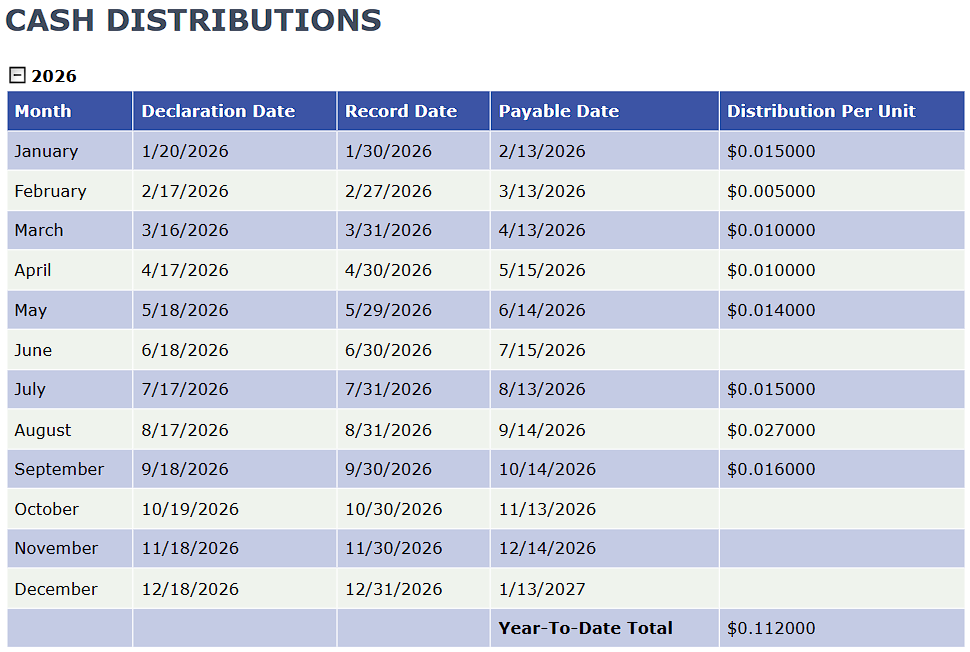
Oil and gas cash receipts increased from the preceding calculation, but capital expenditures rose to $1.7 million, and operating expenses reached $2.9 million.
The sponsor released part of its development reserve while retaining $1.8 million for future spending, which can reduce subsequent distributions.
A September sale of non-producing acreage for $0.3 million will contribute the trust’s attributable net proceeds to an upcoming payment.
Those proceeds are a one-time benefit, rather than evidence of stronger recurring production income.
Permianville currently has a declared cash payment, but earlier distribution interruptions demonstrate how quickly income can disappear when costs exceed receipts.
We estimate a 9.3% annualized five-year total return, with a 9.5% yield based on our annual distribution estimate.
Its F Dividend Risk Score, depleting assets, and variable payments make it a speculative income investment.
Royalty Stock #4: Royal Gold (RGLD)
- Expected Total Return: 10.1%
- Dividend Yield: 0.8%
- Dividend Risk Score: B
Royal Gold finances mines in exchange for precious-metal streams and royalties, giving investors exposure to production without operating the mines itself.
The contracts limit direct exposure to operating costs, while mine owners determine production.
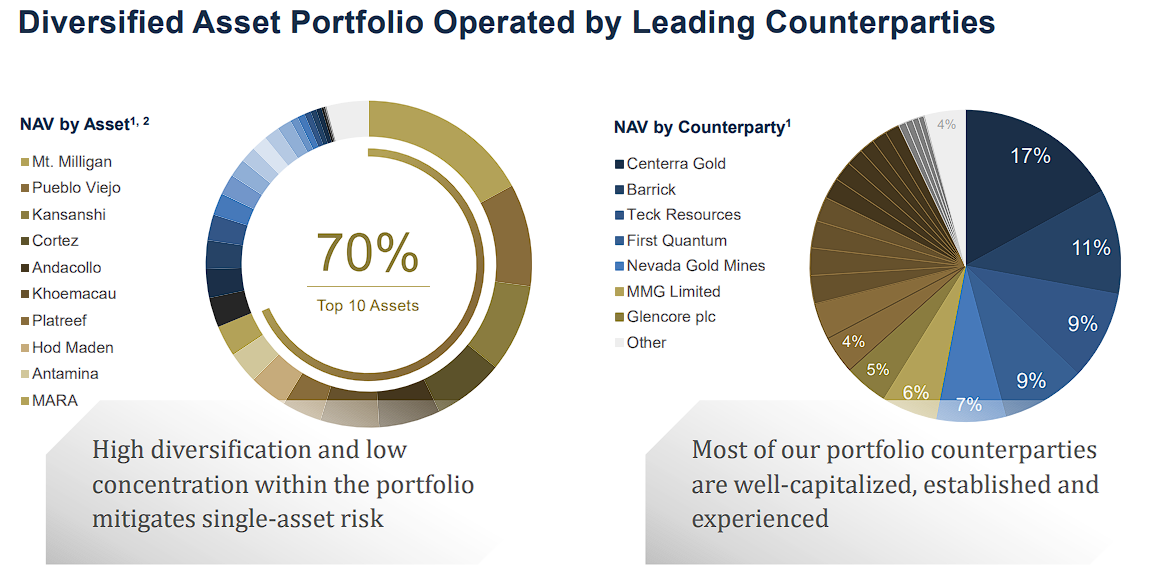
The October 2025 acquisitions of Sandstorm Gold and Horizon Copper expanded its portfolio and increased its share count.
Second-quarter 2026 revenue rose to $450.5 million from $209.6 million a year earlier.
Operating cash flow reached a record $335.2 million, and adjusted net income increased to $2.56 per diluted share.
Higher metal prices and the enlarged portfolio supported those results, with gold contributing 76% of revenue.
Royal Gold repaid $200 million of borrowing and repurchased $30 million of stock during the quarter.
It repaid another $75 million in July, reducing outstanding revolving borrowings to $325 million.
Its latest outlook targeted fourth-quarter repayment, subject to metal prices and further acquisitions.
Restructuring its Hod Maden interests also added a 2.5% net-smelter-return royalty.
The August declaration maintained the $0.475 quarterly dividend, or $1.90 annually, payable October 16th.
Royal Gold has raised its annual dividend for 25 consecutive years and carries a B Dividend Risk Score.
We estimate a 10.1% annualized five-year total return, primarily from earnings growth and valuation recovery.
Its modest starting yield, metal-price volatility, and execution at underlying mines remain the principal limitations.
Deep Dive: Click here to download (for free) our most recent 3-Page Sure Analysis PDF report on Royal Gold (RGLD).
Royalty Stock #3: Pizza Pizza Royalty Corp. (PZRIF)
- Expected Total Return: 10.2%
- Dividend Yield: 8.2%
- Dividend Risk Score: F
Pizza Pizza Royalty Corp. collects royalties from the Pizza Pizza and Pizza 73 restaurant brands in Canada.
Its 2026 royalty pool contains 814 restaurants, comprising 712 Pizza Pizza locations and 102 Pizza 73 locations.
Royalties follow restaurant sales, so shareholders avoid many direct food and labor expenses but remain exposed to weaker customer traffic.
Second-quarter 2026 same-store sales declined 5.0%, and royalty-pool sales fell 3.6% despite the addition of 20 net restaurants to the pool in January.
Adjusted earnings per share decreased 5.4%.
Management cited cautious consumer spending, stronger promotional competition, and a difficult comparison with the previous year’s Canadian hockey playoffs.
Those pressures also forced a dividend reduction.
Beginning in May 2026, the monthly payment fell approximately 13%, from C$0.0775 to C$0.0675 per share.
The new rate equals C$0.81 annually.
Quarterly dividends still consumed 102% of cash available for shareholder dividends, while the working capital reserve declined.
Our full-year estimates of $0.59 in dividends and $0.62 in earnings per share imply a payout ratio near 95%, leaving little room for further sales weakness.
We project a 10.2% annualized five-year return, driven mainly by the dividend and potential valuation recovery rather than earnings growth.
The F Dividend Risk Score, recent cut, and exposure to discretionary spending warrant caution; currency movements also affect payments received on the U.S. shares.
Royalty Stock #2: Dolby Laboratories (DLB)
- Expected Total Return: 15.0%
- Dividend Yield: 2.4%
- Dividend Risk Score: C
Dolby Laboratories licenses audio and video technologies to electronics makers, entertainment platforms, and other customers.
Its intellectual-property royalties provide a different source of cash flow from the energy and mining investments elsewhere in this ranking.
Dolby Atmos, Dolby Vision, the Video Distribution Program, and OptiView broaden the settings in which its technology can earn revenue.
Fiscal third-quarter 2026 revenue declined to $305 million from $316 million a year earlier.
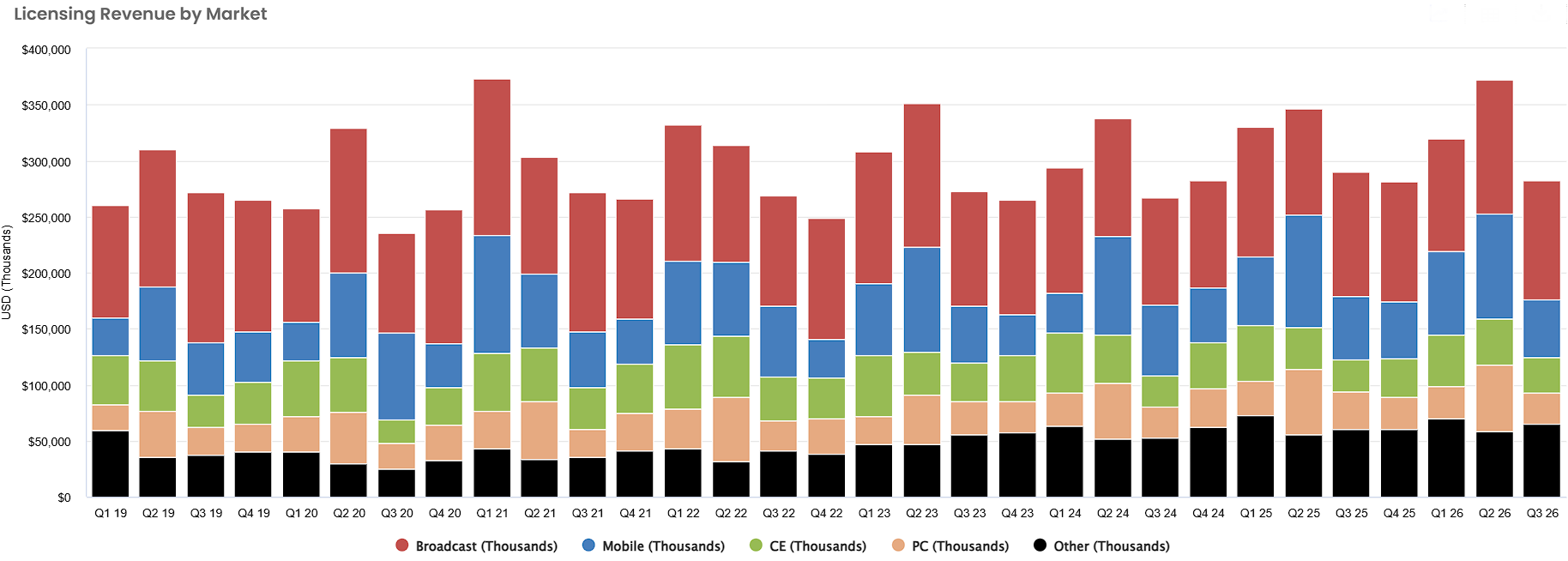
Adjusted earnings fell to $0.69 per share from $0.78 amid uneven demand for consumer electronics.
Management retained full-year revenue guidance of $1.41 billion to $1.44 billion.
The company repurchased $65 million of stock during the quarter and added $350 million to its buyback authorization.
More recently, its October 7th announcement with Apple will bring Dolby Atmos to Formula 1 coverage on Apple TV, alongside Dolby Vision, beginning with the U.S. Grand Prix on October 23rd.
The rollout extends Dolby’s technology into live sports, although the company did not quantify the immediate revenue contribution.
Its $0.36 quarterly dividend equals $1.44 annually and consumes roughly 33% of our $4.30 full-year adjusted earnings estimate.
Dolby has increased its dividend for 11 consecutive years and carries a C Dividend Risk Score.
We estimate a 15.0% annualized five-year return, with valuation recovery and licensing growth providing most of the projected upside.
Royalty Stock #1: PermRock Royalty Trust (PRT)
- Expected Total Return: 15.2%
- Dividend Yield: 11.3%
- Dividend Risk Score: F
PermRock Royalty Trust holds an 80% net-profits interest in oil and gas properties in the Permian Basin of West Texas.
Monthly distributions reflect production revenue after the operator’s expenses, so commodity prices and spending can move payments sharply.
The underlying properties changed hands in March 2025 when T2S Permian Acquisition II bought them from Boaz Energy.
Second-quarter 2026 distributable income fell to $409,050 from $1.20 million a year earlier.
That translated to approximately $0.0336 per unit, compared with $0.0987 in the prior-year quarter.
The September 18th declaration set the next monthly distribution at $0.0196242 per unit, payable October 15th, down from $0.021782 declared in August.
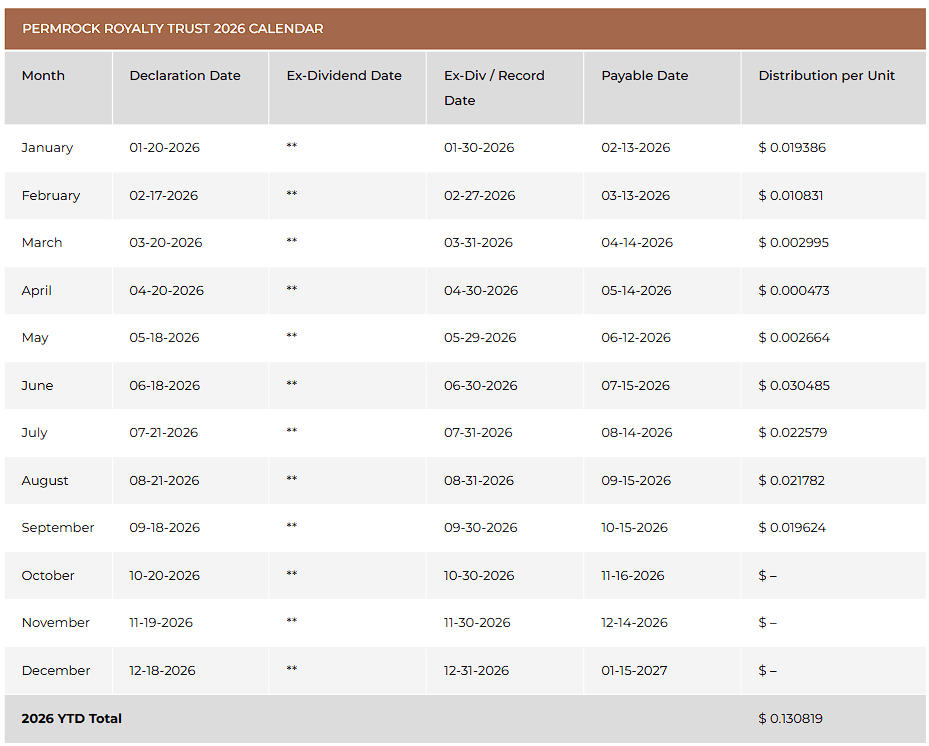
The calculation reflected lower oil prices and volumes, alongside $116,596 of capital expenditures.
It also benefited from a $62,500 net release of previously reserved funds, illustrating how operator accounting affects the cash ultimately distributed.
The displayed 11.3% yield uses our $0.20 annual distribution estimate and should not be treated as a fixed monthly income rate.
We project a 15.2% annualized five-year return, the highest among the covered royalty names.
That forecast relies on recovering per-unit cash flow and is particularly sensitive to production, commodity prices, and development costs.
PermRock has no sustained dividend-growth streak, and its F Dividend Risk Score underscores that the highest projected return does not establish dependable income.
Final Thoughts
Royalty investments come in very different forms, so the strongest projected return does not necessarily come with the safest payout.
Dolby offers exposure to technology licensing and dividend growth; Royal Gold combines precious-metal royalties with a 25-year record of increases; and Pizza Pizza offers a higher monthly corporate dividend supported by restaurant royalties, following a recent payout reduction.
PermRock and Permianville provide exposure to oil and gas cash flows, but their F Dividend Risk Scores, variable distributions, and sensitivity to commodity prices and spending make them less predictable.
The top five are ranked strictly by expected annualized total return among the 15 eligible covered names, rather than by current yield, risk score, or consistency of distributions.
When evaluating a royalty stock, consider the royalty contract, the underlying asset or customer, the legal structure, and the price paid for its cash flows.
If you would prefer companies with longer records of annual dividend increases, that is a core focus of our research at Sure Dividend.
The resources below are a good place to continue.
Additional Reading
Explore these Sure Dividend lists for more dividend growth ideas:
- Dividend Kings: 50+ consecutive years of dividend increases.
- Dividend Champions: 25+ consecutive years of dividend increases.
- Dividend Aristocrats: S&P 500 companies with 25+ consecutive years of dividend increases.
- High Dividend Stocks: 4%+ dividend yields
- Monthly Dividend Stocks: Individual securities that pay out every month
- MLPs: Detailed MLP list
- REITs: Detailed REIT list
- BDCs: Detailed BDC list