Updated on September 12th, 2026 by Nikolaos Sismanis
Real Estate Investment Trusts (REITs) make compelling income investments.
That’s because they are legally required to distribute 90%+ of their income to investors. That often translates to high dividend yields.
Some REITs have much higher dividend yields than others.
This research report analyzes the 10 highest-yielding REITs we cover in the Sure Analysis Research Database.
Not all high-yielding stocks are automatic buys. Investors should carefully assess the fundamentals to ensure that high yields are sustainable.
Dividend safety, valuation, management, balance sheet health, and growth are also very important factors.
We urge investors to use the analysis below as a starting point for high-yield REITs. Be sure to do significant due diligence before buying into any security, especially high-yield securities.
Many (but not all) high-yield securities have a significant risk of a dividend reduction and/or deteriorating business results.
Table of Contents
You can instantly jump to any specific section of the article by using the links below:
- High-Yield REIT No. 10: BTB Real Estate Investment Trust (BTBIF)
- High-Yield REIT No. 9: Nexus Industrial REIT (EFRTF)
- High-Yield REIT No. 8: Allied Properties Real Estate Investment Trust (APYRF)
- High-Yield REIT No. 7: Gladstone Commercial Corp. (GOOD)
- High-Yield REIT No. 6: NexPoint Residential Trust (NXRT)
- High-Yield REIT No. 5: Innovative Industrial Properties (IIPR)
- High-Yield REIT No. 4: AGNC Investment Corp. (AGNC)
- High-Yield REIT No. 3: Dynex Capital (DX)
- High-Yield REIT No. 2: ARMOUR Residential REIT (ARR)
- High-Yield REIT No. 1: Orchid Island Capital (ORC)
High-Yield REIT No. 10: BTB Real Estate Investment Trust (BTBIF)
- Dividend Yield: 8.3%
BTB Real Estate Investment Trust owns industrial, suburban-office, and necessity-based retail properties across Canada, with its largest concentration in Quebec and Eastern Ontario.
As of June 30th, the portfolio included 74 properties totaling about 6.0 million square feet, with industrial assets representing 38% of fair value, suburban offices 41%, and necessity-based retail 21%.
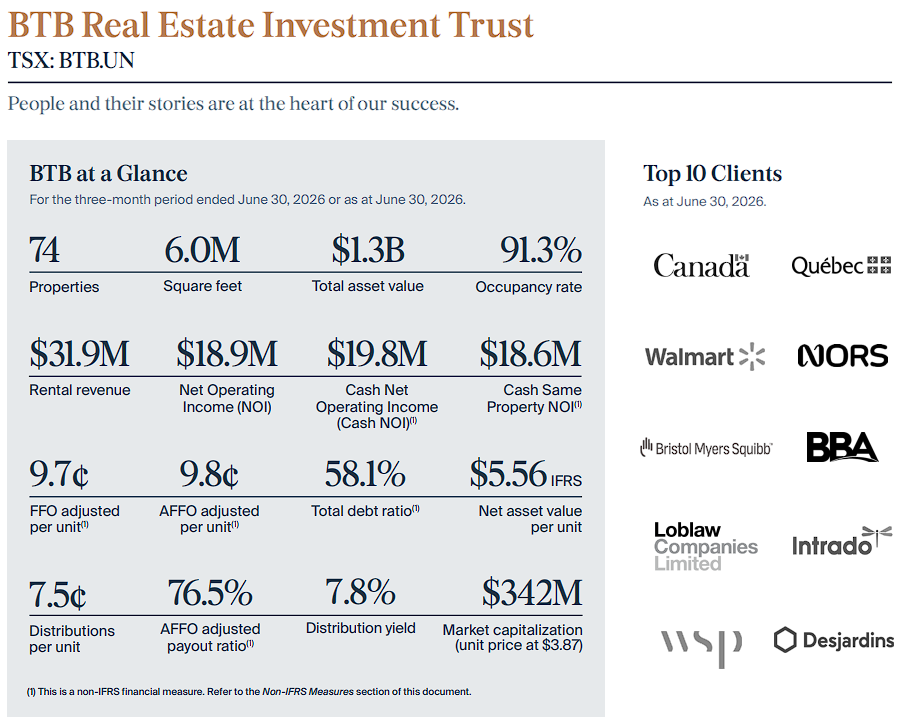
For the second quarter of 2026, rental revenue increased 4.5% year-over-year to $23.0 million in the U.S.-dollar presentation used by Sure Analysis, while net operating income rose 10.5% to $13.7 million.
Cash same-property NOI was essentially flat, and portfolio occupancy was 91.3%.
BTB completed approximately 378,000 square feet of leasing activity, with renewal rents increasing 4.6% on average.
Adjusted FFO per unit improved to $0.070 from $0.060, and adjusted AFFO per unit increased to $0.071 from $0.069.
The adjusted AFFO payout ratio consequently improved to 76.5%.
After quarter-end, BTB sold two office properties, reducing the portfolio to 72 properties and continuing its effort to improve the asset mix.
The REIT pays C$0.025 per unit monthly, or C$0.30 annually, and has kept that rate unchanged since cutting the distribution in 2020.
Coverage has improved, but elevated leverage, material office exposure, and the absence of distribution growth remain important risks behind the high yield.
High-Yield REIT No. 9: Nexus Industrial REIT (EFRTF)
- Dividend Yield: 8.8%
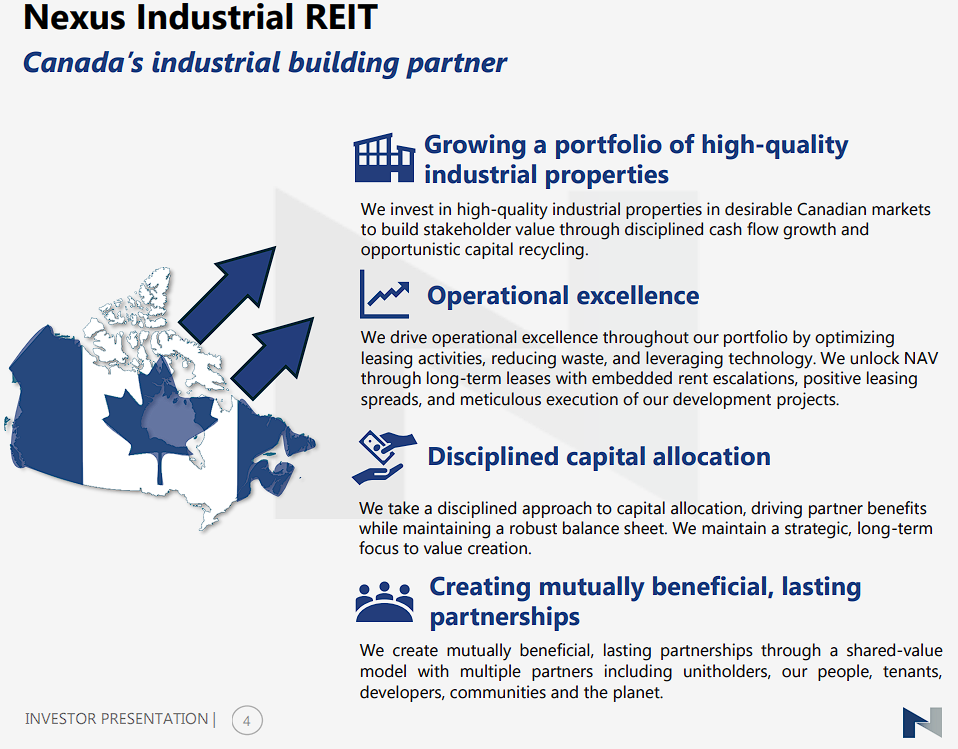
Nexus Industrial REIT is a Canada-focused, pure-play industrial REIT whose properties support distribution, logistics, manufacturing, and other light-industrial uses.
As of June 30th, it owned 87 properties totaling 12.3 million square feet, including three properties and one land parcel classified as held for sale.
Second-quarter 2026 property revenue increased 10.9% year-over-year to approximately $33.7 million in U.S.-dollar terms, while net operating income rose 6.2% to $24.7 million.
Industrial same-property NOI grew 3.3%, and in-place and committed industrial occupancy improved to 97% from 95% in the prior quarter.
Completed lease renewals generated an average rent spread of 6%.
Normalized FFO per unit slipped to $0.133, while normalized AFFO per unit declined to $0.111 as financing costs and portfolio recycling limited the benefit of property-level growth.
The year-to-date normalized AFFO payout ratio improved to 99.3%, leaving only a narrow cushion for the distribution.
Nexus also obtained an investment-grade credit rating and completed its inaugural C$500 million bond offering, strengthening access to long-term capital.
The REIT has paid the same monthly distribution since beginning payments in 2014, so it has avoided a cut but delivered no distribution growth.
High occupancy and industrial demand are positives, although leverage near 10.5 times adjusted EBITDA and tight payout coverage remain significant risks.
High-Yield REIT No. 8: Allied Properties Real Estate Investment Trust (APYRF)
- Dividend Yield: 9.0%
Allied Properties Real Estate Investment Trust owns urban workspace and mixed-use properties in major Canadian cities, including Toronto, Montreal, Vancouver, Calgary, and Kitchener.
At the end of the second quarter, its 179-property portfolio totaled roughly 14.1 million square feet and was 86.7% leased and 84.4% occupied.
Second-quarter 2026 rental revenue declined 3.1% year-over-year to $99.7 million in the U.S.-dollar presentation used by Sure Analysis, while property operating costs increased 8.6%.
Operating income consequently fell 12.7% to $49.5 million, and AFFO per unit declined 62.7% to $0.121.
Higher borrowing costs were a major pressure point, with interest expense increasing 21.4%.
Allied also recorded a $538.6 million property fair-value loss and completed $139.8 million of dispositions during the quarter as management continued to reduce debt and reposition the portfolio.
However, note that Allied cut its monthly distribution by 60% in December 2025, to C$0.06 per unit.
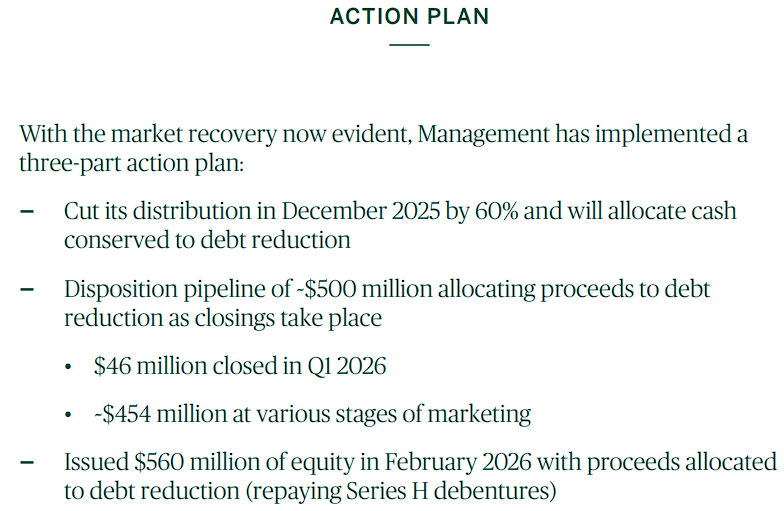
That rate equals C$0.72 annually, and we currently estimate a payout ratio near 74% based on projected full-year AFFO.
The lower payout is better covered, but weak office utilization, leverage near 12.3 times annualized adjusted EBITDA, and rising interest expense make another deterioration in cash flow a meaningful risk.
High-Yield REIT No. 7: Gladstone Commercial Corporation (GOOD)
- Dividend Yield: 9.3%
Gladstone Commercial Corporation owns single-tenant and anchored multi-tenant net-lease properties across the United States.
Management has been steadily repositioning the portfolio toward industrial real estate and away from offices, which should improve the asset mix over time.
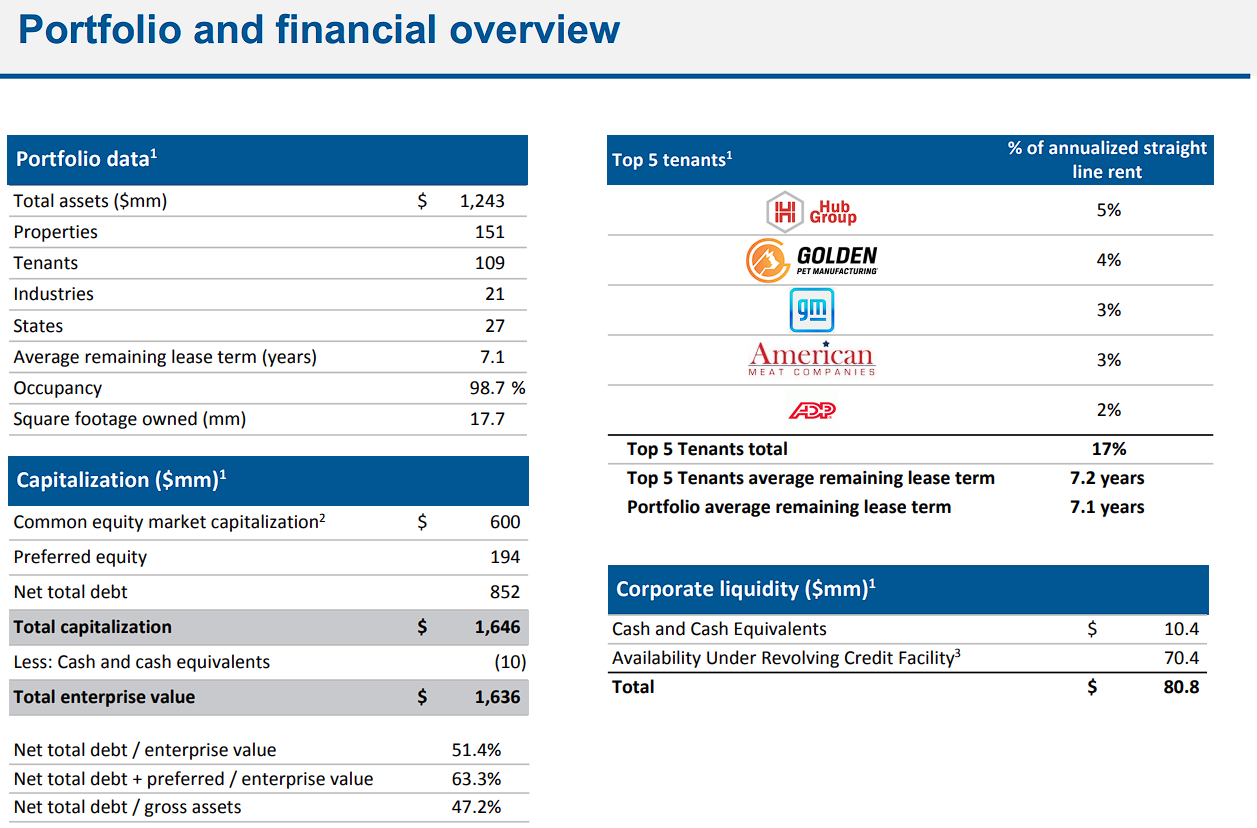
At the end of the second quarter, the portfolio included 151 properties totaling 17.7 million square feet and was 98.7% leased.
Second-quarter 2026 operating revenue was $44.0 million, up 5.0% sequentially.
Core funds from operations increased to $18.3 million, or $0.38 per diluted share, from $17.0 million, or $0.35, in the prior quarter.
Results benefited from a lease-termination payment, while rent collection remained 100% from April through July.
Portfolio recycling remains central to the investment case.
Gladstone acquired a 153,890-square-foot industrial property for $22.8 million at a 6.76% capitalization rate, sold another asset for $12.9 million, and purchased an additional industrial property after quarter-end for $6.6 million at a 9.16% cap rate.
The REIT pays a $0.10 monthly common dividend, or $1.20 annually.
That distribution represented about 79% of second-quarter Core FFO, and the company has made more than 250 consecutive monthly common-stock distributions.
Still, investors should monitor office exposure, refinancing costs, and acquisition discipline.
High-Yield REIT No. 6: NexPoint Residential Trust (NXRT)
- Dividend Yield: 9.4%
NexPoint Residential Trust owns 36 apartment properties containing 13,305 units, primarily in Sunbelt markets such as Phoenix, South Florida, and Dallas-Fort Worth.
Its strategy combines workforce-oriented multifamily housing with renovations intended to support higher rents and property values.
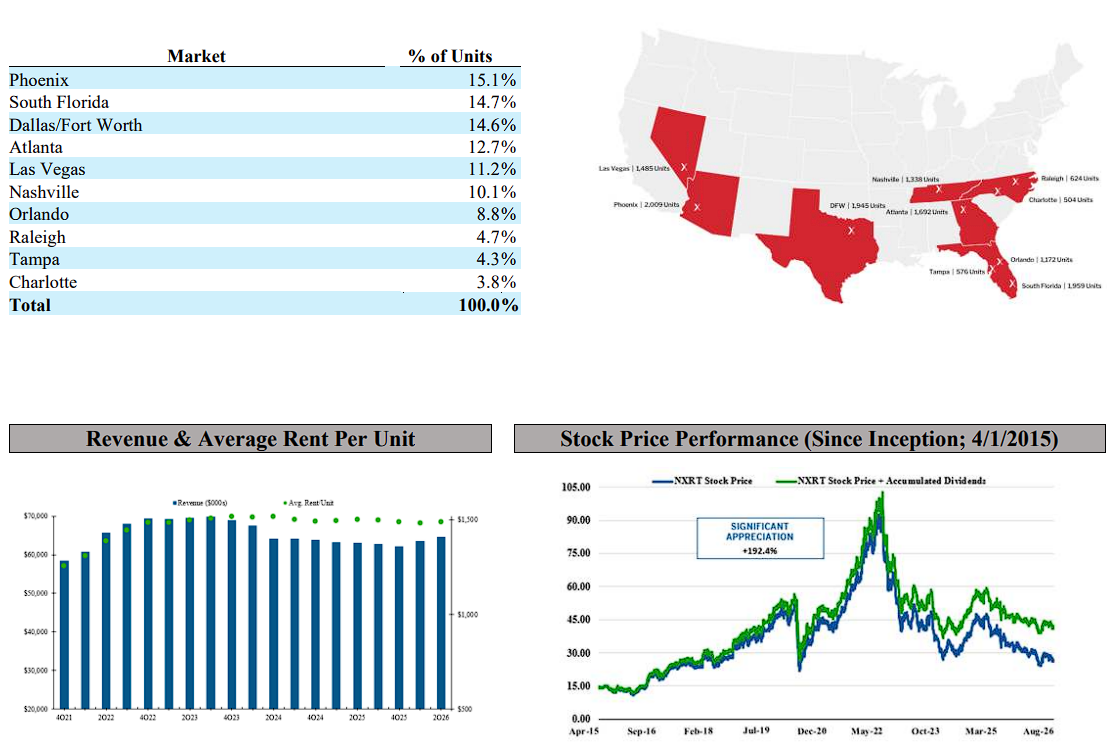
Second-quarter 2026 revenue increased 2.4% to $64.6 million, although same-store NOI declined 2.9% as same-store revenue and average effective rent decreased 0.6% and 0.9%, respectively.
Portfolio occupancy improved 30 basis points to 93.5%.
Core FFO declined to $0.66 per share from $0.71, while AFFO decreased to $0.77 from $0.80.
NexPoint completed 459 full and partial upgrades and leased 255 upgraded units at an average monthly premium of $90.60, producing a 23% return on investment.
It also deployed $22.1 million into a 10% fixed-rate term loan, marking its first investment under a multifamily bridge-lending program.
Management reduced the midpoint of full-year AFFO-per-share guidance to $2.86 from $2.99, reflecting the softer operating backdrop.
The $0.53 quarterly dividend equals $2.12 annually and represents roughly 74% of revised expected AFFO.
NexPoint has increased its dividend for 10 consecutive years, but leverage, weak same-store growth, and the lower outlook make balance-sheet management and a recovery in Sunbelt rental conditions especially important.
High-Yield REIT No. 5: Innovative Industrial Properties (IIPR)
- Dividend Yield: 13.6%
Innovative Industrial Properties is an internally managed specialty REIT that provides real estate capital to regulated cannabis operators and has also invested in life-science real estate.
As of June 30th, it owned 108 properties across 19 states, while its portfolio’s weighted-average remaining lease term was approximately 11.9 years.
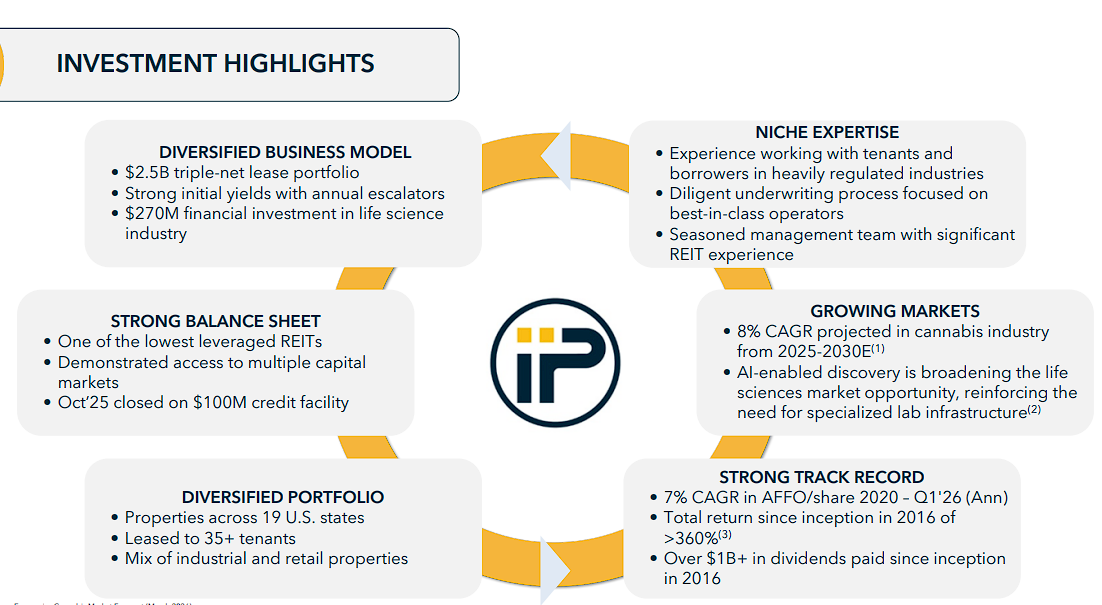
Second-quarter 2026 revenue increased 0.7% to $63.3 million, and AFFO per share rose 7.0% to $1.83.
New leases and contractual rent escalations helped results, but property sales, tenant defaults, and lease terminations remained meaningful offsets.
Interest and other income increased to $10.8 million, largely because IIPR earned $8.5 million from its IQHQ investments.
During the quarter, the REIT signed a 58,000-square-foot lease with Curaleaf for a property surrendered by PharmaCann and reached tentative arrangements for the four properties previously leased to 4Front.
It also sold its Perth, New York, property for $88.5 million and completed its $270 million strategic investment in IQHQ.
Net debt equaled only 14.2% of gross assets, and total liquidity was $299.7 million.
The quarterly dividend remains $1.90, or $7.60 annually, after seven consecutive years of dividend growth.
However, that payout exceeds the current $7.00 full-year AFFO estimate, so tenant credit, rent collection, and dividend coverage remain the central risks behind the double-digit yield.
High-Yield REIT No. 4: AGNC Investment Corp. (AGNC)
- Dividend Yield: 14.0%
AGNC Investment Corp. is a mortgage REIT that invests primarily in residential mortgage-backed securities guaranteed by U.S. government-sponsored enterprises or agencies.
It finances these securities with repurchase agreements and hedges much of its interest-rate exposure.
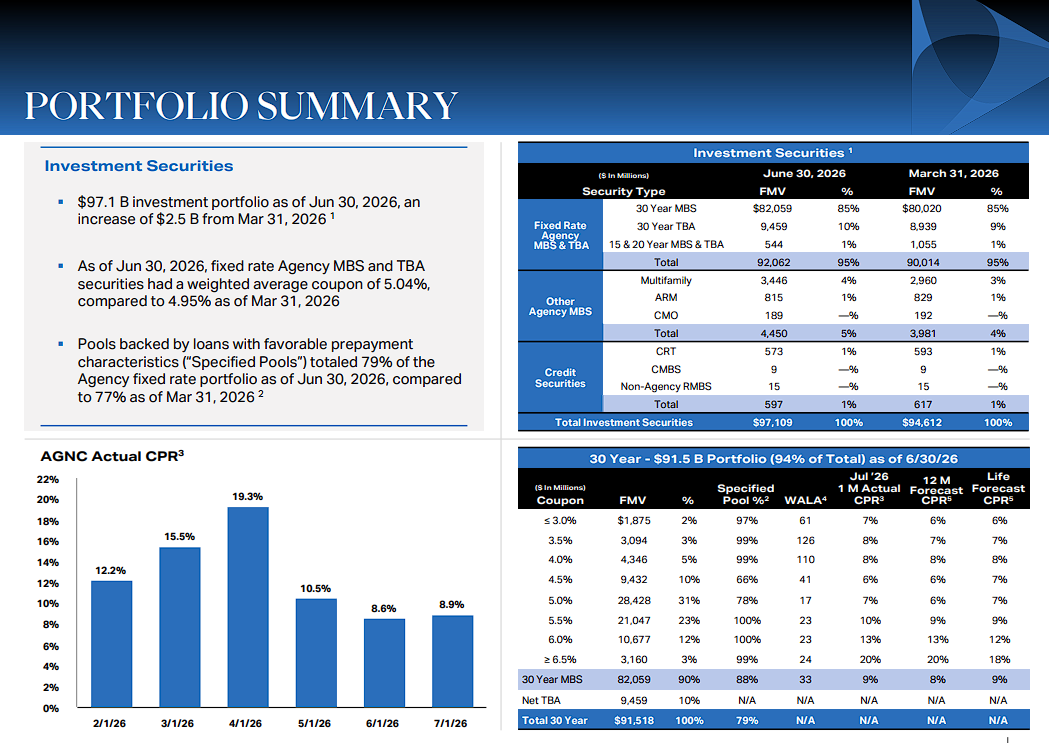
This model can produce substantial income, but results depend heavily on borrowing costs, mortgage spreads, prepayments, leverage, and book-value changes.
In the second quarter of 2026, AGNC generated comprehensive income of $0.52 per share and net spread and dollar-roll income of $0.40 per share.
Tangible net book value increased 2.4% to $8.58 per share, producing a 6.7% economic return for the quarter.
The annualized net interest spread was 2.00%, while the constant prepayment rate remained elevated at 13.0%.
AGNC ended the quarter with 7.4 times tangible at-risk leverage and $7.5 billion of unencumbered cash and Agency securities, equal to 62% of tangible equity.
It also issued 16.2 million common shares through its at-the-market program, raising $167 million and expanding investable capital while diluting existing shareholders.
The company has maintained its $0.12 monthly dividend for more than six years.
Second-quarter net spread income covered the $0.36 of dividends paid, but mortgage REIT earnings and book values can change quickly, so the 14.0% yield should not be viewed as bond-like income.
High-Yield REIT No. 3: Dynex Capital (DX)
- Dividend Yield: 16.2%
Dynex Capital is an internally managed mortgage REIT that invests primarily in Agency residential and commercial mortgage-backed securities.
Nearly all its investment portfolio carries an Agency guarantee, limiting credit risk.
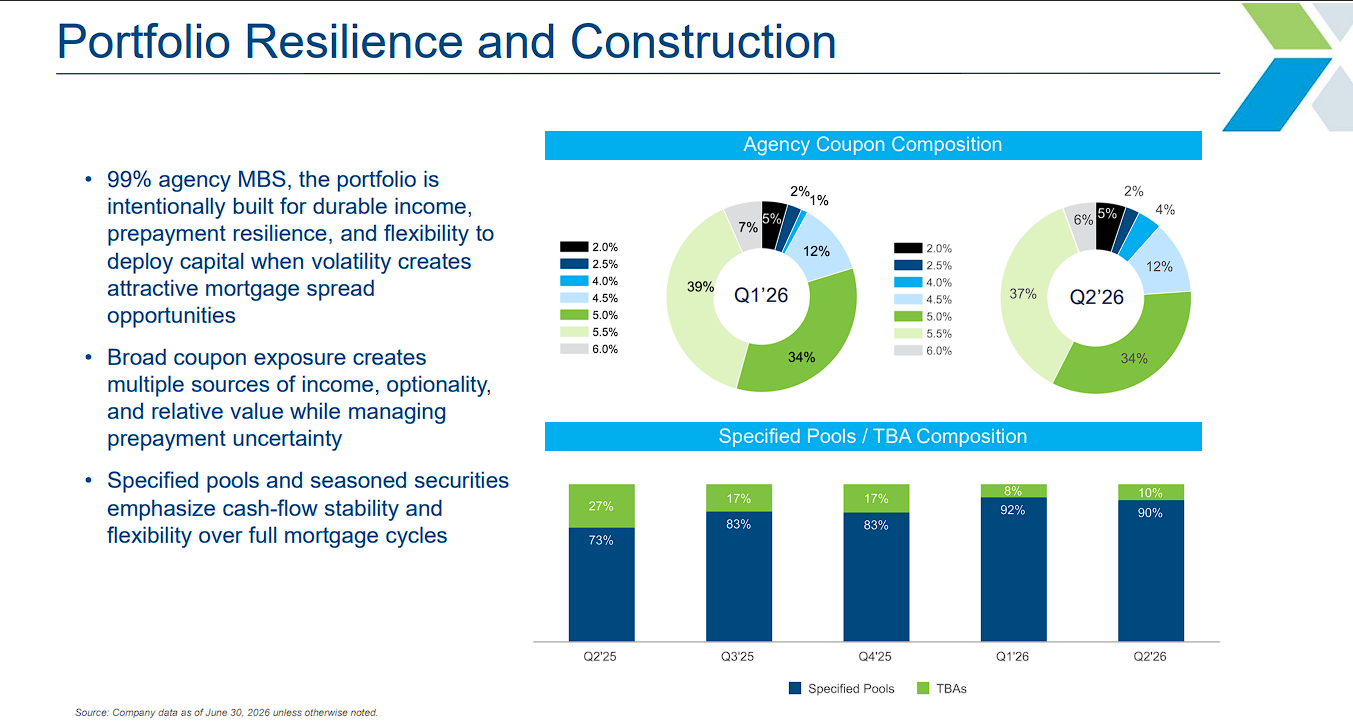
Nevertheless, leverage, funding costs, prepayment behavior, hedging effectiveness, and changes in mortgage-security prices can create substantial earnings and book-value volatility.
Dynex produced a 6.4% total economic return in the second quarter of 2026.
Book value rose by $0.30 to $12.90 per share, while comprehensive income and net income were both $0.80 per common share.
Earnings available for distribution improved to $0.36 per share from $0.31 in the first quarter, reflecting a better earnings environment.
Management expanded the investment portfolio by 11% sequentially to $27.6 billion after purchasing $2.8 billion of mortgage-backed securities.
At the same time, Dynex raised $391 million of common equity and ended the quarter with $1.6 billion of liquidity.
Leverage, including to-be-announced securities, declined to 8.1 times from 8.6 times.
The REIT pays $0.17 per share monthly, or $0.51 for the quarter.
Because second-quarter distributable earnings did not fully cover that amount, dividend coverage remains the central risk despite improving earnings.
Dynex has raised its annual dividend for two consecutive years, but its long-term payout record includes prior reductions.
Deep Dive: Click here to download (for free) our most recent 3-Page Sure Analysis PDF report on Dynex Capital (DX).
High-Yield REIT No. 2: ARMOUR Residential REIT (ARR)
- Dividend Yield: 18.1%
ARMOUR Residential REIT invests mainly in fixed-rate residential mortgage-backed securities issued or guaranteed by U.S. government-sponsored entities.
Credit risk is limited by those guarantees, but the company employs substantial leverage and remains highly sensitive to mortgage spreads, interest-rate volatility, prepayments, financing costs, and the effectiveness of its hedging portfolio.
In the second quarter of 2026, ARMOUR reported GAAP net income available to common shareholders of $111.5 million, or $0.86 per share.
Distributable earnings were $93.2 million, or $0.72 per share, matching the $0.72 of monthly dividends declared for the quarter.
Book value increased 0.6% to $17.53 per share, and the REIT generated a 4.8% total economic return.
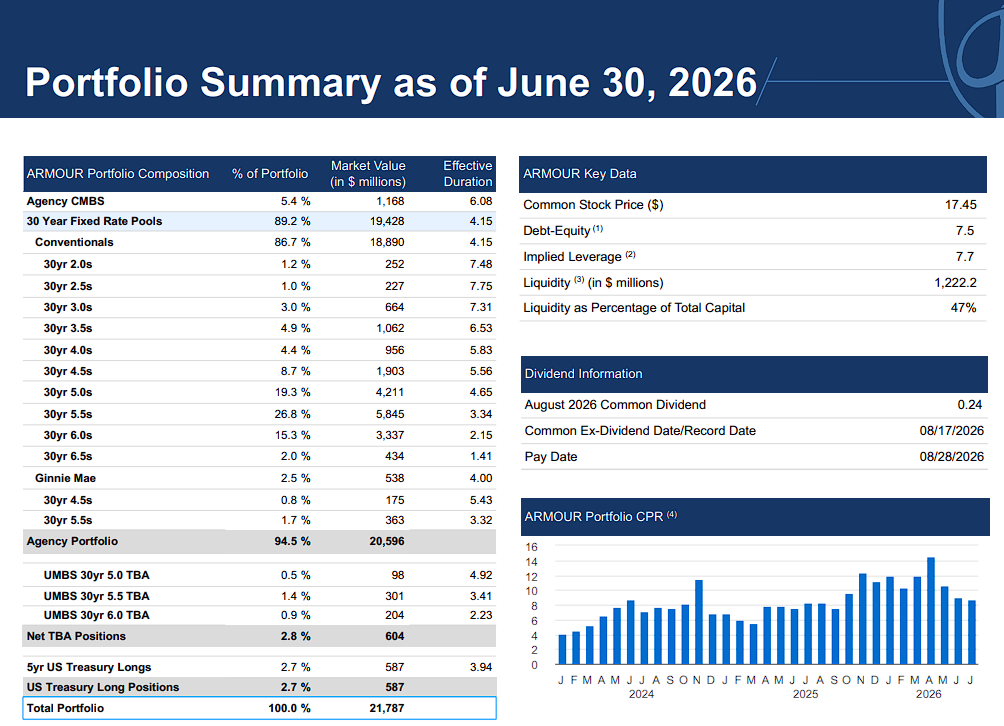
The investment portfolio was about $21.8 billion, with implied leverage near 7.7 times.
Liquidity remained substantial at roughly $1.2 billion, or 47% of shareholders’ equity.
ARMOUR also raised $218.7 million by issuing about 12.7 million common shares through its at-the-market program, supporting portfolio expansion but increasing the share count.
The company currently pays $0.24 per share each month.
While the latest quarter’s distributable earnings covered the payout, ARMOUR has reduced its dividend multiple times over the long term.
That history, combined with leverage and earnings sensitivity, helps explain the exceptionally high 18.1% yield.
High-Yield REIT No. 1: Orchid Island Capital (ORC)
- Dividend Yield: 18.9%
Orchid Island Capital is an externally managed mortgage REIT that invests in Agency residential mortgage-backed securities.
Its portfolio includes pass-through securities and structured Agency RMBS.
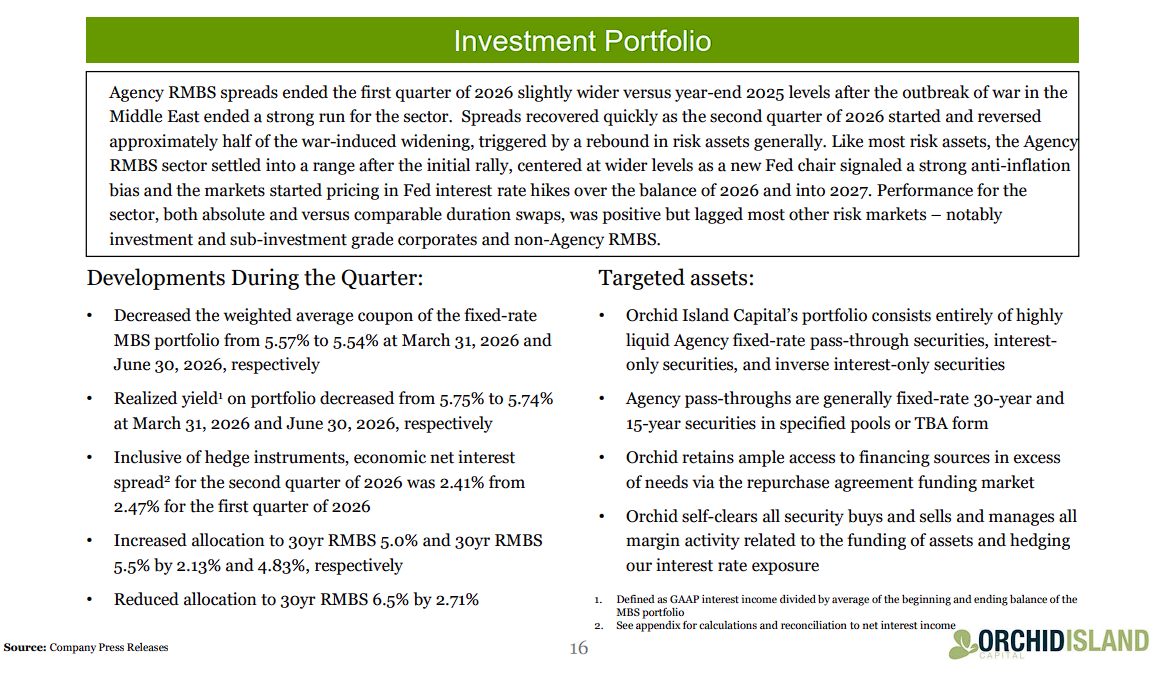
Government guarantees reduce credit risk, but the leveraged business model exposes investors to interest-rate movements, mortgage spreads, prepayment speeds, hedging outcomes, and changes in book value.
For the second quarter of 2026, Orchid generated net income of $89.2 million, or $0.44 per share.
Net interest income was $60.0 million, or $0.30 per share, and investment and derivative gains totaled $36.0 million.
Book value increased by $0.14 to $7.22 per share, helping produce a 6.2% quarterly total return.
The portfolio reached $11.5 billion, economic leverage was 7.3 times, and the net interest spread was just under 2%.
Orchid issued shares during the first half to expand its capital base, although second-quarter issuance was relatively modest.
Note that management cut the monthly payout by 16.7% in April, from $0.12 to $0.10 per share.
The lower rate has since been maintained, but Orchid has a long history of dividend reductions.
Its 18.9% yield is therefore less a sign of dependable income than a reflection of the market’s expectations for continued earnings, book value, and payout volatility.
Final Thoughts
The 10 highest-yielding REITs in the current Sure Analysis universe offer substantial income, but every company in this ranking has an F Dividend Risk Score.
That common risk rating matters more than the small differences between headline yields.
BTB, Nexus, Allied, Gladstone Commercial, NexPoint, and Innovative Industrial own physical real estate, yet their challenges range from office exposure and leverage to weak apartment fundamentals and cannabis-tenant credit.
AGNC, Dynex, ARMOUR, and Orchid are mortgage REITs whose results can shift rapidly with leverage, funding costs, hedging outcomes, mortgage spreads, and book values.
The ranking also demonstrates that a high yield can reflect a recent dividend reduction rather than unusually dependable income, as seen at Allied and Orchid.
We suggest using this list as a research starting point, not a buy list.
Before relying on any distribution, investors should examine current payout coverage, liquidity, refinancing needs, asset or tenant quality, and the company’s history of maintaining its dividend through difficult conditions.
If you are interested in finding high-quality dividend growth stocks and/or other high-yield securities and income securities, the following Sure Dividend resources will be useful:
High-Yield Individual Security Research
Other Sure Dividend Resources
- Dividend Kings: 50+ years of rising dividends
- Dividend Aristocrats: 25+ years of rising dividends and in the S&P 500
- Monthly Dividend Stocks: Individual securities that pay out every month