Guest Post by Tom Hutchinson, Chief Analyst, Cabot Dividend Investor
Market returns have been spectacular.
Consider the S&P 500 returns over the past three calendar years: 2023 (26.29%), 2024 (25.02%), and 2025 (17.88%). In fact, the S&P 500 index value has more than doubled since the bull market began in October of 2022.
You haven’t had to be that picky about price to do well. You could have purchased many of the better stocks near the 52-week highs and still have gotten good returns.
The bigger key to success was being in the market rather than haggling over prices.
Stocks are selling at some of the highest valuations in the history of the market.
When the market is overvalued, investors should look to quality dividend growth stocks, particularly those that are undervalued.
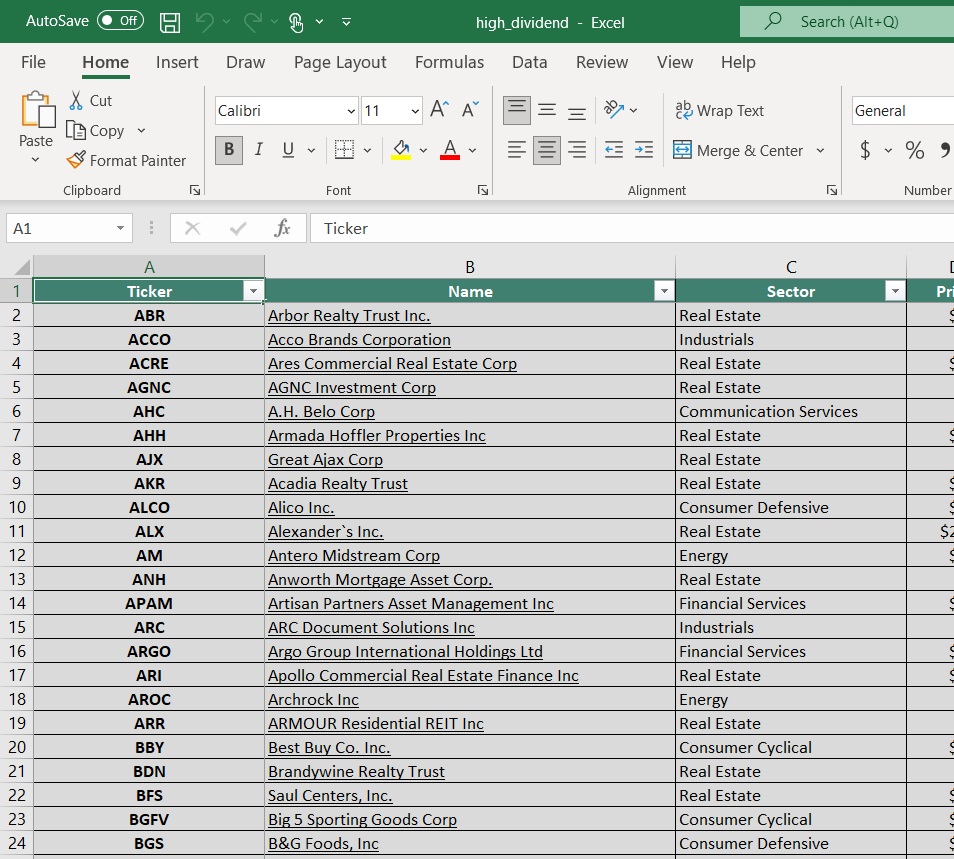
For example, the free high dividend stocks list spreadsheet below has our full list of individual securities (stocks, REITs, MLPs, etc.) with with 5%+ dividend yields.
The main valuation gauge is the price/earnings ratio, which measures stock prices against earnings. Estimates range from 26 times earnings to 32 times, which compares to the long-term historical average of 16 times.
That said, valuations are not as bad as those numbers indicate.
Technology is a much bigger part of the S&P 500 weight than ever before, currently over 35%. The high growth rate in that sector does justify higher prices. In the last quarter, technology sector earnings averaged over 45% growth.
It’s also true that market valuation on a forward PE basis (that factors in estimated earnings growth over the next year) is far lower, near 20 times by several estimates. The massive artificial intelligence catalyst is propelling the index to a much higher level of growth.
But no matter how you slice it, valuations are still very much near the high end historically.
Despite the recent strong market, there are great stocks that have performed very well historically that are selling much closer to the 52-week low than the high.
The stocks should have less downside from here if the market gets funky and more upside as investors get pickier in a flatter market over the rest of the year.
Oracle Corporation (ORCL)
This stock certainly qualified as beaten up. It’s down nearly 40% from the 52-week high. But unlike many low-priced stocks, ORCL also has positive momentum. It has already moved up over 49% from the 52-week low just since early April.
Oracle became the poster child for AI overindulgence when the artificial intelligence trade consolidated from the end of October through March. But investor attitudes have changed again, and AI is back. ORCL is increasingly regarded as a stock that has been unfairly bludgeoned and is roaring back.
Companies require cutting-edge computer power and services to streamline the business and compete effectively. But they don’t have the capital resources or expertise to build out a computer infrastructure nearly as extensive as Oracle’s.
It makes sense to tap into Oracle’s services for a fee. That way, they can compete at the highest levels by utilizing technological systems they could never build themselves.
The emergence of artificial intelligence has dramatically increased the need for Oracle’s services. Oracle offers a service called Oracle Cloud Infrastructure (OCI). The service is highly popular not only for what it provides but because it provides it faster and cheaper than the competition.
The growth potential is illustrated in the last quarterly report. OCI revenue grew 52% to $3 billion. While that’s impressive, management has said growth should eclipse 70% this year. The company recently reported $130 billion in order backlogs.
McKesson Corp. (MCK)
MCK has been a strong performer that has fallen 24% below the 52-week high. This rare price decline for an otherwise very strong performer that has returned just shy of 300% over the past three years presents a buying opportunity.
McKesson Corp. (MCK) is a leading domestic wholesaler of branded, generic, and specialty pharmaceutical products. It has a solid base of over 40,000 customers and supplies about one-third of the U.S. drug distribution market. It’s a Goliath, with $398 billion in annual revenues.
McKesson buys drugs from manufacturers, delivers them, and resells them to retailers at a profit. It delivers from 1,300 producers to over 180,000 retailers by using 29 strategically located distribution centers throughout the country.
The extensive distribution network and enormous scale give McKesson tremendous bargaining leverage with suppliers and customers that can’t be easily duplicated by would-be competitors.
That’s why the business is an oligopoly. McKesson, along with Cencora Inc. and Cardinal Health, accounts for 90% of the drug wholesale distribution market in the United States. In addition, there are very high switching costs among the providers, so they rarely lose business to the other two companies.
McKesson gets predictable earnings from the stable traditional pharmaceutical business while expanding capacity and the rapid-growth, high-margin, specialty drugs and biosimilars. McKesson has a huge share of a business that will grow all by itself because of the aging population. The recent decline in price presents an excellent entry point.
Additional Reading
If you are interested in finding high-quality dividend growth stocks and/or other high-yield securities and income securities, the following Sure Dividend resources will be useful:
High-Yield Individual Security Research
- 20 Highest Yielding Monthly Dividend Stocks
- 10 Super High Dividend REITs
- Highest Yielding Royalty Trusts
Other Sure Dividend Resources
- Dividend Kings: 50+ years of rising dividends
- Dividend Champions: 25+ years of rising dividends
- Dividend Aristocrats: 25+ years of rising dividends and in the S&P 500
- Dividend Achievers: 10+ years of rising dividends and in the NASDAQ
- Monthly Dividend Stocks: Individual securities that pay out every month
- MLPs: List of MLPs and more
- REITs: List of REITs and more
- BDCs: List of BDCs and more