Article updated on November 6th, 2026 by Nick Sismanis
Spreadsheet data updated daily
High dividend stocks are stocks with a dividend yield well in excess of the S&P 500’s average dividend yield of ~1.1%.
The resources in this report focus on truly high yielding securities (4.0%+ yields), with dividend yields multiples higher than the market average.
Resource #1: The High Dividend Stocks List Spreadsheet
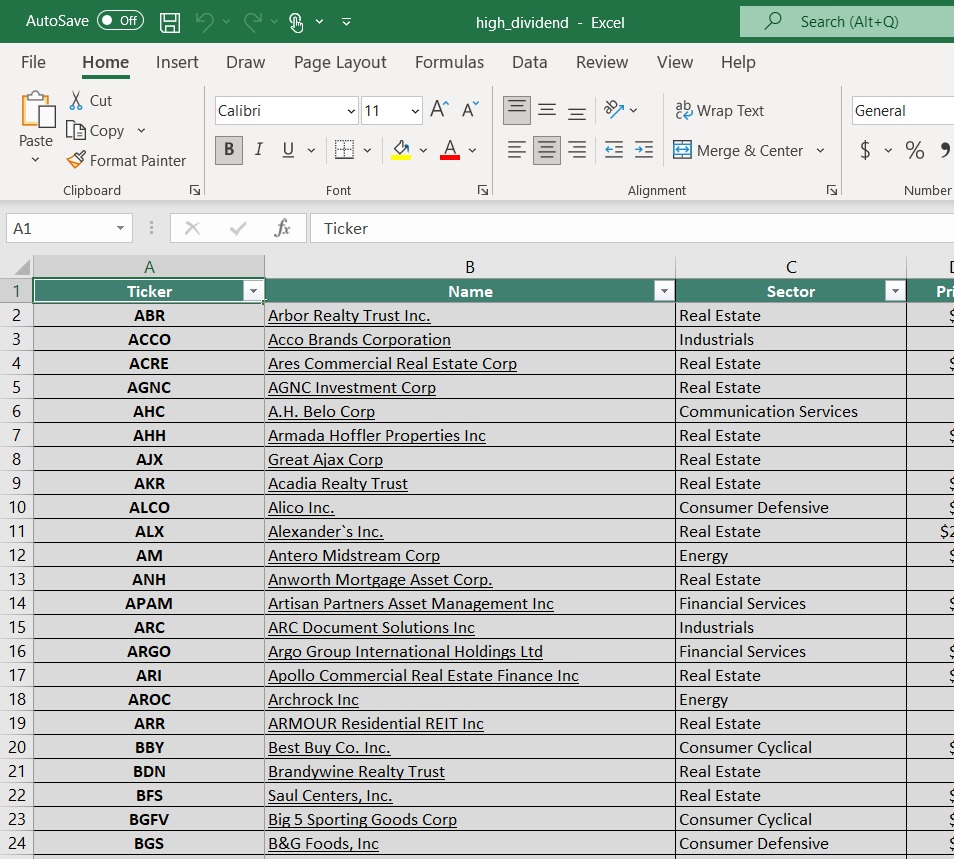
The free high dividend stocks list spreadsheet has our complete list of 217 individual securities (stocks, REITs, MLPs, etc.) with 4%+ dividend yields that we cover in the Sure Analysis Research Database.
This spreadsheet contains important metrics, including: years of dividend growth, dividend yields, payout ratios, buy/hold/sell ratings, fair value prices, expected total returns, and much more.
Resource #2: The 10 Best High Yield Stocks Now
This resource analyzes a selected shortlist of 10 high-yield stocks with Dividend Risk Scores of C or better. The selection criteria and ranking approach are:
- Is in the 900+ income security Sure Analysis Research Database
- Rank the selected securities by dividend yield, from highest to lowest
- Dividend Risk Scores of C or better
- Based in the U.S.
- Dividend yields of at least 4%
- No more than three securities from any one market sector
The ten selections balance yield, dividend quality, and sector representation.
Dividend yields and risk scores below use the November 5th, 2026 spreadsheet; company developments are current through the article update date.
Click below to jump to analysis on any of the Top 10:
- High Dividend Stock #10: Sonoco Products Company (SON)
- High Dividend Stock #9: Albertsons Companies, Inc. (ACI)
- High Dividend Stock #8: Eastman Chemical Company (EMN)
- High Dividend Stock #7: Solvay Bank Corp. (SOBS)
- High Dividend Stock #6: Hormel Foods Corporation (HRL)
- High Dividend Stock #5: Realty Income (O)
- High Dividend Stock #4: Altria Group, Inc. (MO)
- High Dividend Stock #3: Edison International (EIX)
- High Dividend Stock #2: NNN REIT, Inc. (NNN)
- High Dividend Stock #1: Enterprise Products Partners L.P. (EPD)
Resource #3: The High Dividend 50 Series
This series provides our most recent publicly available Sure Analysis PDF report for each of the 50 highest-yielding securities in the Sure Analysis Research Database now. Nearly all securities in Sure Analysis are updated quarterly.
Click here to jump to this resource now.
High Dividend Stock #10: Sonoco Products Company (SON)
- Dividend Risk Score: A
- Dividend Yield: 4.2%
Sonoco Products Company supplies metal and paper packaging to consumer and industrial customers worldwide.
Its portfolio is now concentrated in Consumer Packaging and Industrial Paper Packaging following the Eviosys acquisition and the 2025 divestitures of its Thermoformed and Flexible Packaging and ThermoSafe businesses.
On October 21st, Sonoco reported third-quarter 2026 results, with sales down 4.2% to $2.04 billion and adjusted earnings-per-share declining to $1.67 from $1.92.
Consumer Packaging sales fell 2.9% as weaker harvests and unfavorable pricing relative to costs pressured results, while Industrial Paper Packaging sales rose 5.2%.
An $829 million non-cash goodwill impairment contributed to a GAAP net loss of $732 million, or $7.36 per share. Management reduced 2026 adjusted EPS guidance to $5.30 to $5.50 from $5.80 to $6.20.
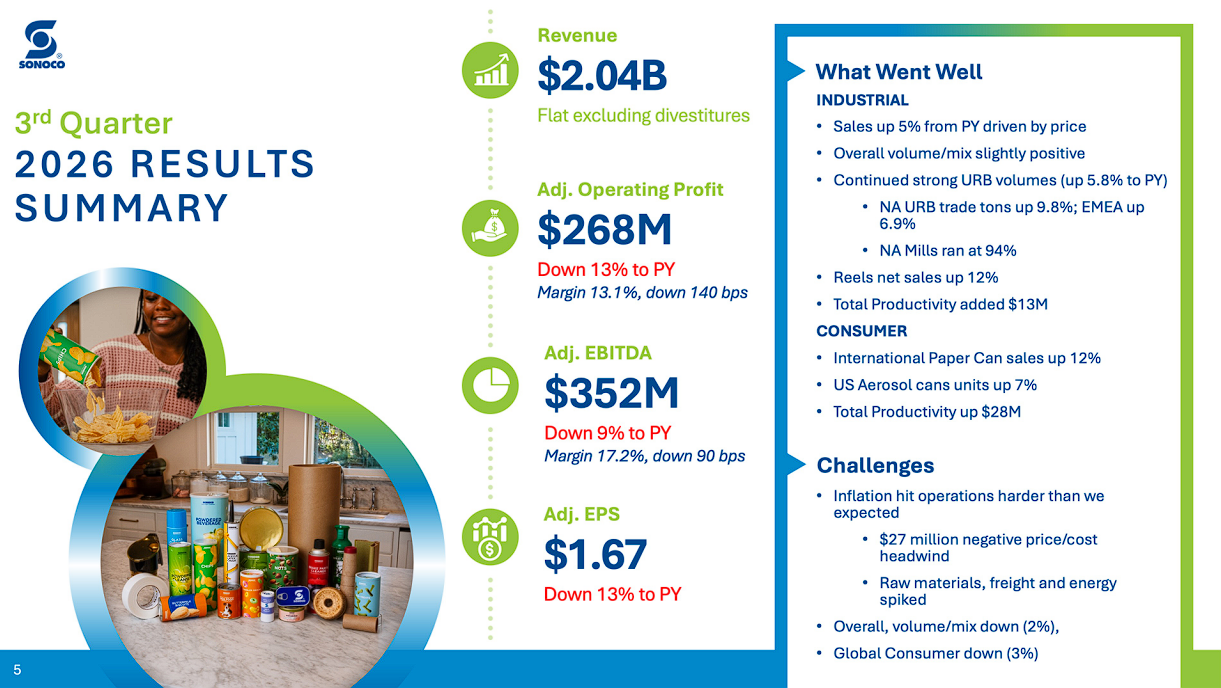
Third-quarter operating cash flow was $285 million, bringing the year-to-date total to $218 million. Net debt declined to $4.1 billion as of September 27th.
The impairment did not directly consume cash, but weaker earnings, integration demands, and debt reduction remain important to the dividend outlook.
In April, Sonoco raised its quarterly dividend to $0.54, or $2.16 annually.
Sonoco has now increased its dividend for 50 consecutive years.
That payout represents 40% of our updated $5.40 adjusted EPS estimate, providing earnings coverage while packaging demand and cash generation remain key considerations.
High Dividend Stock #9: Albertsons Companies, Inc. (ACI)
- Dividend Risk Score: C
- Dividend Yield: 4.9%
Albertsons Companies, Inc. is one of the largest U.S. food and drug retailers.
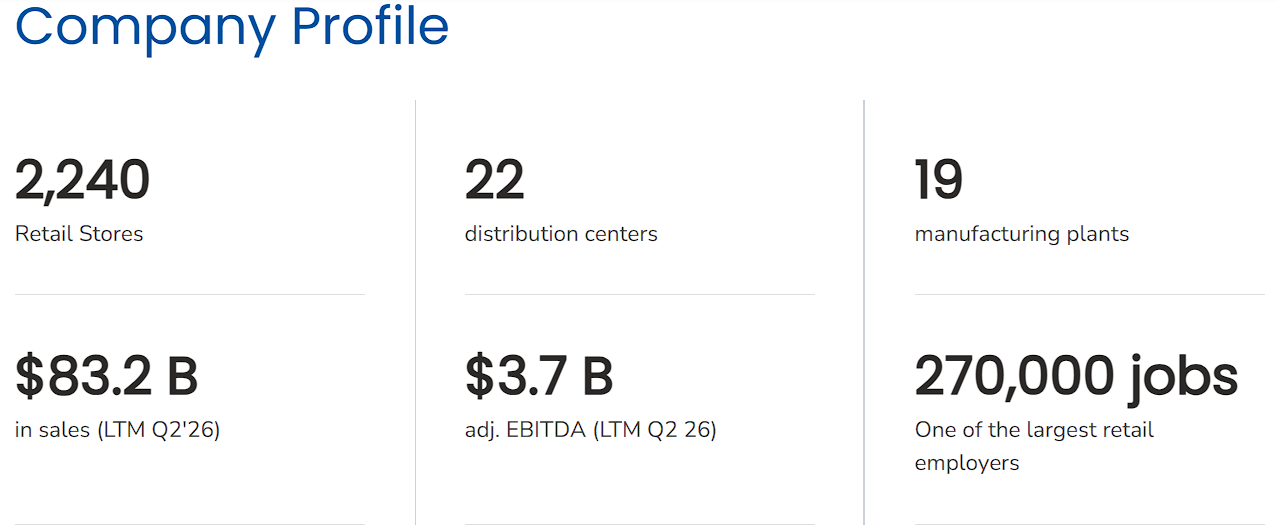
As of September 12th, 2026, it operated 2,240 stores and 1,709 in-store pharmacies across 35 states and the District of Columbia, under banners including Albertsons, Safeway, Vons, and Jewel-Osco.
On October 13th, Albertsons reported fiscal second-quarter results. Revenue declined 0.1% to $18.9 billion, and identical sales fell 0.8%.
Digital sales rose 11%, but adjusted EBITDA declined to $784 million from $848 million, and adjusted EPS fell to $0.36 from $0.44. GAAP EPS was $0.11.
Management withdrew its fiscal 2026 outlook while conducting a comprehensive business review covering customer strategy, costs, its operating model, assets, and capital allocation. It expects a refreshed financial framework and turnaround plan by the fiscal fourth-quarter earnings call.
Albertsons responded through ACI Edge, consolidating 11 operating divisions into four regions and centralizing center-store merchandising to simplify decisions and improve operating efficiency.
In September, the company appointed Meg Whitman as executive chair to support CEO Susan Morris and its operating and technology transformation.
Cody Perdue became interim CFO on September 30th following Sharon McCollam’s retirement from the role, while a permanent CFO search continues.
The board raised the quarterly dividend 13% to $0.17 in April and expanded the share-repurchase authorization to $2.0 billion.
The $0.68 annualized payout represents about 38% of our $1.80 adjusted EPS estimate. That is our forecast rather than company guidance; weaker sales and the turnaround leave meaningful operating risk.
High Dividend Stock #8: Eastman Chemical Company (EMN)
- Dividend Risk Score: C
- Dividend Yield: 5.0%
Eastman Chemical Company produces specialty materials and chemicals used in transportation, consumer products, construction, agriculture, and other markets.
Its four segments are Advanced Materials, Additives & Functional Products, Fibers, and Chemical Intermediates, providing diversification while retaining exposure to industrial cycles and raw-material costs.
On October 29th, Eastman reported third-quarter 2026 results. Sales increased 8% to $2.39 billion, driven by 7% higher selling prices and 1% higher sales volume/mix.
Adjusted earnings-per-share increased to $1.84 from $1.14 as improved asset utilization, lower maintenance costs, and favorable pricing relative to costs supported profitability.
Operating cash flow was $290 million for the quarter and $377 million through the first nine months.
Management expects full-year adjusted EPS of $6.00 to $6.20 and operating cash flow of approximately $850 million, reduced from its prior $900 million cash-flow outlook.
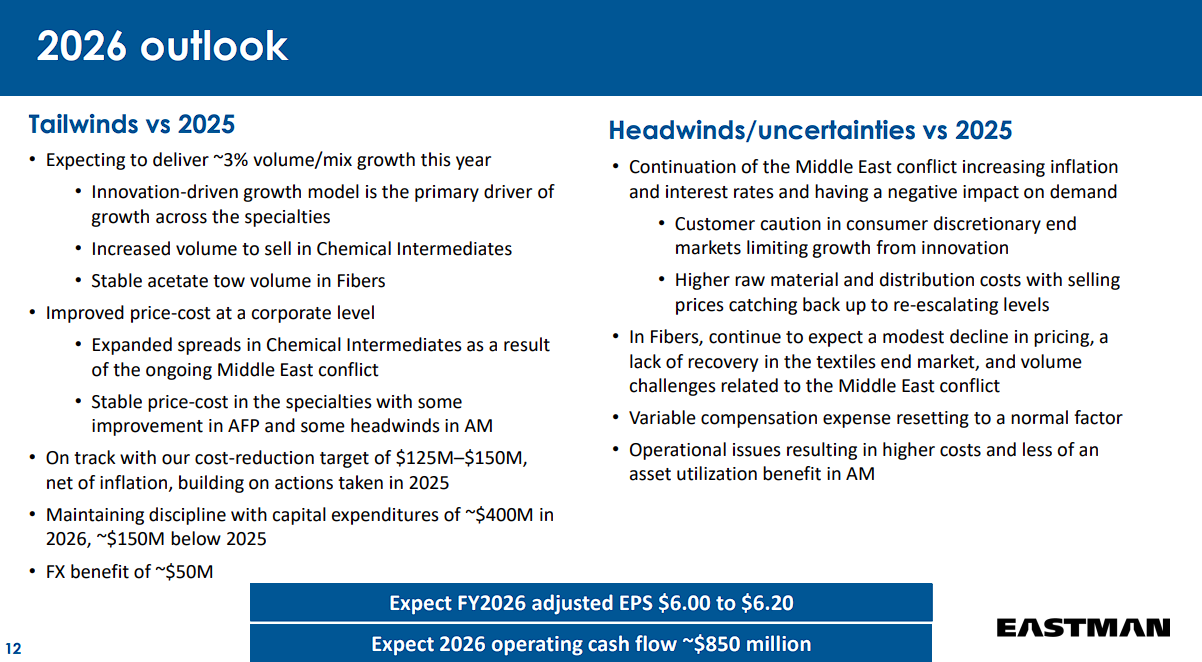
Eastman remains on track for $125 million to $150 million of cost savings, net of inflation, while a reinstated $375 million U.S. Department of Energy award supports its circular recycling platform.
Higher input costs, softer automotive and consumer-durables demand, and planned shutdowns remain important headwinds.
The $0.84 quarterly dividend, or $3.36 annually, represents approximately 55% of our $6.10 adjusted EPS estimate. Eastman has increased its dividend for 16 consecutive years.
That earnings coverage supports the income case, although cash generation and the chemical cycle warrant continued monitoring.
High Dividend Stock #7: Solvay Bank Corp. (SOBS)
- Dividend Risk Score: B
- Dividend Yield: 5.1%
Solvay Bank Corp. is the holding company for Solvay Bank, a state-chartered community bank serving Onondaga County and nearby markets in New York.
Its operations include consumer and commercial banking, trust and investment management, and insurance services, providing several sources of fee and interest income within a focused regional franchise.
On October 30th, 2026, Solvay Bank Corp.’s banking subsidiary filed its regulatory report for the nine months ended September 30th, 2026. Bank net income increased 52.2% year-over-year to $6.53 million, while net interest income rose 19.0% to $22.13 million.
Lending income increased and interest expense fell 9.3%. Noninterest income was $4.24 million, while noninterest expense rose 5.9% to $18.90 million. Results also included $930,000 of unrealized gains on equity securities.
Net loans grew 4.2% year-over-year to $766.1 million. Assets were $1.23 billion and deposits were $1.13 billion. Nine-month credit-loss provisions were $444,000, and the bank’s regulatory leverage ratio was 9.3%.
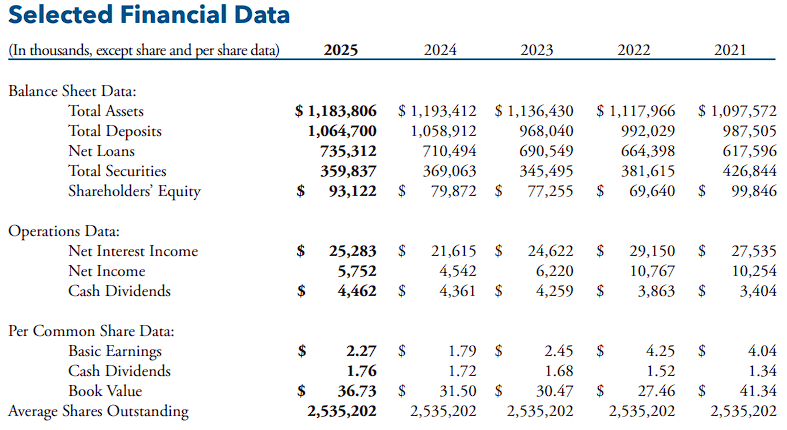
These are nine-month bank-level figures; consolidated quarterly earnings-per-share were not disclosed. Deposit costs, loan growth, credit conditions, and securities gains remain important when assessing recurring earnings and dividend coverage.
Solvay increased its quarterly dividend to $0.45 per share in 2026 from $0.44 previously, bringing the annualized payout to $1.80.
Solvay’s dividend-growth streak now stands at 35 consecutive years. The $1.80 annualized dividend represents approximately 53% of our unchanged $3.40 earnings-per-share estimate for 2026.
Investors should nevertheless account for the stock’s limited trading liquidity and relatively sparse public disclosures, which can produce wider bid-ask spreads and require careful monitoring.
High Dividend Stock #6: Hormel Foods Corporation (HRL)
- Dividend Risk Score: B
- Dividend Yield: 5.2%
Hormel Foods Corporation is a branded food producer whose portfolio includes SPAM, Planters, Jennie-O, Applegate, and Hormel-branded products.
Its mix of retail, foodservice, and international operations provides diversification, although commodity costs and cautious consumer spending can pressure margins.
For the fiscal third quarter ended July 26th, 2026, net sales were $2.96 billion and organic net sales declined 2%.
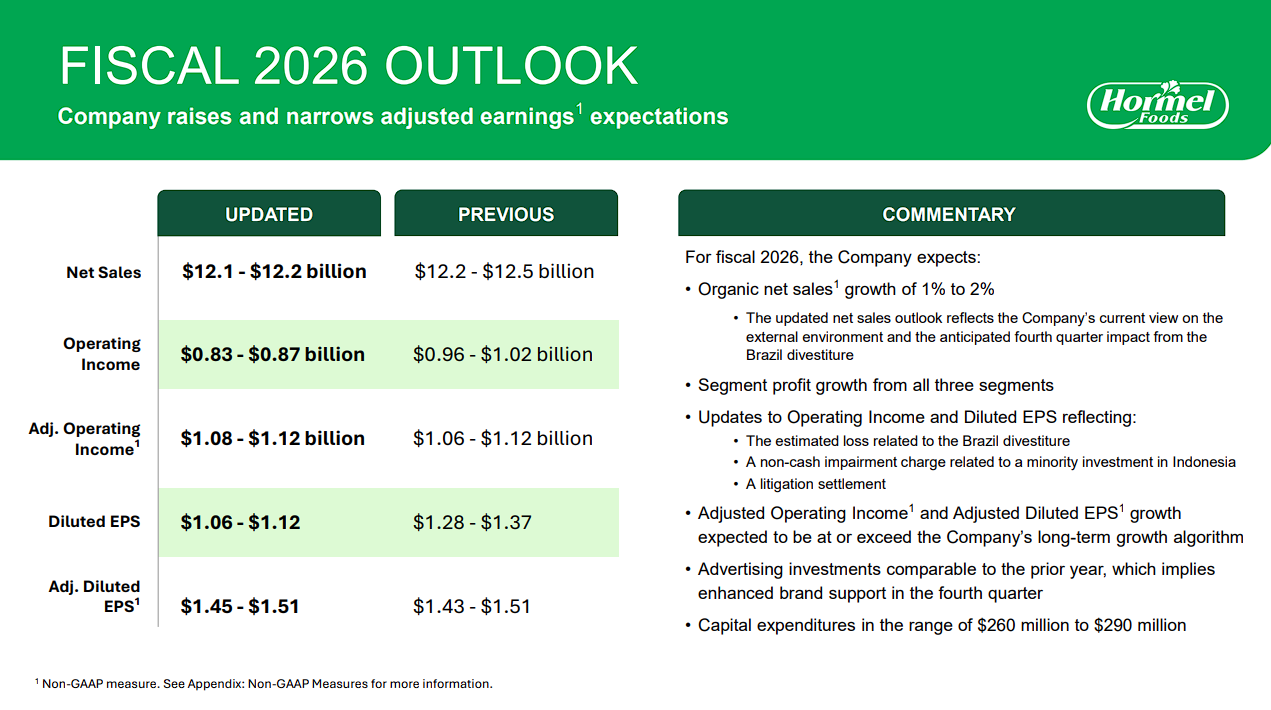
Adjusted operating income was $266 million, adjusted earnings-per-share was $0.37, and operating cash flow rose 54% to $241 million.
Foodservice organic sales increased 2%, and segment profit grew 3%, while Retail organic sales declined 3%.
Hormel raised and narrowed fiscal 2026 adjusted EPS guidance to $1.45 to $1.51, while trimming its sales outlook to $12.1 billion to $12.2 billion.
On September 30th, Hormel agreed to acquire Brakebush Brothers for approximately $1.055 billion, expanding its value-added chicken and Foodservice businesses.
The deal is expected to close in the first quarter of fiscal 2027, subject to approvals, and become accretive to adjusted EPS beginning in fiscal 2028.
John Ghingo became president and CEO on October 26th, succeeding interim CEO Jeff Ettinger following the completed sale of the Brazil business.
Hormel’s annualized dividend remains $1.17 per share after 60 consecutive years of increases. It represents approximately 78% of our $1.50 fiscal 2026 adjusted EPS estimate, making acquisition execution and earnings coverage central to the income outlook.
High Dividend Stock #5: Realty Income (O)
- Dividend Risk Score: C
- Dividend Yield: 5.5%
Realty Income is a diversified net-lease REIT known as “The Monthly Dividend Company.”
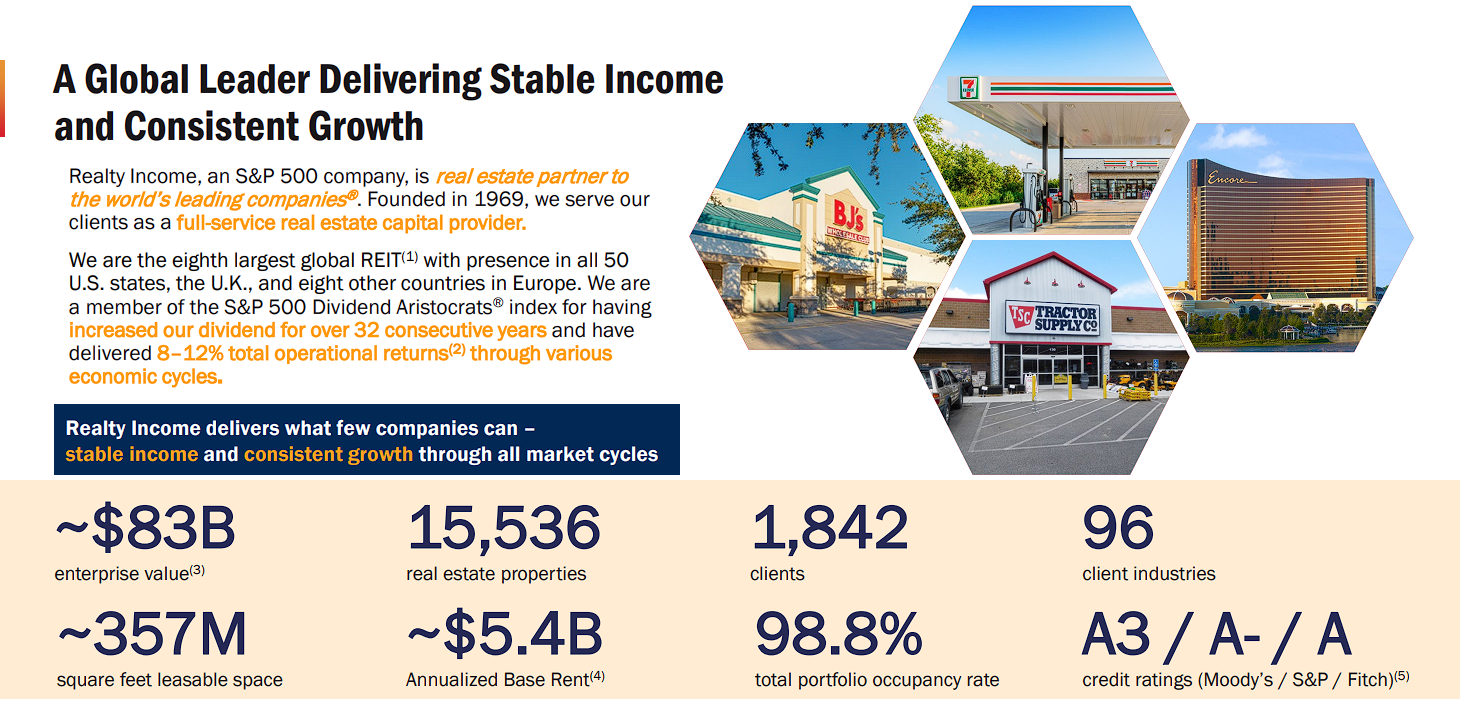
As of September 30th, it owned or held interests in 15,536 properties, with occupancy of 98.8% and a weighted-average remaining lease term of 8.5 years.
On November 2nd, Realty Income reported third-quarter 2026 results. Adjusted funds from operations increased 3.7% to $1.12 per share.
Realty Income invested $2.6 billion during the quarter, or $2.2 billion at its proportionate share, at an initial weighted-average cash yield of 6.8%.
It achieved 103.5% rent recapture on re-leased properties, while net debt to annualized pro forma adjusted EBITDAre was 5.4 times.
Management raised full-year AFFO guidance to $4.45 to $4.46 per share and maintained its $10.0 billion investment-volume outlook.
In September, Realty Income and KKR established a European joint venture in which KKR invested €528 million for a 49% interest, with Realty Income retaining 51% and managing the properties.
The venture, comprising 54 stabilized net-lease properties across four European countries, broadens its private capital funding options.
On September 8th, the board raised the monthly dividend to $0.2715, or $3.258 annually, its 136th increase since listing in 1994.
The new payout represents approximately 73% of the midpoint of AFFO guidance, while interest rates, tenant credit, and investment execution remain important risks.
Deep Dive: Click here to download (for free) our most recent 3-Page Sure Analysis PDF report on Realty Income (O).
High Dividend Stock #4: Altria Group, Inc. (MO)
- Dividend Risk Score: B
- Dividend Yield: 5.7%
Altria Group, Inc. owns the leading U.S. cigarette brand Marlboro along with Copenhagen, Skoal, on!, and NJOY.
Cigarettes still generate most of its profits, while oral nicotine and other smoke-free products are intended to offset persistent industry volume declines.
On October 29th, Altria reported third-quarter 2026 results. Revenue net of excise taxes increased 3.6% to $5.44 billion, and adjusted EPS rose 4.8% to $1.52.
Pricing and cost control supported profits despite lower cigarette and oral tobacco shipment volumes.
Management raised full-year adjusted EPS guidance to $5.66 to $5.74, implying growth of 4.5% to 6.0%, and the board expanded its share-repurchase program by $1 billion.
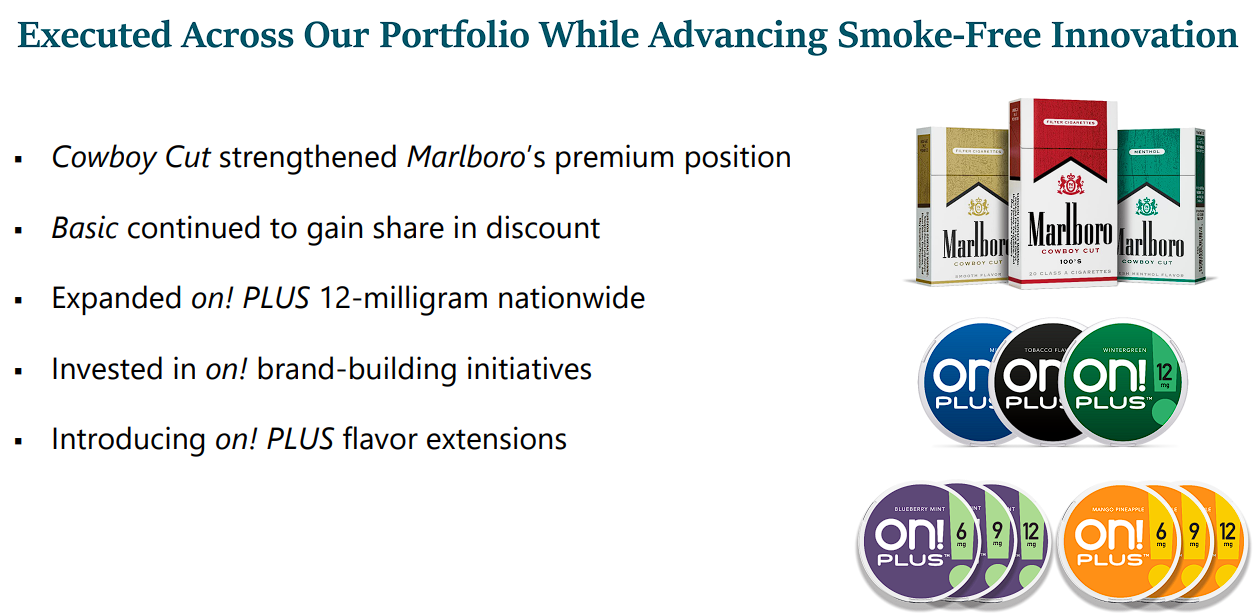
Altria is expanding on! PLUS nationally, although NJOY ACE is still not expected to return in 2026.
In August, Philip Morris USA announced a contract manufacturing arrangement with overseas Philip Morris International affiliates, with initial shipments expected in early 2027 and no material 2026 financial impact.
Helix has expanded on! PLUS with new flavors and nicotine strengths, while litigation and product authorization requirements continue to create regulatory uncertainty for smoke-free expansion.
In August, the board increased the quarterly dividend 4.7% to $1.11 per share, lifting the annualized payout to $4.44.
That was Altria’s 61st dividend increase in 57 years.
The annualized dividend consumes approximately 78% of the midpoint of adjusted EPS guidance, leaving pricing power and continued cash generation essential to sustaining income.
Deep Dive: Click here to download (for free) our most recent 3-Page Sure Analysis PDF report on Altria Group, Inc. (MO).
High Dividend Stock #3: Edison International (EIX)
- Dividend Risk Score: C
- Dividend Yield: 5.7%
Edison International is the parent of Southern California Edison, which supplies electricity to roughly 15 million people across Southern, Central, and Coastal California.
The company disposed of its smaller, nonregulated Trio advisory business during the second quarter of 2026.
On October 29th, Edison reported third-quarter 2026 net income of $724 million, or $1.88 per share, compared with $832 million, or $2.16 per share, a year earlier.
Core earnings declined to $738 million, or $1.92 per share, from $901 million, or $2.34 per share.
The decline primarily reflected the comparison with retroactive revenue recognized in the third quarter of 2025 when Southern California Edison implemented its general rate case decision.
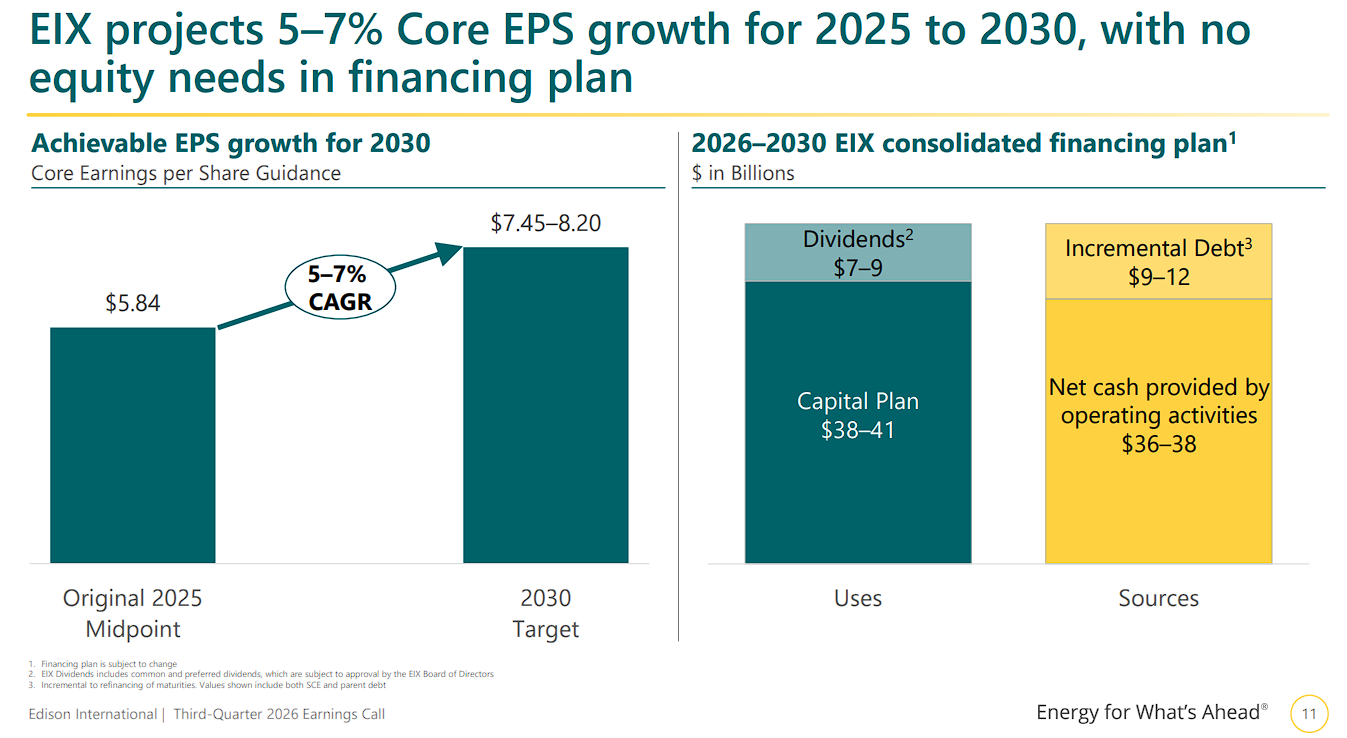
Management reaffirmed 2026 core EPS guidance of $5.90 to $6.20 and its longer-term target of 5% to 7% annual core EPS growth through 2030.
Wildfire exposure remains the central risk. As of October 30th, Southern California Edison reported about $1.1 billion in Eaton Fire compensation offers and more than $625 million paid through its recovery program.
Nearly 17,000 individuals, trusts, and legal entities were represented in submitted claims. These program figures do not establish the ultimate liability, and durable wildfire liability reform remains unresolved.
SCE recorded $1.8 billion of Eaton Fire settlement losses through September, alongside expected recoveries from self-insurance, the Wildfire Fund, and electric rates. It considers additional material losses probable but cannot reasonably estimate a range.
Edison’s $0.8775 quarterly dividend represents 23 consecutive years of growth, but the C Dividend Risk Score appropriately recognizes the unusually significant liability and regulatory risks.
High Dividend Stock #2: NNN REIT, Inc. (NNN)
- Dividend Risk Score: C
- Dividend Yield: 6.0%
NNN REIT, Inc. owns a large portfolio of single-tenant properties leased primarily under long-term triple-net agreements.
Tenants generally pay property taxes, insurance, and maintenance, keeping NNN’s recurring capital requirements relatively low and supporting predictable cash flow.
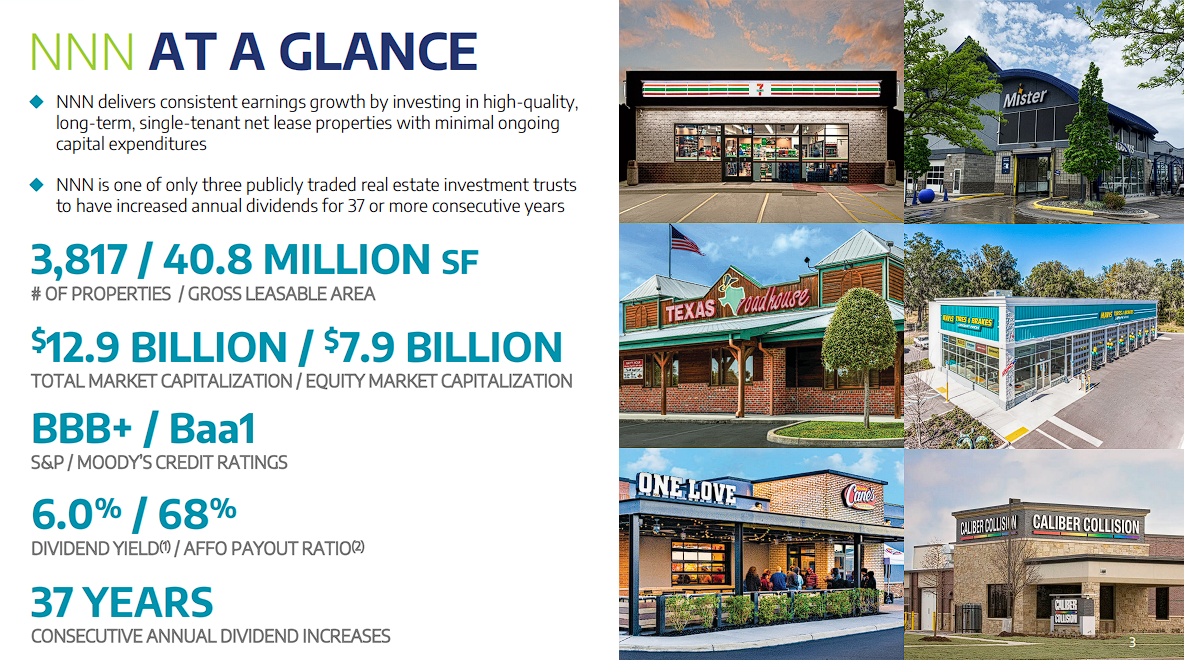
On November 4th, NNN reported third-quarter 2026 results. Adjusted funds from operations increased 5.8% to $0.91 per share, while core FFO rose 5.9% to $0.90.
Occupancy improved to 99.2% across 3,817 properties. The REIT completed $222 million of investments at a 7.3% initial cash cap rate and a 19.6-year weighted-average lease term.
Management maintained 2026 AFFO guidance of $3.55 to $3.59 per share and its $700 million to $800 million acquisition target, while increasing expected dispositions to $160 million to $180 million.
The company had approximately $1.4 billion of available liquidity and a weighted-average debt maturity of 9.8 years, supporting flexibility as it expands the portfolio.
In July, NNN raised its quarterly dividend 3.3% to $0.62 per share.
That marked its 37th consecutive annual dividend increase, a record matched by very few publicly traded REITs.
High occupancy, long leases, disciplined acquisition yields, and a long dividend record strengthen the income case, although interest rates and tenant credit remain important risks.
Deep Dive: Click here to download (for free) our most recent 3-Page Sure Analysis PDF report on NNN REIT, Inc. (NNN).
High Dividend Stock #1: Enterprise Products Partners L.P. (EPD)
- Dividend Risk Score: C
- Dividend Yield: 6.1%
Enterprise Products Partners L.P. is one of the largest publicly traded midstream partnerships.
Its integrated system of pipelines, processing plants, fractionators, storage facilities, and export terminals earns primarily fee-based cash flows by transporting and handling natural gas, natural gas liquids, crude oil, refined products, and petrochemicals.
On October 29th, Enterprise reported third-quarter 2026 results. Net income attributable to common unitholders was $1.6 billion, or $0.75 per diluted unit, up 21% per unit.
Adjusted EBITDA rose 16% to $2.8 billion, while operational distributable cash flow increased 27% to $2.3 billion and covered the quarterly distribution 1.9 times.
Co-CEO Jim Teague plans to retire on January 4th, 2027, when Randy Fowler will become sole CEO.
The quarterly distribution remained $0.56 per unit, or $2.24 annualized, up 2.8% from a year earlier. Enterprise repurchased $112 million of units and retained $1.1 billion of operational distributable cash flow during the quarter.
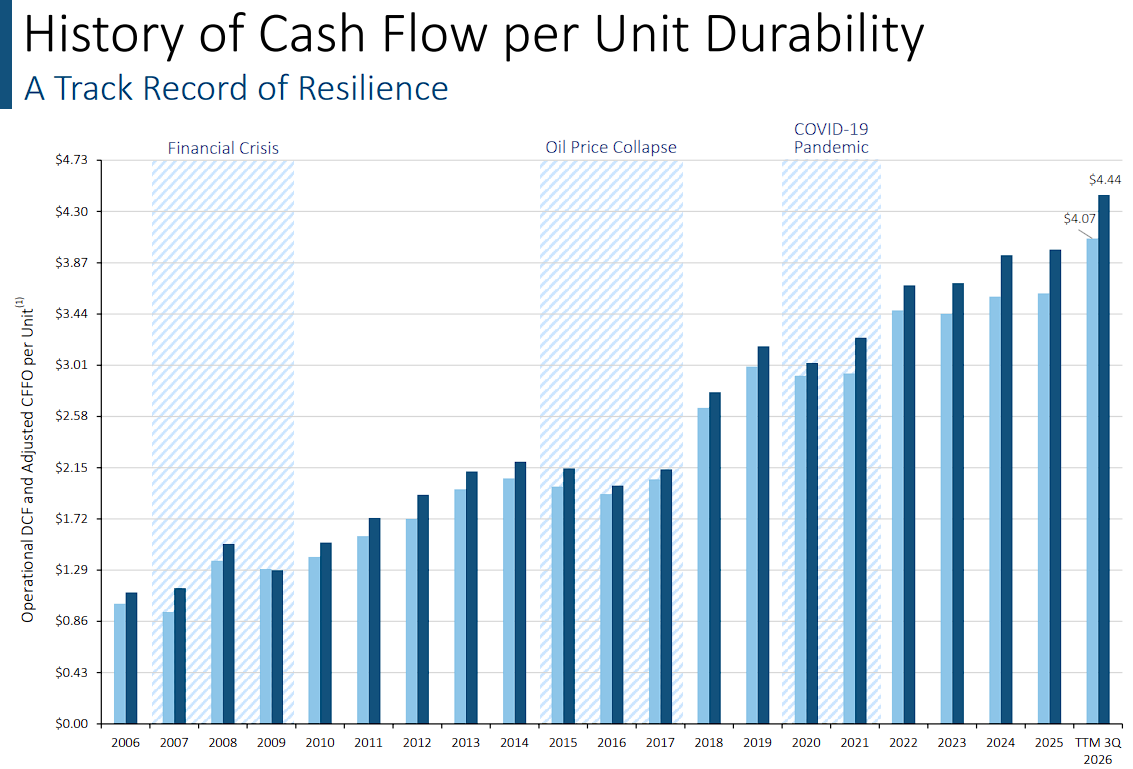
Enterprise has increased its distribution for 29 consecutive years, supported by its integrated asset network and fee-based cash generation.
Management expects 2026 growth capital spending of $2.9 billion to $3.4 billion, net of asset-sale proceeds.
The partnership has $6.3 billion of growth projects under construction, scheduled to enter service through 2028. These projects support its cash-flow outlook, while the 1.9-times coverage ratio provides a cushion for the current distribution.
The High Dividend 50 Series
The High Dividend 50 Series includes download links for our most recent publicly available Sure Analysis PDF Reports for the 50 highest-yielding Sure Analysis Research Database securities.
Securities are organized by yield, from highest to lowest.
- Prospect Capital Corp. (PSEC)
- Invesco Mortgage Capital Inc. (IVR)
- Orchid Island Capital Inc. (ORC)
- ARMOUR Residential REIT Inc. (ARR)
- Saratoga Investment Corp. (SAR)
- Oxford Square Capital Corp. (OXSQ)
- Dynex Capital, Inc. (DX)
- BCP Investment Corporation (BCIC)
- Horizon Technology Finance Corp. (HRZN)
- CION Investment Corporation (CION)
- AGNC Investment Corp. (AGNC)
- PennantPark Investment Corporation (PNNT)
- PermRock Royalty Trust (PRT)
- Timbercreek Financial Corp. (TBCRF)
- Stellus Capital Investment Corp. (SCM)
- PennantPark Floating Rate Capital Ltd. (PFLT)
- Innovative Industrial Properties Inc. (IIPR)
- Ellington Financial Inc. (EFC)
- Himalaya Shipping Ltd. (HSHP)
- NexPoint Residential Trust Inc. (NXRT)
- Trinity Capital Inc. (TRIN)
- Gladstone Commercial Corp. (GOOD)
- MSC Income Fund, Inc. (MSIF)
- SIR Royalty Income Fund (SIRZF)
- FinVolution Group (FINV)
- Banco Bradesco S.A. (BBD)
- Hess Midstream LP (HESM)
- Capital Southwest Corp. (CSWC)
- Permianville Royalty Trust (PVL)
- Gladstone Capital Corp. (GLAD)
- Oxford Industries, Inc. (OXM)
- True North Commercial REIT (TUERF)
- Firm Capital Mortgage Investment Corp. (FCMGF)
- Nexus Industrial REIT (EFRTF)
- Western Midstream Partners, LP (WES)
- Delek Logistics Partners, LP (DKL)
- Blue Owl Capital Inc. (OWL)
- Universal Corp. (UVV)
- Atrium Mortgage Investment Corporation (AMIVF)
- BTB Real Estate Investment Trust (BTBIF)
- Gaming and Leisure Properties Inc. (GLPI)
- Itau Unibanco Holding S.A. (ITUB)
- Amerisafe Inc (AMSF)
- Pizza Pizza Royalty Corp. (PZRIF)
- Artisan Partners Asset Management Inc. (APAM)
- Gladstone Land Corp (LAND)
- Silvercrest Asset Management Group Inc. (SAMG)
- Universal Health Realty Income Trust (UHT)
- Virtus Investment Partners, Inc. (VRTS)
- MPLX LP (MPLX)
Final Thoughts
The ranking shows why a high starting yield must be considered alongside the source and durability of the underlying cash flow.
Enterprise Products now leads the shortlist, followed by NNN, while Edison International and Altria offer similar yields with very different risk profiles centered on wildfire liabilities and tobacco regulation, respectively.
Enterprise Products, Realty Income, and NNN rely more heavily on contracted or lease-based cash flows, whereas Hormel and Albertsons depend on consumer demand, pricing, and operating execution.
Eastman Chemical adds exposure to specialty materials and the chemical cycle, while Solvay Bank provides locally focused income with greater trading-liquidity and concentration considerations, and Sonoco adds exposure to packaging demand and debt reduction.
Dividend Risk Scores of C or better provide a useful first screen, but they do not eliminate payout, valuation, interest-rate, regulatory, or company-specific risk.
The separate High Dividend 50 list illustrates this point even more clearly, as its highest yields include mortgage REITs, BDCs, royalty trusts, foreign securities, and other structures whose distributions may fluctuate substantially.
Comparing payout coverage, balance-sheet strength, business cyclicality, and the latest company developments remains essential before relying on any headline yield.
Other Sure Dividend Resources
- Dividend Kings: 50+ years of rising dividends
- Dividend Champions: 25+ years of rising dividends
- Dividend Aristocrats: 25+ years of rising dividends and in the S&P 500
- Monthly Dividend Stocks: Individual securities that pay out every month
- Royalty Stocks: Detailed royalty stocks list
- MLPs: Detailed MLP list
- REITs: Detailed REIT list
- BDCs: Detailed BDC list