Published on October 17th, 2025 by Felix Martinez
High-yield stocks with dividend yields above 5% are appealing to income investors. However, not all high-dividend stocks are created equally.
Some have secure dividend payouts, but others are in questionable financial condition, leaving shareholders vulnerable to a dividend cut in a downturn.
With this in mind, we created a complete list of high-dividend stocks.
Mesa Royalty Trust (MTR) is part of our ‘High Dividend 50’ series, where we cover the 50 highest-yielding stocks in the Sure Analysis Research Database.
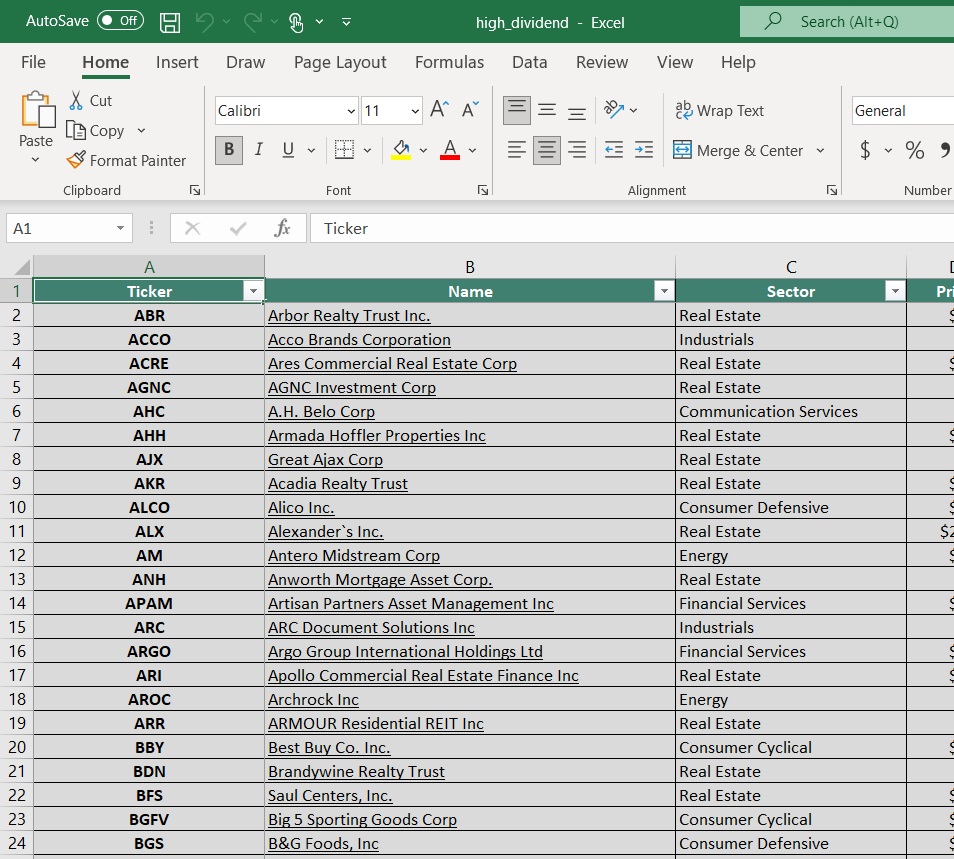
You can download your free full list of all high dividend stocks with 5%+ yields (along with important financial metrics such as dividend yield and payout ratio) by clicking on the link below:
Mesa Royalty Trust (MTR) has reinstated its monthly dividend. This could make the stock more attractive to income investors seeking more frequent dividend payouts.
This article will provide a detailed analysis of Mesa Royalty Trust.
Business Overview
Mesa Royalty Trust was formed in 1979 and is based in Houston, Texas. It holds overriding royalty interests in natural gas and oil properties in the Hugoton field of Kansas and the San Juan Basin of New Mexico and Colorado.
The Trust does not operate the assets; it receives 11.44% of 90% of the net proceeds from production on these properties after operating and marketing costs, with the interests managed and developed by third-party working interest owners such as Hilcorp San Juan LP, Scout Energy Group, Simcoe LLC, and Red Willow Production Company.
The Trust has a market cap of just $9.4 million.
On August 14, 2025, Mesa Royalty Trust released its Q2 results for the quarter ended June 30, 2025. The Trust reported distributable income of $0.105 per unit before reserve adjustments, which, after adjustments to the contingent reserve, translated into $0.0946 per unit actually distributed, down from $0.1125 per unit a year earlier.
Royalty income of $220,855 came entirely from the San Juan Basin – New Mexico properties operated by Hilcorp, while the Hugoton and San Juan, with Colorado properties again generating no net proceeds because costs topped revenues.
Excess production costs rose to $933,830, an increase from $793,838 at year-end 2024, and must be recovered before cash flow from those properties can resume. We believe the company has an earnings power of $0.80.
Growth Prospects
Mesa Royalty Trust’s performance over the past decade has closely tracked commodity prices, production declines, and operator costs in its Hugoton and San Juan Basin properties. Distributable EPU fell in 2016 amid weak gas prices but rebounded to $1.58 in 2017 as prices improved. Payouts softened in 2018–2019, coinciding with a shift in Hugoton operations from Riviera to Scout Energy.
The COVID-19 downturn in 2020 led to EPU dropping to $0.30, further exacerbated by high excess production costs. A modest recovery occurred in 2021, followed by strong distributions of $1.98 and $1.53 per unit in 2022–2023, as natural gas and NGL prices surged. Momentum faded in 2024, with lower commodity prices and higher costs reducing payouts to $0.25 per unit.
Competitive Advantages
The company possesses several competitive advantages that support its long-term income potential and appeal to investors seeking steady cash flow. One of its primary strengths lies in its exposure to proven, low-cost natural gas and oil properties located in established U.S. basins.
These assets are operated by experienced energy companies, enabling MTR to benefit from efficient production without assuming the operational or capital risks typically associated with exploration and development. The trust’s structure also provides tax-efficient pass-through income, making it attractive to income-focused investors.
Additionally, MTR maintains minimal overhead costs, as it has no employees or active management team—ensuring that nearly all revenue generated from royalties flows directly to unitholders. While its production volumes and distributions are inherently tied to commodity prices, the trust’s conservative structure and lack of debt provide stability and resilience during industry downturns.
Dividend Analysis
Mesa Royalty Trust distributes nearly all its cash flow, which is expected since the trust’s purpose is to pass through net proceeds after operating costs. However, this makes distributions highly volatile—rising in strong commodity markets and falling when prices decline. The trust owns long-lived natural gas interests in the Hugoton and San Juan basins, but reserves are steadily depleting, and it cannot acquire new assets.
Mesa has no real competitive advantage or operational control, though its debt-free structure offers clean exposure to natural gas prices. Its cash flow and valuation metrics, such as the P/E ratio, swing sharply with commodity cycles. Given annual reserve declines of 4–6%, a P/E near 7 seems fair, reflecting both depletion and volatility. Shares currently yield about 4.5%.
With expected returns driven by a 14.5% yield and roughly -2% annual growth, total returns of about 12.5% appear achievable. Still, high risk and income volatility make Mesa Royalty Trust a sell for most investors.
Final Thoughts
Mesa Royalty Trust can be an appealing vehicle for investors seeking pure, unleveraged exposure to natural gas prices and pass-through cash flow, with the simplicity of a debt-free structure and a direct link between commodity cycles and distributions.
However, it is not a long-term investment, as the Trust has no reinvestment ability, no operational control, and steadily declining reserves that guarantee shrinking payouts over time.
If you are interested in finding high-quality dividend growth stocks and/or other high-yield securities and income securities, the following Sure Dividend resources will be useful:
High-Yield Individual Security Research
- 20 Highest Yielding Monthly Dividend Stocks
- 10 Super High Dividend REITs
- 5 Highest Yielding Royalty Trusts
Other Sure Dividend Resources
- Dividend Champions: 25+ years of rising dividends
- Dividend Aristocrats: 25+ years of rising dividends and in the S&P 500
- Dividend Kings: 50+ years of rising dividends
- Dividend Achievers: 10+ years of rising dividends and in the NASDAQ
- Monthly Dividend Stocks: Individual securities that pay out every month
- MLP List
- REIT List
- BDC List