Updated on February 24th, 2026 by Felix Martinez
Each year, we individually review each of the Dividend Aristocrats, a group of 69 stocks in the S&P 500 Index that have raised their dividends for at least 25 consecutive years.
To make it on the list of Dividend Aristocrats, a company must possess a profitable business model with a valuable brand, global competitive advantages, and the ability to withstand recessions. This is why Dividend Aristocrats can continue raising dividends in difficult years.
With this in mind, we have created a list of all 69 Dividend Aristocrats.
You can download your free copy of the Dividend Aristocrats list, along with important financial metrics such as price-to-earnings ratios and dividend yields, by clicking on the link below:
Disclaimer: Sure Dividend is not affiliated with S&P Global in any way. S&P Global owns and maintains The Dividend Aristocrats Index. The information in this article and downloadable spreadsheet is based on Sure Dividend’s own review, summary, and analysis of the S&P 500 Dividend Aristocrats ETF (NOBL) and other sources, and is meant to help individual investors better understand this ETF and the index upon which it is based. None of the information in this article or spreadsheet is official data from S&P Global. Consult S&P Global for official information.
Caterpillar Inc. (CAT) joined the Dividend Aristocrats list in 2019. Even more impressive is that Caterpillar operates in a highly cyclical industry, which typically prevents companies from maintaining long histories of annual dividend increases.
However, Caterpillar’s management team has proven its commitment to returning cash to shareholders even through the inevitable ebbs and flows of the business over the years. Caterpillar also has durable competitive advantages that allow it to raise its dividend each year, even through downturns in the global economy.
Business Overview
Caterpillar was founded in 1925 and today competes in the manufacturing and selling of construction and mining equipment. The company also manufactures ancillary industrial products, including diesel engines and gas turbines. Caterpillar stock has a market capitalization of ~$351 billion, making it one of the largest industrial stocks in the world.
Industrial manufacturers benefited from strong demand in 2022 and 2021, which fueled growth and spurred global economic activity off the low base established in 2020 amid the pandemic.
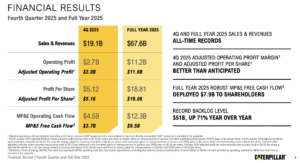
On January 29th, 2026, Caterpillar delivered strong fourth-quarter 2025 results, with sales rising 18% year over year to $19.1 billion, driven primarily by higher equipment demand across construction, mining, and energy markets.
Adjusted EPS reached $5.16, slightly above the prior year, while operating margins declined to 13.9% due to higher manufacturing and restructuring costs, including tariff impacts. Growth was led by the Power & Energy segment, where sales increased 23%, supported by oil & gas activity and data-center power generation demand.
For full-year 2025, revenue increased 4% to a record $67.6 billion, while adjusted EPS totaled $19.06, down from $21.90 in 2024, as margins normalized from peak-cycle levels. Despite lower profitability, Caterpillar generated $11.7 billion in enterprise operating cash flow and ended the year with $10.0 billion in cash, returning $7.9 billion to shareholders through dividends and share repurchases. Equipment sales volume remained the primary growth driver, partially offset by weaker price realization.
Looking ahead, Caterpillar enters 2026 with a record backlog and strong end-market demand, particularly in infrastructure, energy, and electrification-related projects.
Continued investment in power generation, mining equipment, and services revenue positions the company for stable long-term growth, although margins may remain pressured in the near term by input costs and restructuring actions.
Source: Investor Presentation
Growth Prospects
Caterpillar is closely tied to global economic growth and commodity prices. Its customers extract resources from the earth and build and construct a wide variety of structures, so economic growth is key to funding that development.
This leads to fairly extreme cyclicality in Caterpillar’s results, with the stock swinging wildly across the extremes of the sentiment scale.
The coronavirus pandemic weighed heavily on the company, but the ensuing global economic recovery enabled Caterpillar to become highly profitable in 2021 and 2022. Caterpillar is offsetting higher manufacturing costs with higher prices.
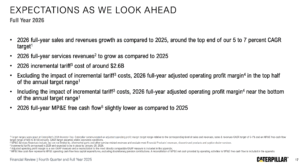
We forecast $22.65 in earnings per share for 2026, with a 16% annual growth rate over the next five years.
Source: Investor Presentation
Competitive Advantages & Recession Performance
Competitive advantages in industrial applications can be challenging, given that some competitors make similar products for most applications.
However, over the years, Caterpillar has become one of the most significant players in lucrative end markets, including construction, energy, and mining.
Its global presence affords it some diversification of revenue by segment and industry, as well as geographically, which has served it well in recent years. Its scale also allows it to leverage down variable costs per unit, boosting margins.
However, Caterpillar is certainly not immune to recessions, as global economic slowdowns are generally accompanied by lower commodity prices and slower construction spending.
These factors took a major toll on Caterpillar’s bottom line during the Great Recession, as its earnings were devastated, if only briefly.
Caterpillar’s earnings-per-share during the Great Recession are below:
- 2007 earnings-per-share of $5.32
- 2008 earnings-per-share of $5.71 (7% increase)
- 2009 earnings-per-share of $1.43 (75% decline)
- 2010 earnings-per-share of $4.15 (190% increase)
While Caterpillar certainly felt the pain of the Great Recession, its earnings rebounded fairly quickly, and it reclaimed its pre-recession earnings-per-share level in 2011.
Caterpillar also experienced a large decline in earnings per share in 2020 due to the coronavirus pandemic, but recovered strongly since then in a short period of time.
Therefore, Caterpillar is clearly exposed to recessions due to the economic bellwether nature of the heavy machinery industry. But it also has a history of recovering from downturns fairly quickly.
Valuation & Expected Returns
Caterpillar’s current price-to-earnings ratio is 33.9x, based on the 2026 expected EPS of $22.65. This is an elevated valuation level for Caterpillar. Since 2013, Caterpillar’s shares have traded with an average P/E ratio of about 17x. We believe 25x is a reasonable, fair value estimate for Caterpillar, given its cyclical business and vulnerability to recessions and the current rising rate environment.
Periods of cyclicality are normal for Caterpillar’s valuation. Still, the stock appears overvalued. A declining P/E multiple could reduce future returns; if the P/E multiple declines from 33.9x to 25x over the next five years, it would lower annual returns slightly.
Another negative aspect of stocks with elevated valuations is that they often have lower dividend yields. As Caterpillar’s share price has risen in the past year, its dividend yield has declined to 0.8%. Dividends and earnings-per-share growth (expected to grow at 16% per year) will add to shareholder returns, but the stock’s overvaluation is a hurdle.
Based upon the factors discussed above, we see total returns of 11.8% per year. This leads us to rate Caterpillar a hold today.
Final Thoughts
Caterpillar stock continues its impressive rise, up over 190% in the past year, compared with the S&P 500 index’s gain. Results in 2026 are expected to be higher. While the stock is trading above its average PE and our fair value estimate, it is severely overvalued.
Caterpillar has an industry-leading brand and a positive long-term growth outlook, but we feel the stock has become overpriced amid the rally since the pandemic lows. With an expected future return in the low-double digits, we rate the stock a hold. Investors may be better off waiting for a decline in the share price.
Further reading: See analysis on our favorite agriculture stocks.
Additionally, the following Sure Dividend databases contain the most reliable dividend growers in our investment universe:
- The Dividend Contenders List: 10-24 consecutive years of dividend increases.
- The Dividend Challengers List: 5-9 consecutive years of dividend increases.
- The Dividend Champions: Dividend stocks with 25+ years of dividend increases, including those that may not qualify as Dividend Aristocrats.
- The Dividend Achievers: dividend stocks with 10+ years of consecutive dividend increases.
- The Dividend Kings: considered to be the ultimate dividend growth stocks, the Dividend Kings list is comprised of stocks with 50+ years of consecutive dividend increases
If you’re looking for stocks with unique dividend characteristics, consider the following Sure Dividend databases:
- The Complete List of Monthly Dividend Stocks: stocks that pay dividends each month, for 12 payments over the year.
- The Blue Chip Stocks List: this database contains stocks that qualify as either Dividend Achievers, Dividend Aristocrats, or Dividend Kings.