Updated on March 11th, 2026 by Nathan Parsh
Sherwin-Williams (SHW) is a legendary dividend growth stock. It has increased its dividend for 47 consecutive years, putting it in a very rare company when it comes to raising payouts to shareholders.
As a member of the Dividend Aristocrats, Sherwin-Williams is one of just 69 S&P 500 stocks that have raised their dividends each year for 25+ years.
We believe the Dividend Aristocrats are excellent stocks for generating steadily rising passive income over time. With this in mind, we created a list of all 69 Dividend Aristocrats.
You can download the full Dividend Aristocrats list, with important metrics like dividend yields and price-to-earnings ratios, by clicking on the link below:

Disclaimer: Sure Dividend is not affiliated with S&P Global in any way. S&P Global owns and maintains The Dividend Aristocrats Index. The information in this article and downloadable spreadsheet is based on Sure Dividend’s own review, summary, and analysis of the S&P 500 Dividend Aristocrats ETF (NOBL) and other sources, and is meant to help individual investors better understand this ETF and the index upon which it is based. None of the information in this article or spreadsheet is official data from S&P Global. Consult S&P Global for official information.
Sherwin-Williams stands out because of its remarkable rate of dividend growth. Even better, the company shows no sign of slowing down. It has frequently increased its dividend by double-digits on a percentage basis.
Sherwin-Williams’ sizable dividend growth forecast makes it an appealing stock to dividend growth investors. However, an elevated valuation makes the stock less attractive on a valuation basis.
This article will analyze the investment prospects of Sherwin-Williams in greater detail.
Business Overview
Sherwin-Williams is the world’s second-largest manufacturer of paints and coatings. The company distributes its products through wholesalers as well as retail stores. Sherwin-Williams was founded in 1866 and has grown to a company with annual sales approaching $24 billion.
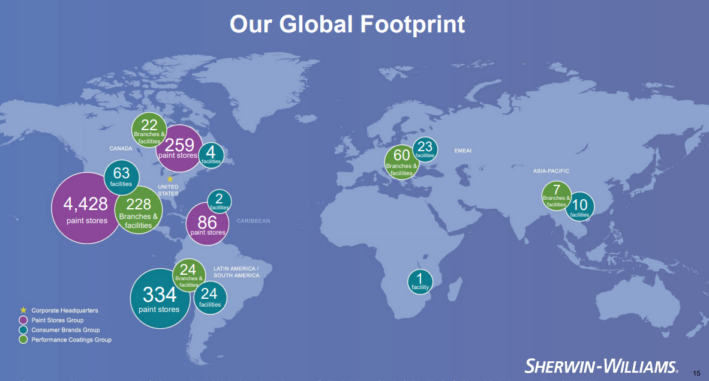
The company distributes its products through wholesalers and retail stores with the Sherwin-Williams name. Its only competitor of comparable size is fellow Dividend Aristocrat PPG Industries (PPG). The company has a very large global footprint.
Source: Investor Presentation
Sherwin-Williams is certainly a market leader. The company became significantly larger after its acquisition of Valspar in 2017. The Valspar merger was transformative for Sherwin-Williams.
Post-merger, Sherwin-Williams is a much more diversified company than it was prior to the Valspar purchase. Management believes it can deliver strong earnings-per-share growth with less volatility and variability in earnings.
On January 29th, 2026, Sherwin-Williams released financial results for the fourth-quarter and full fiscal year 2025. For the quarter, revenue grew 5.6% to $5.6 billion. Diluted net income per share grew 1.1% to $1.92 while adjusted earnings-per-share of $2.23 compared favorably to $2.09 in the same period of 2024. Gross margin declined 10 basis points to 48.6%.
The company reported record 2025 net sales of $23.6 billion, an increase of 2.1% from the prior year. Same-store sales in the Paint Stores Group open more than one year rose 1.7%. Diluted net income per share decreased 2.7% to $10.26, while adjusted earnings increased 0.9% to $11.43. The company generated $3.45 billion in operating cash during the year and returned $2.4 billion to shareholders through share repurchases and dividends.
For 2026, Sherwin-Williams expects adjusted earnings of $11.50 to $11.90. While navigating market fluctuations, the company remains focused on margin expansion, cash flow generation, and shareholder returns.
Growth Prospects
Sherwin-Williams has grown at strong rates over the past couple of years. The Valspar acquisition helped drive significant top-line expansion, as did the strong performance of the U.S. housing market.
Looking ahead, Sherwin-Williams stands to benefit from broad-based demand for its products, especially in the international markets. Demand for Sherwin-Williams products is expected to grow rapidly in Asia-Pacific.
In addition, the company has a scale that is unlike any of its competitors in Latin America and North America. There is still plenty of growth potential in its more mature markets, but the Valspar acquisition helped expedite expansion into Asia-Pacific, where the company is relatively small.
The strong U.S. housing market is an additional growth catalyst. Low unemployment and rising home values are continued tailwinds for Sherwin-Williams, although a return to a rising interest rate cycle could put a dent in the company’s growth.
Still, management is optimistic about the company’s future outlook, as industry fundamentals support growth.
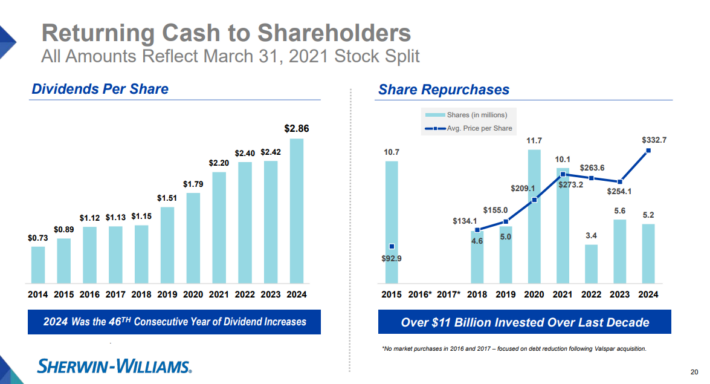
Revenues are just one component of Sherwin-Williams’ future growth in earnings-per-share. The company generates excess cash flow, which it can use to repurchase shares yearly, thereby boosting EPS.
Sherwin-Williams has plenty of opportunities to grow its sales and earnings for the foreseeable future. The company has a broad and deep portfolio of popular brands with high margins and a favorable sales growth outlook.
In short, even though Sherwin-Williams is the dominant player in its sector, it still has a long runway for growth. Overall, we expect 7% annual earnings-per-share growth in the next five years.
Source: Investor Presentation
Competitive Advantages & Recession Performance
Sherwin-Williams is not a recession-resistant Dividend Aristocrat. The company’s performance depends on a healthy U.S. and international housing market, which is the underlying driver of paint and coatings sales.
Sherwin-Williams has a high level of leverage in construction markets and new buildings, which need many coating products.
However, the company has a silver lining during recessions. We believe homeowners are more likely to repaint their houses than to move completely or take on more costly repairs during a recession.
On balance, recessions negatively impact Sherwin-Williams’ earnings. This can be seen by looking at the company’s performance during the 2007-2009 financial crisis:
- 2007 adjusted earnings-per-share: $4.70
- 2008 adjusted earnings-per-share: $4.00 (15% decline)
- 2009 adjusted earnings-per-share: $3.78 (5.5% decline)
- 2010 adjusted earnings-per-share: $4.21 (11% increase)
It took Sherwin-Williams’ earnings three full years to recover from its Great Recession lows; however, the company remained profitable and continued to raise its dividend (which is why it remains a Dividend Aristocrat today).
We expect the dividend increase streak will continue during the next recession, but investors should note that its earnings, and therefore the share price, will likely see meaningful declines in a downturn.
Valuation & Expected Total Returns
Sherwin-Williams has many of the characteristics of a high-quality business, and it is valued at a premium. The stock trades with a price-to-earnings multiple of 27.5, based on its 2026 earnings-per-share estimate of $11.70, which compares to our fair value multiple of 23.0.
That implies a ~3.5% annual reduction in shareholder returns in the next five years.
Separately, we expect 7% annual EPS growth for Sherwin-Williams. The stock also has a secure dividend, which results in a yield of 1.0% right now. This results in annual expected returns of 4.4% over the next five years.
The unfavorable valuation makes the stock overvalued. The dividend yield is still relatively low. However, the high dividend growth rate makes the stock attractive for long-term investors. The dividend is also very safe, with a projected 2026 payout ratio of just 27%.
Final Thoughts
Sherwin Williams’ acquisition of Valspar created compelling growth opportunities for this high-quality dividend growth stock. The company should continue to grow its revenue, earnings, and dividends at a high rate over the next several years, barring a major recession.
However, the valuation is too high to warrant a buy recommendation at this time. This is a typical example of a great business trading at a not-so-great price.
We think there is a lot of growth ahead, along with continued dividend increases each year, but the very high valuation could negatively impact shareholder returns. We rate Sherwin-Williams a hold right now.
Additionally, the following Sure Dividend databases contain the most reliable dividend growers in our investment universe:
- The Dividend Contenders List: 10-24 consecutive years of dividend increases.
- The Dividend Challengers List: 5-9 consecutive years of dividend increases.
- The Dividend Champions: Dividend stocks with 25+ years of dividend increases, including those that may not qualify as Dividend Aristocrats.
- The Dividend Achievers: dividend stocks with 10+ years of consecutive dividend increases.
- The Dividend Kings: considered to be the ultimate dividend growth stocks, the Dividend Kings list is comprised of stocks with 50+ years of consecutive dividend increases
If you’re looking for stocks with unique dividend characteristics, consider the following Sure Dividend databases:
- The Complete List of Monthly Dividend Stocks: stocks that pay dividends each month, for 12 payments over the year.
- The Blue Chip Stocks List: this database contains stocks that qualify as either Dividend Achievers, Dividend Aristocrats, or Dividend Kings.