Updated on May 7th, 2026 by Felix Martinez
As the saying goes, if something looks too good to be true, it usually is just that. This often applies to unusually high-yielding dividend stocks, many of which have to cut their dividends in a recession.
For example, Stellus Capital Investment Corp. (SCM) has a dividend yield of more than 14%, which is very attractive on the surface. The S&P 500 Index has an average dividend yield of just 1.4%.
Not only that, but Stellus pays its dividend monthly rather than quarterly, unlike most companies. This helps Stellus stand out, as we currently cover 119 monthly dividend-paying stocks.
You can download the full list of monthly dividend stocks (along with important financial metrics such as dividend yields and payout ratios) by clicking on the link below:

However, while high dividend stocks appeal in a relatively low-rate environment, investors must ensure the dividend is sustainable.
Stellus has a very high expected payout ratio exceeding 100%. As a BDC, Stellus is required to distribute all of its income essentially, so its payout ratio will always be high. However, it is in investors’ best interests to carefully monitor the company’s earnings performance for signs of an impending distribution cut.
This article will discuss Stellus’ fundamentals as they pertain to supporting its high dividend yield.
Business Overview
Stellus is a Business Development Company (BDC) that invests in small, predominantly private companies, usually at an early stage in their growth cycles.
Stellus is a middle-market investment firm that makes equity and debt investments in private middle-market companies. The company provides capital solutions to companies with $5 million to $50 million in EBITDA, using various instruments, most of which are debt.
Stellus provides first- and second-lien, mezzanine, convertible debt, and equity investments to a diverse group of customers, generally at high yields, in the US and Canada.
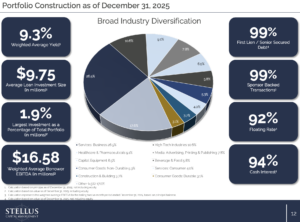
Source: Investor Presentation
It also has a highly diversified investment portfolio, both geographically and by industry. Stellus will make various debt investments, including first- and second-lien, uni-tranche, and mezzanine financing.
The investments are placed in various industries, including business services, industrial, healthcare, technology, energy, consumer products, and finance. Invested capital is used for a wide range of purposes, including acquisitions, growth investments, and more. Stellus is externally managed by Stellus Capital Management LLC, a registered investment advisor.
The company follows a disciplined investment strategy. In prior years, it closed only about 2% of deals reviewed. Its relative selectiveness allows the company to focus on the highest-quality investments.
It also means the company has far more investment opportunities than it needs, enhancing its ability to select only the best investments. Stellus generates particularly high yields on its first- and second-lien, as well as unsecured, debt investments.
Next, we’ll take a look at the company’s growth prospects.
Growth Prospects
A strong catalyst for Stellus is its growing investment portfolio. Over the past five years, Stellus has seen its portfolio rise rapidly, allowing the company to earn higher investment income.
However, this all ended in 2020, as the coronavirus pandemic sent the U.S. economy into a deep recession, adversely affecting many of Stellus’ investments.
SCM reported mixed financial results for the fourth quarter and full year ended December 31, 2025, as lower investment income and unrealized portfolio losses offset continued portfolio growth.
In Q4 2025, net investment income declined to $8.4 million, or $0.29 per share, compared to $9.6 million, or $0.35 per share, in the prior year. Total investment income also decreased slightly to $25.2 million. The company recorded $5.5 million in realized investment gains but reported $8.6 million in unrealized depreciation on investments, contributing to a decline in net asset value per share from $13.46 to $12.82.
Despite weaker earnings, Stellus expanded its portfolio to approximately $1.01 billion in fair value investments, up from $953.5 million in 2024. The company funded $52.1 million in new investments during the quarter and maintained quarterly shareholder distributions of $0.40 per share.
Stellus also strengthened its capital structure by repaying the remaining $50 million of its 4.875% notes due 2026. In addition, the company announced a new $20 million share repurchase program and disclosed that Ridgepost Capital plans to acquire its external adviser, Stellus Capital Management, in a transaction expected to close in mid-2026.
Dividend Analysis
As far as dividend stocks go, Stellus is not a typical choice. Its dividend history is less than 10 years, which means it has not yet developed a long track record of consistency.
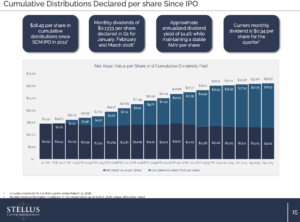
You can see an image of the company’s distribution history below:
Source: Investor Presentation
Stellus currently pays a monthly dividend of $0.1333 per share, equating to an annualized payout of $1.5996. The company cut its dividend in mid-2020 due to the pandemic. On a positive note, Stellus has paid special distributions in the past to supplement its attractive monthly dividend, but the last such distribution was in 2022.
Net investment income is expected to come in at $1.03 per share for 2026. With an annualized dividend of $1.5996, Stellus has a payout ratio of 132%. This means the current dividend payout exceeds the company’s current income. Remember that BDCs are required to distribute nearly all of their income, so Stellus’ payout ratio will always be high.
Even a modest decline in investment income could cause the payout ratio to rise further than already projected, signaling a potentially unsustainable dividend.
As its recent results indicate, Stellus must continue to increase its investments. Stellus is a high-risk, high-reward dividend stock. If the company’s growth stays on track, investors will receive a ~15% dividend return, plus any capital appreciation from a rising share price.
Even if the company maintains its dividend, investors should not expect much dividend growth going forward. Net investment growth has been sluggish, and given the high payout ratio, we don’t see any catalysts for a higher payout in the near future.
Final Thoughts
Stellus could be an attractive pick, as it has a 14%+ dividend yield and some growth potential.
Plus, Stellus pays dividends monthly, which boosts the compounding effect of reinvested dividends and enhances the stock’s appeal to those who rely on dividends to cover living expenses.
Of course, there is no guarantee that the company’s growth plans will be successful, and with a payout ratio above 100%, there is little room for error. As a result, investors must accept the risk of a future dividend cut if financial results deteriorate. Only investors willing to take this risk should consider buying the stock.
Don’t miss the resources below for more monthly dividend stock investing research.
- The Monthly Dividend Stocks List
- 20 Highest Yielding Monthly Dividend Stocks
- 10 Cheapest Monthly Dividend Stocks
- 10 Safest Monthly Dividend Stocks
- 3 Top ‘Hold Forever’ Monthly Dividend Stocks
And see the resources below for more compelling investment ideas for dividend growth stocks and/or high-yield investment securities.
- Dividend Kings: 50+ years of rising dividends
- Dividend Champions: 25+ years of rising dividends
- Dividend Aristocrats: 25+ years of rising dividends and in the S&P 500
- Dividend Achievers: 10+ years of rising dividends and in the NASDAQ
- High Dividend Stocks: 4%+ dividend yields
- Blue Chip Stock: Kings, Aristocrats, and Achievers
- MLPs: List of MLPs and more
- REITs: List of REITs and more
- BDCs: List of BDCs and more