Updated on April 29th, 2026 by Felix Martinez
Gladstone Land Corporation (LAND) is a Real Estate Investment Trust (REIT). REITs are popular investments because they typically pay high dividend yields. Gladstone Land is one of 106 publicly traded REITs in the Sure Dividend database. You can see all 106 REITs here.
Gladstone Land’s dividend yield is 5.6%, which is generous for a REIT. The trust pays dividends monthly rather than quarterly, but the yield is still meaningfully higher than the S&P 500’s.
You can download our full Excel spreadsheet of all monthly dividend stocks (along with metrics that matter like dividend yield and payout ratio) by clicking on the link below:
Gladstone Land is a unique REIT. While many REITs own physical buildings across industries such as retail and healthcare, Gladstone Land also owns farmland and vineyards.
This article will discuss the trust’s prospects and why it could be a valuable addition to a diversified portfolio.
Business Overview
Gladstone Land Corporation is a real estate investment trust, or REIT, that specializes in owning and operating farmland in the U.S. The trust owns roughly 160 farms, comprising over 110,000 acres of farmable land. Gladstone’s business involves three different options available to farmers, all of which are done on a triple–net basis.
Related: Agriculture stocks list and analysis
The trust offers long–term sale-leaseback transactions, traditional farmland leases, and outright purchases of farm properties.
Triple-net leases are appealing because the trust receives a steady stream of rental income while the tenants are responsible for real estate taxes, insurance, and maintenance expenses. Some of the trust’s leases also include a revenue-sharing component based on the crops harvested on the farms.
The REIT has enjoyed strong portfolio metrics, including occupancy and rental income growth.
Source: Investor Presentation
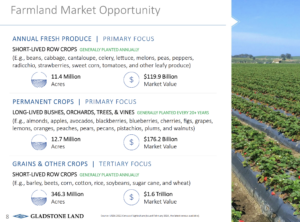
Gladstone Land’s investment focus is primarily on fresh produce, which it believes has superior long-term fundamentals.
Commodities tend to yield less for farmers, so lessors of farmland also tend to earn less. Gladstone Land has an advantage by focusing on the best plots of land for the most profitable crops.
U.S. farmland has proven to be a very strong investment over many years, with returns that are stronger and volatility that is lower than those of other real estate investments and the S&P 500 Index.
Gladstone reported mixed Q4 2025 results, with revenue surging 96.5% year over year to $41.5 million but EPS missing expectations. Growth was driven by a shift toward participation-based leases, resulting in most revenue and earnings being recognized in Q4. Net income rose to $4.2 million, while AFFO increased significantly to $14.4 million ($0.38 per share).
For the full year 2025, performance was pressured despite a stable net income of $13.5 million. AFFO declined 14.1% to $14.4 million due to farm sales, higher operating costs, and timing delays in the recognition of crop revenue. The company sold 13 farms, reducing total acreage, and saw lower fixed rent income, partially offset by higher participation rents and direct farming income.
Strategically, the company is repositioning its portfolio with flexible lease structures and direct farming exposure, while maintaining a strong balance sheet with mostly fixed-rate debt. Management expects continued variability in revenue timing into 2026 but remains focused on liquidity, asset optimization, and long-term farmland productivity.
Growth Prospects
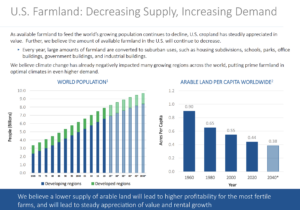
Gladstone Land has positive long-term growth prospects because it stands to capitalize on two major long-term trends. The first catalyst is the growth of the global population, which is around 8.0 billion, with strong growth expected to continue.
This is a long-term tailwind for those who own farmland, as a constantly increasing population will need ever-increasing amounts of food.
At the same time, there is only so much land for farming. In fact, the supply of available farmland in the U.S. is decreasing, as large amounts of farmland are converted to suburban uses each year, such as housing, schools, and offices.
The combination of falling supply and increasing demand has caused farmland prices to rise steadily for many years. As supply and demand trends are not expected to reverse any time soon, Gladstone Land continues to have a strong outlook for future growth.
Source: Investor Presentation
Future growth will be achieved through expansion at existing properties and investment in new properties, with ample room for M&A.
The U.S. farmland industry is highly fragmented, with significant family ownership. This means the environment for continued acquisitions remains fertile for Gladstone Land. Gladstone Land continues to make meaningful acquisitions, as seen above, and we believe this is a steady source of growth for the trust moving forward.
This strategy has led to a higher share count over time. Acquisitions are key to the trust’s growth. Gladstone Land continues to pursue attractive acquisition opportunities, and there is little reason to think its growth will cease.
These fundamentals have led to long-term growth as measured by adjusted FFO, although growth has recently declined.
However, we expect an adjusted FFO/share growth of 0% per year over the next five years.
Dividend Analysis
Gladstone Land currently pays a monthly dividend of $0.0467 per share. The annualized payout of $0.56 per share represents a current dividend yield of 5.6%.
Gladstone Land has a good dividend track record. The company has paid consecutive monthly dividends since its initial public offering in January 2013 and has increased its dividend yearly.
Most importantly, the company’s adjusted funds from operations have typically covered dividend payouts quite easily. That said, this year’s expected payout ratio is above 100%, something investors will want to monitor.
Final Thoughts
The rising global population and declining supply of available farmland in the U.S. create a very favorable future for Gladstone Land. Supply and demand factors support continued investment in farmland. This means Gladstone Land should be able to continue growing its FFO and dividends over the long term.
The trust pays an attractive dividend yield of 5.6%, with the potential for dividend increases that outpace inflation over time. Overall, Gladstone Land is an attractive monthly dividend stock for investors prioritizing income.
Don’t miss the resources below for more monthly dividend stock investing research.
- The Monthly Dividend Stocks List
- 20 Highest Yielding Monthly Dividend Stocks
- 10 Cheapest Monthly Dividend Stocks
- 10 Safest Monthly Dividend Stocks
- 3 Top ‘Hold Forever’ Monthly Dividend Stocks
And see the resources below for more compelling investment ideas for dividend growth stocks and/or high-yield investment securities.
- Dividend Kings: 50+ years of rising dividends
- Dividend Champions: 25+ years of rising dividends
- Dividend Aristocrats: 25+ years of rising dividends and in the S&P 500
- Dividend Achievers: 10+ years of rising dividends and in the NASDAQ
- High Dividend Stocks: 4%+ dividend yields
- Blue Chip Stock: Kings, Aristocrats, and Achievers
- MLPs: List of MLPs and more
- REITs: List of REITs and more
- BDCs: List of BDCs and more