Article updated on March 4th, 2026 by Bob Ciura
Spreadsheet data updated daily
The Dividend Aristocrats are a select group of 69 S&P 500 stocks with 25+ years of consecutive dividend increases.
They are the ‘best of the best’ dividend growth stocks. The Dividend Aristocrats have a long history of outperforming the market.
The requirements to be a Dividend Aristocrat are:
- Be in the S&P 500
- Have 25+ consecutive years of dividend increases
- Meet certain minimum size & liquidity requirements
There are currently 69 Dividend Aristocrats. You can download an Excel spreadsheet of all 69 (with metrics that matter such as dividend yields and price-to-earnings ratios) by clicking the link below:
Disclaimer: Sure Dividend is not affiliated with S&P Global in any way. S&P Global owns and maintains The Dividend Aristocrats Index. The information in this article and downloadable spreadsheet is based on Sure Dividend’s own review, summary, and analysis of the S&P 500 Dividend Aristocrats ETF (NOBL) and other sources, and is meant to help individual investors better understand this ETF and the index upon which it is based. None of the information in this article or spreadsheet is official data from S&P Global. Consult S&P Global for official information.
Note 1: On January 24th, 2025, Erie Indemnity (ERIE), Eversource Energy (ES), and FactSet Research System (FDS) were added to the list with no deletions, leaving 69 Dividend Aristocrats.
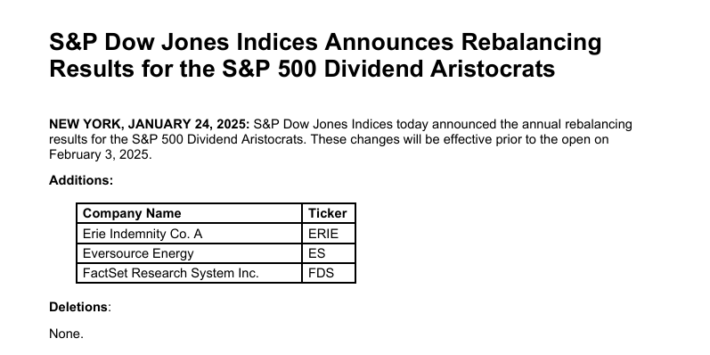
Source: S&P News Releases.
You can see detailed analysis on all 69 further below in this article, in our Dividend Aristocrats In Focus Series. Analysis includes valuation, growth, and competitive advantage(s).
Table of Contents
- How To Use The Dividend Aristocrats List To Find Dividend Investment Ideas
- Performance of the Dividend Aristocrats
- Sector Overview
- The 10 Best Dividend Aristocrats Now
- Dividend Aristocrats Analysis (The Dividend Aristocrats In Focus Series)
- Historical Dividend Aristocrats List (1989 – 2026)
- Frequently Asked Questions
- Final Thoughts
How to Use The Dividend Aristocrats List To Find Dividend Investment Ideas
The downloadable Dividend Aristocrats Excel Spreadsheet List above contains the following for each stock in the index:
- Price-to-earnings ratio
- Dividend yield
- Market capitalization
All Dividend Aristocrats are high-quality businesses based on their long dividend histories. A company cannot pay rising dividends for 25+ years without having a strong and durable competitive advantage.
But not all Dividend Aristocrats make equally good investments today. That’s where the spreadsheet in this article comes into play. You can use the Dividend Aristocrats spreadsheet to quickly find quality dividend investment ideas.
The list of all Dividend Aristocrats is valuable because it gives you a concise list of all S&P 500 stocks with 25+ consecutive years of dividend increases (that also meet certain minimum size and liquidity requirements).
These are businesses that have both the desire and ability to pay shareholders rising dividends year-after-year. This is a rare combination.
Together, these two criteria are powerful – but they are not enough. Value must be considered as well.
The spreadsheet above allows you to sort by trailing price-to-earnings ratio so you can quickly find undervalued, high-quality dividend stocks.
Here’s how to use the Dividend Aristocrats list to quickly find high-quality dividend growth stocks potentially trading at a discount:
- Download the list
- Sort by ‘Trailing PE Ratio,’ smallest to largest
- Research the top stocks further
Here’s how to do this quickly in the spreadsheet:
Step 1: Download the list, and open it.
Step 2: Apply a filter function to each column in the spreadsheet.
Step 3: Click on the small gray down arrow next to ‘Trailing P/E Ratio’, and then sort smallest to largest.
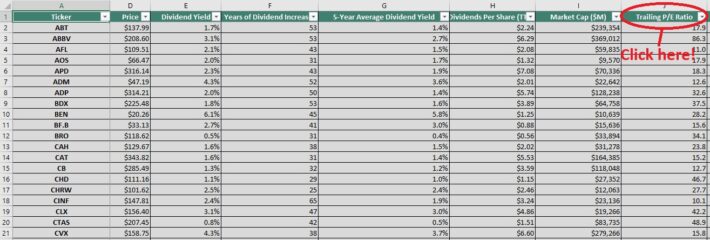
Step 4: Review the highest ranked Dividend Aristocrats before investing. You can see detailed analysis on every Dividend Aristocrat found below in this article.
That’s it; you can follow the same procedure to sort by any other metric in the spreadsheet.
Performance Of The Dividend Aristocrats
In February 2026, the Dividend Aristocrats, as measured by the Dividend Aristocrats ETF (NOBL), registered a total return of 4.2%. It out-performed the SPDR S&P 500 ETF (SPY) for the month.
- NOBL generated returns of 4.2% in February 2026
- SPY generated returns of -0.9% in February 2026
Short-term performance is mostly noise. Performance should be measured over a minimum of 3 years, and preferably longer periods of time.
The Dividend Aristocrats Index has slightly under-performed the broader market index over the last decade, with a 11.6% total annual return for the Dividend Aristocrats and a 15.5% total annual return for the S&P 500 Index.
But the Dividend Aristocrats have exhibited lower risk than the benchmark, as measured by standard deviation.
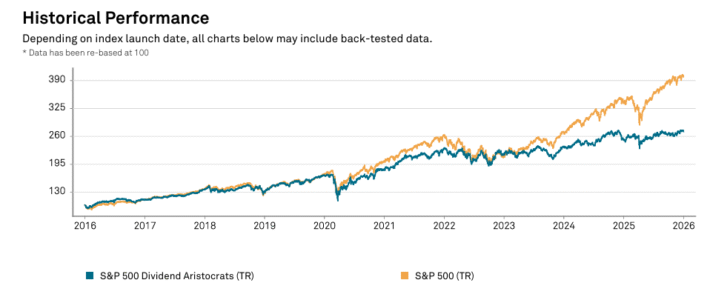
Source: S&P Fact Sheet
Higher total returns with lower volatility is the ‘holy grail’ of investing. It is worth exploring the characteristics of the Dividend Aristocrats in detail to determine why they have performed so well.
Note that a good portion of the outperformance relative to the S&P 500 comes during recessions (2000 – 2002, 2008). Dividend Aristocrats have historically seen smaller drawdowns during recessions versus the S&P 500. This makes holding through recessions that much easier.
Case-in-point: In 2008 the Dividend Aristocrats Index declined 22%. That same year, the S&P 500 declined 38%.
Great businesses with strong competitive advantages tend to be able to generate stronger cash flows during recessions. This allows them to gain market share while weaker businesses fight to stay alive.
We believe dividend paying stocks outperform non-dividend paying stocks for three reasons:
- A company that pays dividends is likely to be generating earnings or cash flows so that it can pay dividends to shareholders. This excludes ‘pre-earnings’ start-ups and failing businesses. In short, it excludes the riskiest stocks.
- A business that pays consistent dividends must be more selective with the growth projects it takes on because a portion of its cash flows are being paid out as dividends. Scrutinizing over capital allocation decisions likely adds to shareholder value.
- Stocks that pay dividends are willing to reward shareholders with cash payments. This is a sign that management is shareholder friendly.
In our view, Dividend Aristocrats have historically outperformed the market and other dividend paying stocks because they are, on average, higher-quality businesses.
A high-quality business should outperform a mediocre business over a long period of time, all other things being equal.
For a business to increase its dividends for 25+ consecutive years, it must have or at least had in the very recent past a strong competitive advantage.
Sector Overview
A sector breakdown of the Dividend Aristocrats Index is shown below:
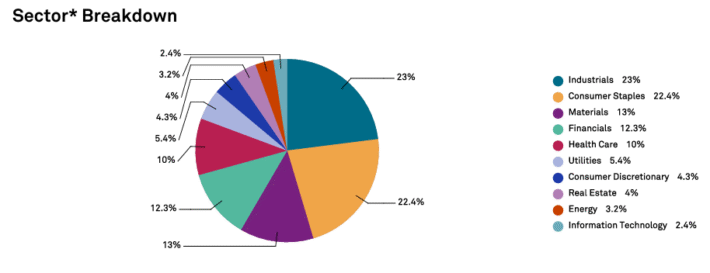
The Dividend Aristocrats Index is tilted toward Consumer Staples and Industrials relative to the S&P 500. These 2 sectors make up over 40% of the Dividend Aristocrats Index, but less than 20% of the S&P 500.
The Dividend Aristocrats Index is also significantly underweight the Information Technology sector, with a ~3% allocation compared with over 20% allocation within the S&P 500.
The Dividend Aristocrat Index is filled with stable ‘old economy’ blue chip consumer products businesses and manufacturers; the Coca-Cola’s (KO), and Johnson & Johnson’s (JNJ) of the investing world.
These ‘boring’ businesses aren’t likely to generate 20%+ earnings-per-share growth, but they also are very unlikely to see large earnings drawdowns as well.
The 10 Best Dividend Aristocrats Now
This research report examines the 10 best Dividend Aristocrats from our Sure Analysis Research Database with the highest 5-year forward expected total returns.
Dividend Aristocrat #10: Kimberly-Clark Corp. (KMB)
- 5-year Expected Annual Returns: 12.5%
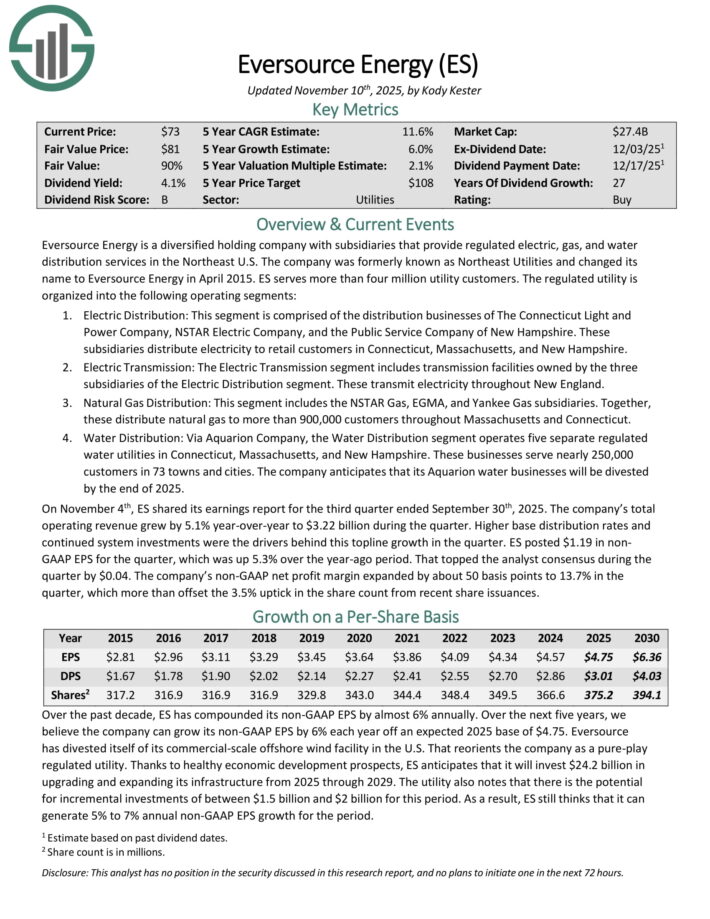
Eversource Energy is a diversified holding company with subsidiaries that provide regulated electric, gas, and water distribution services in the Northeast U.S.
ES serves more than four million utility customers. The regulated utility is organized into the following operating segments.
The Electric Distribution segment is comprised of the distribution businesses of The Connecticut Light and Power Company, NSTAR Electric Company, and the Public Service Company of New Hampshire. These subsidiaries distribute electricity to retail customers in Connecticut, Massachusetts, and New Hampshire.
The Electric Transmission segment includes transmission facilities owned by the three subsidiaries of the Electric Distribution segment. These transmit electricity throughout New England.
The Natural Gas Distribution segment includes the NSTAR Gas, EGMA, and Yankee Gas subsidiaries. Together, these distribute natural gas to more than 900,000 customers throughout Massachusetts and Connecticut.
Lastly, the Water Distribution segment operates five separate regulated water utilities in Connecticut, Massachusetts, and New Hampshire. These businesses serve nearly 250,000 customers in 73 towns and cities.
On November 4th, ES shared its earnings report for the third quarter ended September 30th, 2025. The company’s total operating revenue grew by 5.1% year-over-year to $3.22 billion during the quarter.
Higher base distribution rates and continued system investments were the drivers behind this topline growth in the quarter.
ES posted $1.19 in non-GAAP EPS for the quarter, which was up 5.3% over the year-ago period. That topped the analyst consensus during the quarter by $0.04.
Click here to download our most recent Sure Analysis report on ES (preview of page 1 of 3 shown below):
Dividend Aristocrat #9: PepsiCo Inc. (PEP)
- 5-year Expected Annual Returns: 13.5%
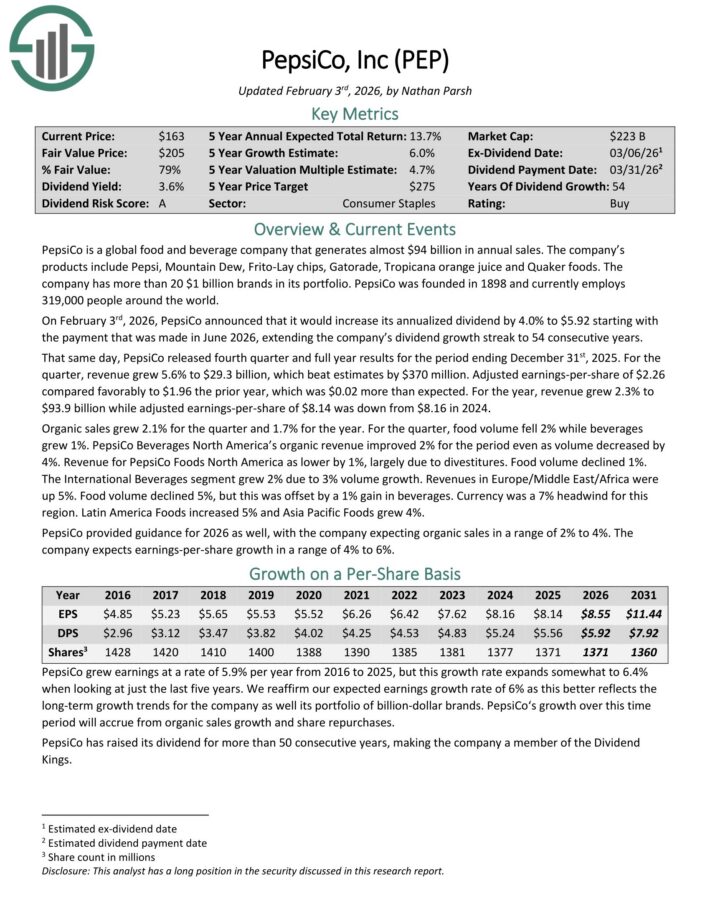
PepsiCo is a global food and beverage company that generates almost $94 billion in annual sales. The company’s products include Pepsi, Mountain Dew, Frito-Lay chips, Gatorade, Tropicana orange juice and Quaker foods.
The company has more than 20 $1 billion brands in its portfolio.
On February 3rd, 2026, PepsiCo announced that it would increase its annualized dividend by 4.0% to $5.92 starting with the payment that was made in June 2026, extending the company’s dividend growth streak to 54 consecutive years.
That same day, PepsiCo released fourth quarter and full year results for the period ending December 31st, 2025. For the quarter, revenue grew 5.6% to $29.3 billion, which beat estimates by $370 million.
Adjusted earnings-per-share of $2.26 compared favorably to $1.96 the prior year, which was $0.02 more than expected.
For the year, revenue grew 2.3% to $93.9 billion while adjusted earnings-per-share of $8.14 was down from $8.16 in 2024. Organic sales grew 2.1% for the quarter and 1.7% for the year.
For the quarter, food volume fell 2% while beverages grew 1%. PepsiCo Beverages North America’s organic revenue improved 2% for the period even as volume decreased by 4%.
Revenue for PepsiCo Foods North America as lower by 1%, largely due to divestitures. Food volume declined 1%.
The International Beverages segment grew 2% due to 3% volume growth. Revenues in Europe/Middle East/Africa were up 5%. Food volume declined 5%, but this was offset by a 1% gain in beverages.
Currency was a 7% headwind for this region. Latin America Foods increased 5% and Asia Pacific Foods grew 4%.
PepsiCo provided guidance for 2026 as well, with the company expecting organic sales in a range of 2% to 4%. The company expects earnings-per-share growth in a range of 4% to 6%.
Click here to download our most recent Sure Analysis report on PEP (preview of page 1 of 3 shown below):
Dividend Aristocrat #8: Becton Dickinson & Co. (BDX)
- 5-year Expected Annual Returns: 13.5%
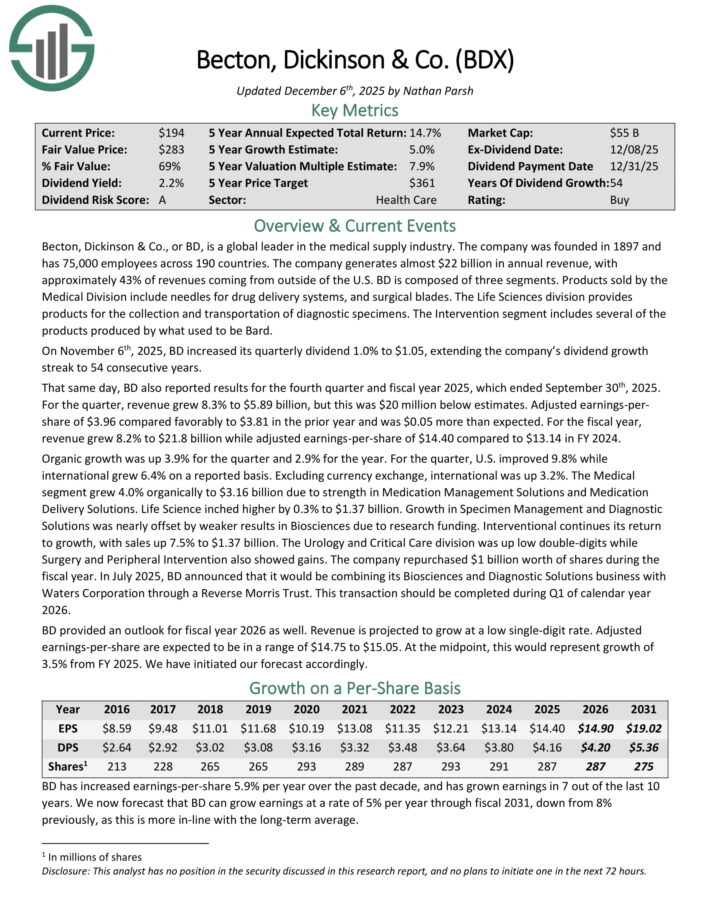
Becton, Dickinson & Co. is a global leader in the medical supply industry. The company was founded in 1897 and has 75,000 employees across 190 countries.
The company generates about $20 billion in annual revenue, with approximately 43% of revenues coming from outside of the U.S.
On November 6th, 2025, BD increased its quarterly dividend 1.0% to $1.05, extending the company’s dividend growth streak to 54 consecutive years.
BD also reported results for the fourth quarter and fiscal year 2025, which ended September 30th, 2025. For the quarter, revenue grew 8.3% to $5.89 billion, but this was $20 million below estimates.
Adjusted earnings-per-share of $3.96 compared favorably to $3.81 in the prior year and was $0.05 more than expected. For the fiscal year, revenue grew 8.2% to $21.8 billion while adjusted earnings-per-share of $14.40 compared to $13.14 in FY 2024.
BD provided an outlook for fiscal year 2026 as well. Revenue is projected to grow at a low single-digit rate. Adjusted earnings-per-share are expected to be in a range of $14.75 to $15.05.
At the midpoint, this would represent growth of 3.5% from FY 2025.
Click here to download our most recent Sure Analysis report on BDX (preview of page 1 of 3 shown below):
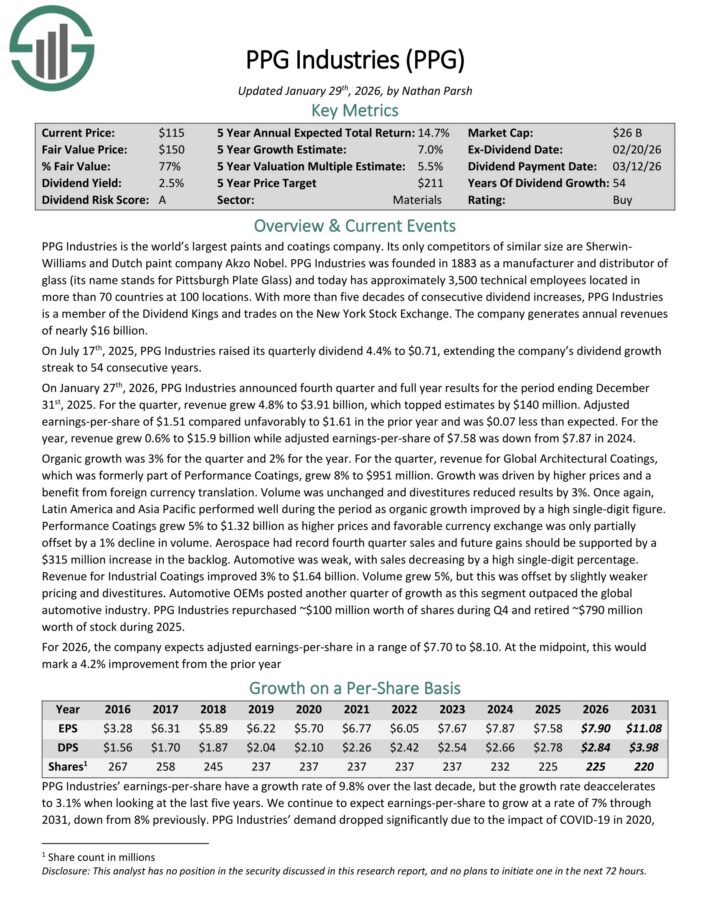
Dividend Aristocrat #7: PPG Industries (PPG)
- 5-year Expected Annual Returns: 14.7%
PPG Industries is the world’s largest paints and coatings company. Its only competitors of similar size are Sherwin-Williams and Dutch paint company Akzo Nobel.
On January 27th, 2026, PPG Industries announced fourth quarter and full year results. For the quarter, revenue grew 4.8% to $3.91 billion, which topped estimates by $140 million. Adjusted earnings-per-share of $1.51 compared unfavorably to $1.61 in the prior year and was $0.07 less than expected.
For the year, revenue grew 0.6% to $15.9 billion while adjusted earnings-per-share of $7.58 was down from $7.87 in 2024. Organic growth was 3% for the quarter and 2% for the year.
For the quarter, revenue for Global Architectural Coatings, which was formerly part of Performance Coatings, grew 8% to $951 million.
Growth was driven by higher prices and a benefit from foreign currency translation. Volume was unchanged and divestitures reduced results by 3%.
Once again, Latin America and Asia Pacific performed well during the period as organic growth improved by a high single-digit figure.
Performance Coatings grew 5% to $1.32 billion as higher prices and favorable currency exchange was only partially offset by a 1% decline in volume.
Aerospace had record fourth quarter sales and future gains should be supported by a $315 million increase in the backlog. Automotive was weak, with sales decreasing by a high single-digit percentage.
Revenue for Industrial Coatings improved 3% to $1.64 billion. Volume grew 5%, but this was offset by slightly weaker pricing and divestitures. Automotive OEMs posted another quarter of growth as this segment outpaced the global automotive industry.
PPG Industries repurchased ~$100 million worth of shares during Q4 and retired ~$790 million worth of stock during 2025.
Click here to download our most recent Sure Analysis report on PPG (preview of page 1 of 3 shown below):
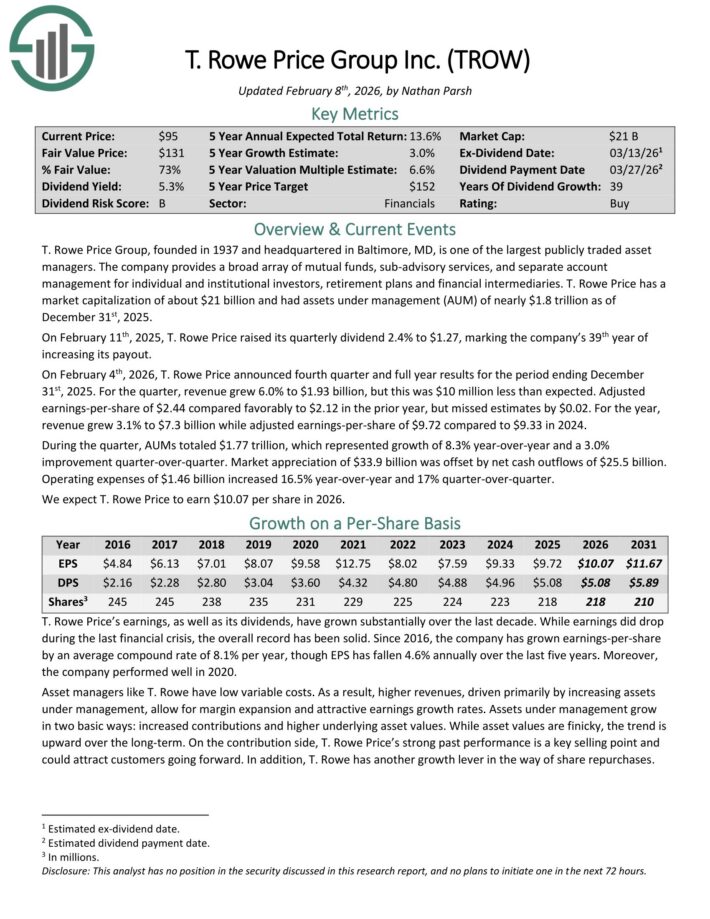
Dividend Aristocrat #6: T. Rowe Price Group (TROW)
- 5-year Expected Annual Returns: 14.1%
T. Rowe Price Group is one of the largest publicly traded asset managers. The company provides a broad array of mutual funds, sub-advisory services, and separate account management for individual and institutional investors, retirement plans and financial intermediaries.
T. Rowe Price had assets under management (AUM) of nearly $1.8 trillion as of December 31st, 2025.
On February 11th, 2025, T. Rowe Price raised its quarterly dividend 2.4% to $1.27, marking the company’s 39th year of increasing its payout.
On February 4th, 2026, T. Rowe Price announced fourth quarter and full year results for the period ending December 31st, 2025. For the quarter, revenue grew 6.0% to $1.93 billion, but this was $10 million less than expected.
Adjusted earnings-per-share of $2.44 compared favorably to $2.12 in the prior year, but missed estimates by $0.02. For the year, revenue grew 3.1% to $7.3 billion while adjusted earnings-per-share of $9.72 compared to $9.33 in 2024.
During the quarter, AUMs totaled $1.77 trillion, which represented growth of 8.3% year-over-year and a 3.0% improvement quarter-over-quarter.
Market appreciation of $33.9 billion was offset by net cash outflows of $25.5 billion. Operating expenses of $1.46 billion increased 16.5% year-over-year and 17% quarter-over-quarter.
Click here to download our most recent Sure Analysis report on TROW (preview of page 1 of 3 shown below):
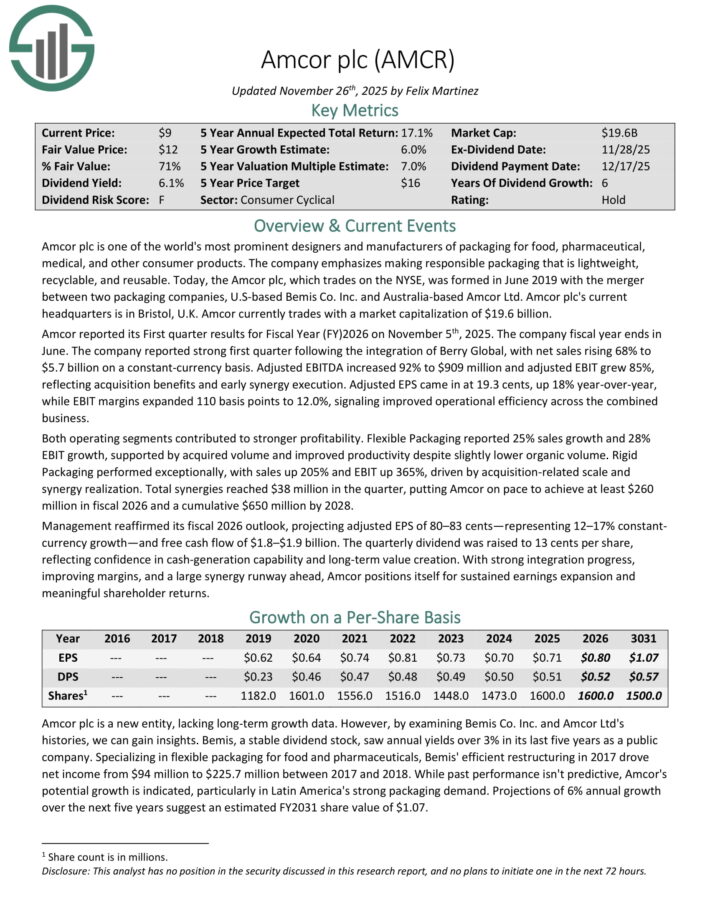
Dividend Aristocrat #5: Amcor plc (AMCR)
- 5-year Expected Annual Returns: 14.9%
Amcor plc is one of the world’s most prominent designers and manufacturers of packaging for food, pharmaceutical, medical, and other consumer products.
The company emphasizes making responsible packaging that is lightweight, recyclable, and reusable.
Amcor reported its First quarter results for Fiscal Year (FY) 2026 on November 5th, 2025. The company fiscal year ends in June.
The company reported strong first quarter following the integration of Berry Global, with net sales rising 68% to $5.7 billion on a constant-currency basis.
Adjusted EBITDA increased 92% to $909 million and adjusted EBIT grew 85%, reflecting acquisition benefits and early synergy execution.
Adjusted EPS came in at 19.3 cents, up 18% year-over-year, while EBIT margins expanded 110 basis points to 12.0%, signaling improved operational efficiency across the combined business.
Both operating segments contributed to stronger profitability. Flexible Packaging reported 25% sales growth and 28% EBIT growth, supported by acquired volume and improved productivity despite slightly lower organic volume.
Rigid Packaging performed exceptionally, with sales up 205% and EBIT up 365%, driven by acquisition-related scale and synergy realization.
Click here to download our most recent Sure Analysis report on AMCR (preview of page 1 of 3 shown below):
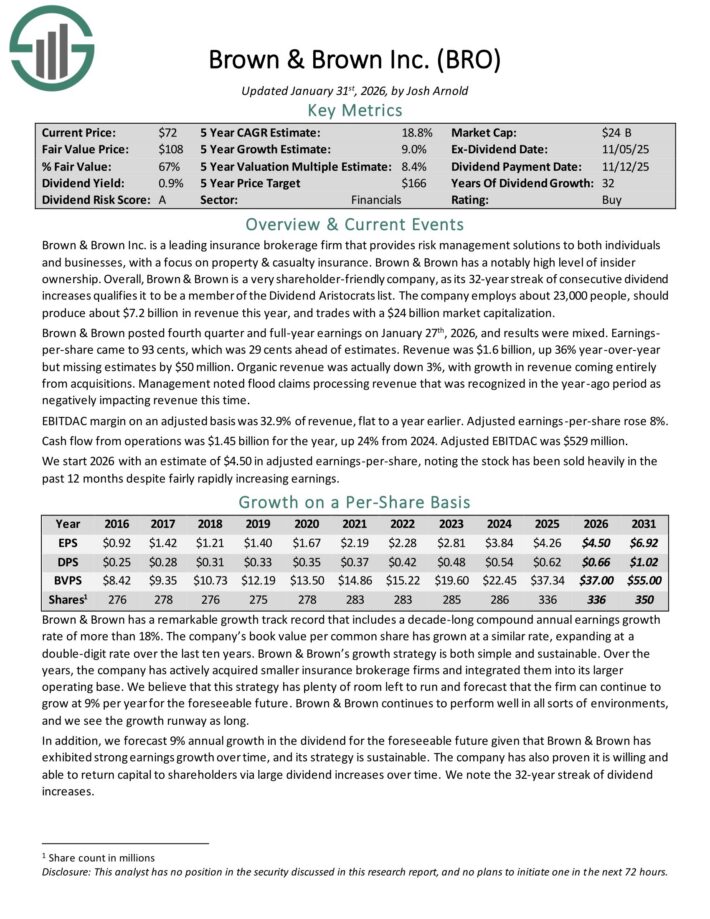
Dividend Aristocrat #4: Brown & Brown (BRO)
- 5-year Expected Annual Returns: 18.8%
Brown & Brown Inc. is a leading insurance brokerage firm that provides risk management solutions to both individuals and businesses, with a focus on property & casualty insurance. Brown & Brown has a notably high level of insider ownership.
Brown & Brown posted fourth quarter and full-year earnings on January 27th, 2026, and results were mixed. Earnings-per-share came to 93 cents, which was 29 cents ahead of estimates.
Revenue was $1.6 billion, up 36% year-over-year but missing estimates by $50 million. Organic revenue was actually down 3%, with growth in revenue coming entirely from acquisitions.
Management noted flood claims processing revenue that was recognized in the year-ago period as negatively impacting revenue this time.
EBITDAC margin on an adjusted basis was 32.9% of revenue, flat to a year earlier. Adjusted earnings-per-share rose 8%.
Cash flow from operations was $1.45 billion for the year, up 24% from 2024. Adjusted EBITDAC was $529 million.
Click here to download our most recent Sure Analysis report on BRO (preview of page 1 of 3 shown below):
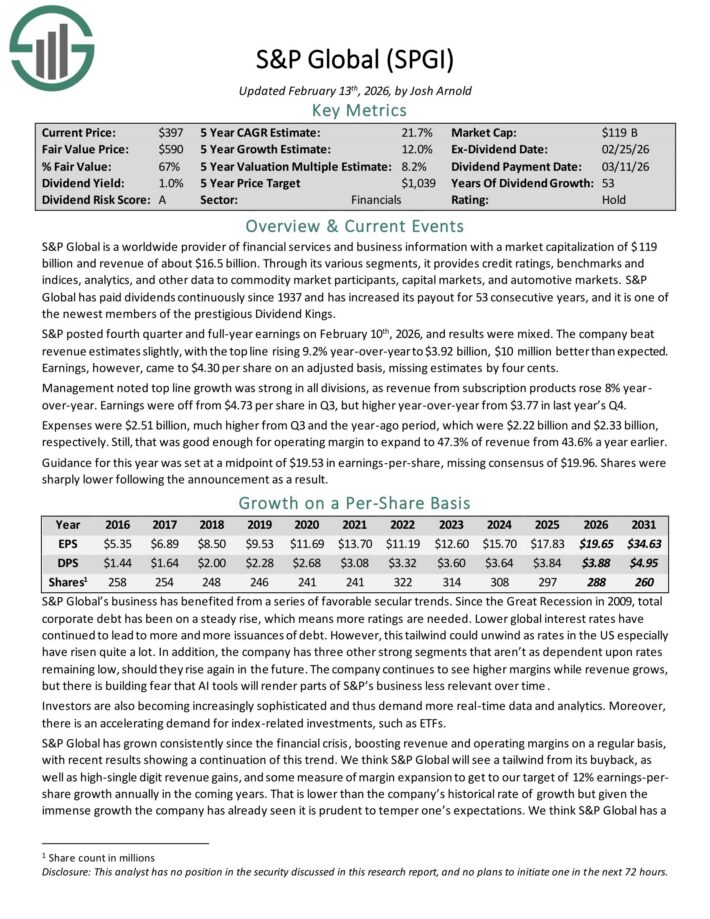
Dividend Aristocrat #3: S&P Global (SPGI)
- 5-year Expected Annual Returns: 19.1%
S&P Global is a worldwide provider of financial services and business information with revenue of about $16.5 billion.
Through its various segments, it provides credit ratings, benchmarks and indices, analytics, and other data to commodity market participants, capital markets, and automotive markets.
S&P Global has paid dividends continuously since 1937 and has increased its payout for 53 consecutive years.
S&P posted fourth quarter and full-year earnings on February 10th, 2026, and results were mixed. The company beat revenue estimates slightly, with the top line rising 9.2% year-over-year to $3.92 billion, $10 million better than expected.
Earnings, however, came to $4.30 per share on an adjusted basis, missing estimates by four cents. Management noted top line growth was strong in all divisions, as revenue from subscription products rose 8% year-over-year.
Earnings were off from $4.73 per share in Q3, but higher year-over-year from $3.77 in last year’s Q4.
Expenses were $2.51 billion, much higher from Q3 and the year-ago period, which were $2.22 billion and $2.33 billion, respectively. Still, that was good enough for operating margin to expand to 47.3% of revenue from 43.6% a year earlier.
Click here to download our most recent Sure Analysis report on SPGI (preview of page 1 of 3 shown below):
Dividend Aristocrat #2: Automatic Data Processing (ADP)
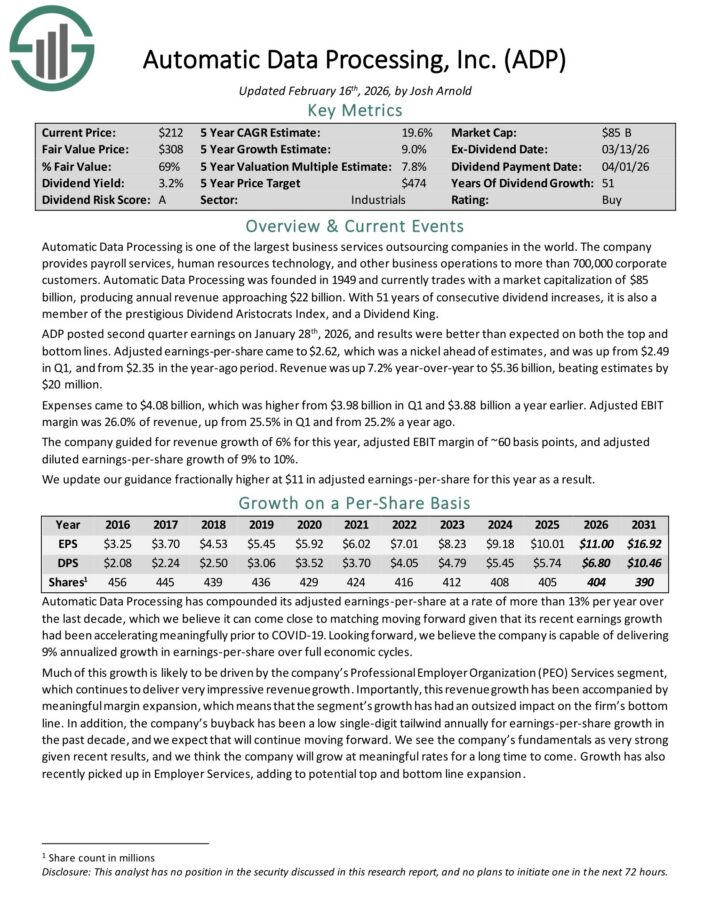
- 5-year Expected Annual Returns: 19.2%
Automatic Data Processing is one of the largest business services outsourcing companies in the world. The company provides payroll services, human resources technology, and other business operations to more than 700,000 corporate customers.
ADP posted second quarter earnings on January 28th, 2026, and results were better than expected on both the top and bottom lines.
Adjusted earnings-per-share came to $2.62, which was a nickel ahead of estimates, and was up from $2.49 in Q1, and from $2.35 in the year-ago period. Revenue was up 7.2% year-over-year to $5.36 billion, beating estimates by $20 million.
Expenses came to $4.08 billion, which was higher from $3.98 billion in Q1 and $3.88 billion a year earlier. Adjusted EBIT margin was 26.0% of revenue, up from 25.5% in Q1 and from 25.2% a year ago.
The company guided for revenue growth of 6% for this year, adjusted EBIT margin of ~60 basis points, and adjusted diluted earnings-per-share growth of 9% to 10%.
Click here to download our most recent Sure Analysis report on ADP (preview of page 1 of 3 shown below):
Dividend Aristocrat #1: Factset Research Systems (FDS)
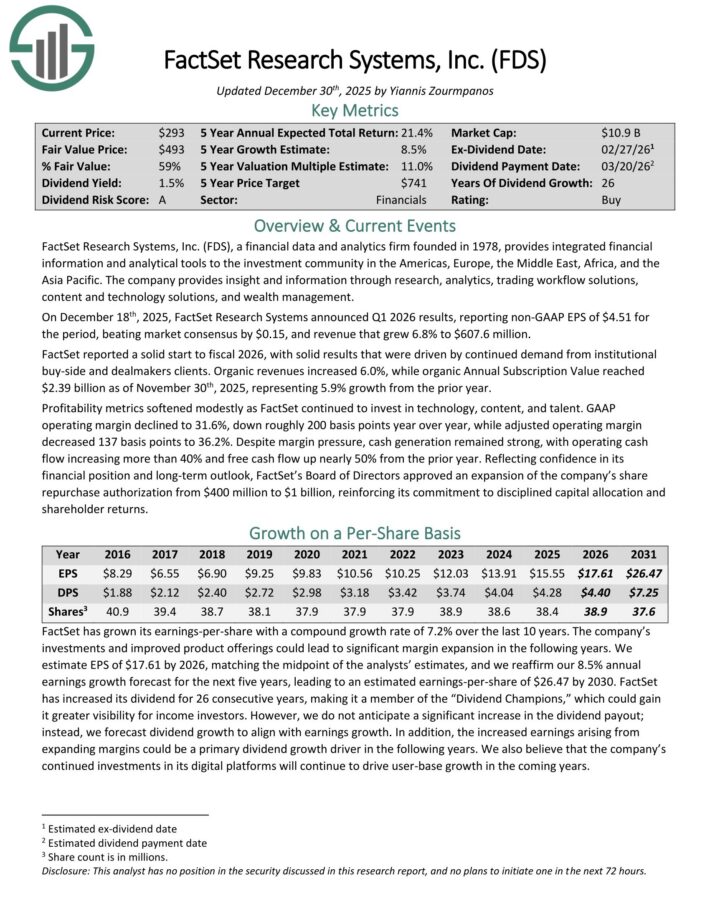
- 5-year Expected Annual Returns: 28.2%
FactSet Research Systems, a financial data and analytics firm founded in 1978, provides integrated financial information and analytical tools to the investment community in the Americas, Europe, the Middle East, Africa, and Asia-Pacific.
The company provides insight and information through research, analytics, trading workflow solutions, content and technology solutions, and wealth management.
On December 18th, 2025, FactSet Research Systems announced Q1 2026 results, reporting non-GAAP EPS of $4.51 for the period, beating market consensus by $0.15, and revenue that grew 6.8% to $607.6 million.
FactSet reported a solid start to fiscal 2026, with solid results that were driven by continued demand from institutional buy-side and dealmakers clients.
Organic revenues increased 6.0%, while organic Annual Subscription Value reached $2.39 billion as of November 30th, 2025, representing 5.9% growth from the prior year.
Profitability metrics softened modestly as FactSet continued to invest in technology, content, and talent. GAAP operating margin declined to 31.6%, down roughly 200 basis points year over year, while adjusted operating margin decreased 137 basis points to 36.2%.
Despite margin pressure, cash generation remained strong, with operating cash flow increasing more than 40% and free cash flow up nearly 50% from the prior year.
Reflecting confidence in its financial position and long-term outlook, FactSet’s Board of Directors approved an expansion of the company’s share repurchase authorization from $400 million to $1 billion.
Click here to download our most recent Sure Analysis report on FDS (preview of page 1 of 3 shown below):
The Dividend Aristocrats In Focus Analysis Series
You can see analysis on every single Dividend Aristocrat below. Each is sorted by GICS sectors and listed in alphabetical order by name. The newest Sure Analysis Research Database report for each security is included as well.
Consumer Staples
- Archer-Daniels-Midland (ADM) | [See newest Sure Analysis report]
- Amcor (AMCR) | [See newest Sure Analysis report]
- Brown-Forman (BF-B) | [See newest Sure Analysis report]
- Colgate-Palmolive (CL) | [See newest Sure Analysis report]
- Church & Dwight (CHD) | [See newest Sure Analysis report]
- Clorox (CLX) | [See newest Sure Analysis report]
- Coca-Cola (KO) | [See newest Sure Analysis report]
- Hormel Foods (HRL) | [See newest Sure Analysis report]
- J.M. Smucker (SJM) | [See newest Sure Analysis report]
- Kimberly-Clark (KMB) | [See newest Sure Analysis report]
- McCormick & Company (MKC) | [See newest Sure Analysis report]
- PepsiCo (PEP) | [See newest Sure Analysis report]
- Procter & Gamble (PG) [See newest Sure Analysis report]
- Sysco Corporation (SYY) [See newest Sure Analysis report]
- Walmart (WMT) | [See newest Sure Analysis report]
Industrials
- Automatic Data Processing (ADP) | [See newest Sure Analysis report]
- A.O. Smith (AOS) | [See newest Sure Analysis report]
- C.H. Robinson Worldwide (CHRW) | [See newest Sure Analysis report]
- Cintas (CTAS) | [See newest Sure Analysis report]
- Dover (DOV) | [See newest Sure Analysis report]
- Emerson Electric (EMR) | [See newest Sure Analysis report]
- Expeditors International (EXPD) | [See newest Sure Analysis report]
- Fastenal Co. (FAST) | [See newest Sure Analysis report]
- Illinois Tool Works (ITW) | [See newest Sure Analysis report]
- Nordson Corporation (NDSN) | [See newest Sure Analysis report]
- Pentair (PNR) | [See newest Sure Analysis report]
- Roper Technologies (ROP) | [See newest Sure Analysis report]
- Stanley Black & Decker (SWK) | [See newest Sure Analysis report]
- W.W. Grainger (GWW) | [See newest Sure Analysis report]
- General Dynamics (GD) | [See newest Sure Analysis report]
- Caterpillar (CAT) | [See newest Sure Analysis report]
Health Care
- Abbott Laboratories (ABT) | [See newest Sure Analysis report]
- AbbVie (ABBV) | [See newest Sure Analysis report]
- Becton, Dickinson & Company (BDX) | [See newest Sure Analysis report]
- Cardinal Health (CAH) | [See newest Sure Analysis report]
- Johnson & Johnson (JNJ) | [See newest Sure Analysis report]
- Kenvue Inc. (KVUE) | [See newest Sure Analysis report]
- Medtronic (MDT) | [See newest Sure Analysis report]
- West Pharmaceutical Services (WST) | [See newest Sure Analysis report]
Consumer Discretionary
- Genuine Parts Company (GPC) | [See newest Sure Analysis report]
- Lowe’s Companies (LOW) | [See newest Sure Analysis report]
- McDonald’s (MCD) | [See newest Sure Analysis report]
- Target (TGT) | [See newest Sure Analysis report]
Financials
- Aflac (AFL) | [See newest Sure Analysis report]
- Brown & Brown (BRO) | [See newest Sure Analysis report]
- Cincinnati Financial (CINF) | [See newest Sure Analysis report]
- Erie Indemnity (ERIE) | [See newest Sure Analysis report]
- FactSet Research Systems (FDS) | [See newest Sure Analysis report]
- Franklin Resources (BEN) | [See newest Sure Analysis report]
- S&P Global (SPGI) | [See newest Sure Analysis report]
- T. Rowe Price Group (TROW) | [See newest Sure Analysis report]
- Chubb (CB) | [See newest Sure Analysis report]
Materials
- Air Products and Chemicals (APD) | [See newest Sure Analysis report]
- Albemarle (ALB) | [See newest Sure Analysis report]
- Ecolab (ECL) | [See newest Sure Analysis report]
- PPG Industries (PPG) | [See newest Sure Analysis report]
- Sherwin-Williams (SHW) | [See newest Sure Analysis report]
- Nucor (NUE) | [See newest Sure Analysis report]
- Linde (LIN) | [See newest Sure Analysis report]
Energy
- Chevron (CVX) | [See newest Sure Analysis report]
- Exxon Mobil (XOM) | [See newest Sure Analysis report]
- Eversource Energy (ES) | [See newest Sure Analysis report]
Information Technology
Real Estate
- Essex Property Trust (ESS) | [See newest Sure Analysis report]
- Federal Realty Investment Trust (FRT) | [See newest Sure Analysis report]
- Realty Income (O) | [See newest Sure Analysis report]
Utilities
- Atmos Energy (ATO) | [See newest Sure Analysis report]
- Consolidated Edison (ED) | [See newest Sure Analysis report]
- NextEra Energy (NEE) | [See newest Sure Analysis report]
Historical Dividend Aristocrats List
(1989 – 2026)
The image below shows the history of the Dividend Aristocrats Index from 1989 through 2026.
Note: CL, GPC, and NUE were all removed and re-added to the Dividend Aristocrats Index through the historical period analyzed above. We are unsure as to why. Companies created via a spin-off (like AbbVie) can be Dividend Aristocrats with less than 25 years of rising dividends if the parent company was a Dividend Aristocrat.
Disclaimer: Sure Dividend is not affiliated with S&P Global in any way. S&P Global owns and maintains The Dividend Aristocrats Index. The information in this article and downloadable spreadsheet and image below is based on Sure Dividend’s own review, summary, and analysis of the S&P 500 Dividend Aristocrats ETF (NOBL) and other sources, and is meant to help individual investors better understand this ETF and the index upon which it is based. None of the information in this article or spreadsheet is official data from S&P Global. Consult S&P Global for official information.
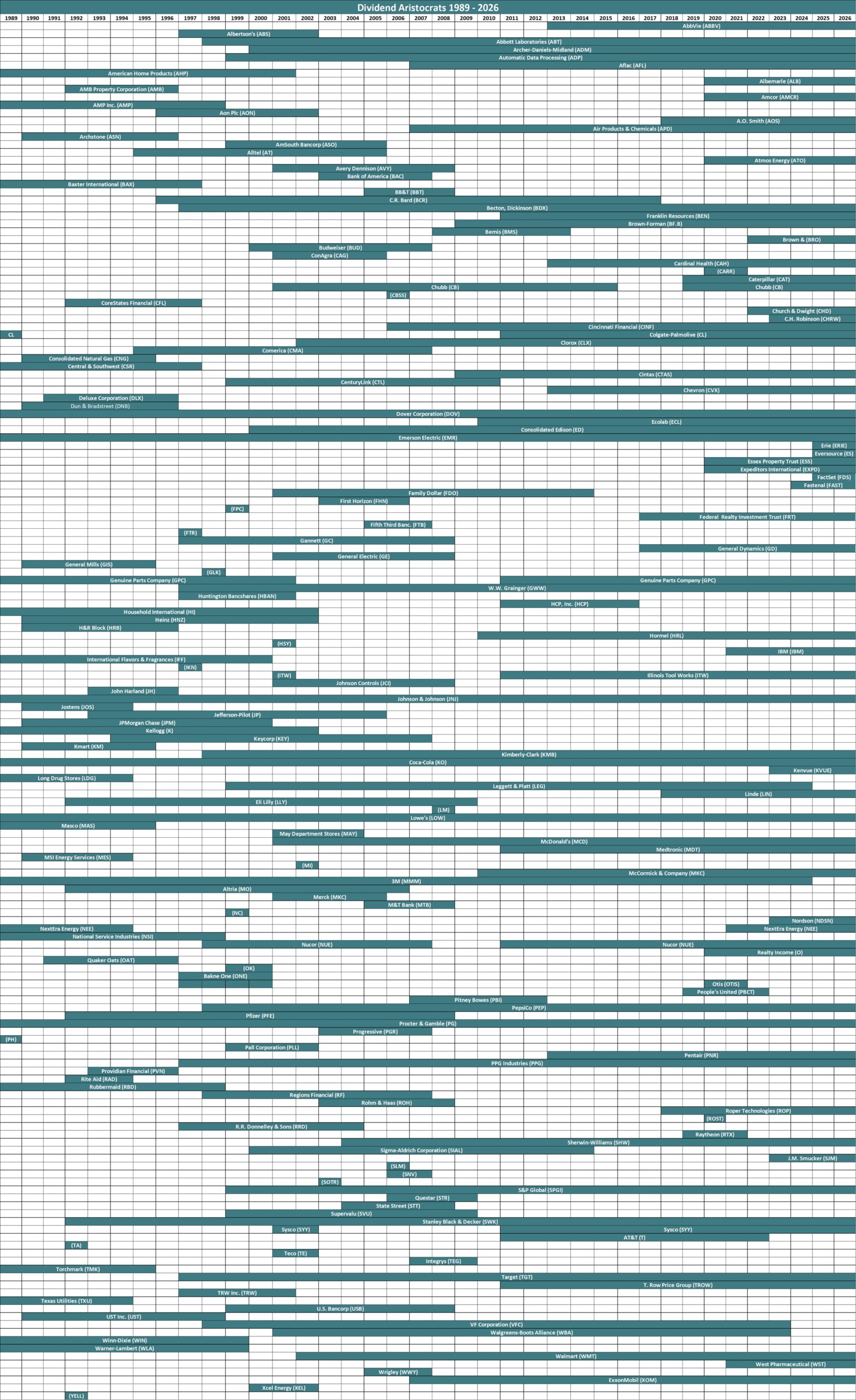
This information was compiled from the following sources:
- 1989 – 1991: Dividend Growth Investor
- 1992 – 2015: NOBL Index Historical Constituents
- 2016: Sure Dividend update
- 2017 – 2026: Data from S&P press releases and tracking dividends
Frequently Asked Questions
This section will address some of most common questions investors have regarding the Dividend Aristocrats.
1. What is the highest-paying Dividend Aristocrat?
Answer: Amcor currently yields 6%.
2. What is the difference between the Dividend Aristocrats and the Dividend Kings?
Answer: The Dividend Aristocrats must be constituents of the S&P 500 Index, have raised their dividends for at least 25 consecutive years, and satisfy a number of liquidity requirements.
The Dividend Kings only need to have raised their dividends for at least 50 consecutive years.
3. Is there an ETF that tracks the Dividend Aristocrats?
Answer: Yes, the Dividend Aristocrats ETF (NOBL) is an exchange-traded fund that specifically holds the Dividend Aristocrats.
4. What is the difference between the Dividend Aristocrats and the Dividend Champions?
Answer: The Dividend Aristocrats and Dividend Champions share one requirement, which is that a company must have raised its dividend for at least 25 consecutive years.
But like the Dividend Kings, the Dividend Champions do not need to be in the S&P 500 Index, nor satisfy the various liquidity requirements.
5. Which Dividend Aristocrat has the longest active streak of annual dividend increases?
Currently, there are 3 Dividend Aristocrats tied at 69 years: Procter & Gamble, Genuine Parts, and Dover Corporation.
6. What is the average dividend yield of the Dividend Aristocrats?
Right now, the average dividend yield of the Dividend Aristocrats is 2.1%.
7. Are the Dividend Aristocrats safe investments?
While there are never any guarantees when it comes to the stock market, we believe the Dividend Aristocrats are among the safest dividend stocks when it comes to the sustainability of their dividend payouts.
The Dividend Aristocrats have durable competitive advantages that allow them to raise their dividends each year, even during a recession.
Other Dividend Lists & Final Thoughts
The Dividend Aristocrats list is not the only way to quickly screen for stocks that regularly pay rising dividends.
- The Dividend Kings List is even more exclusive than the Dividend Aristocrats. It is comprised of 56 stocks with 50+ years of consecutive dividend increases.
- The Blue Chip Stocks List: stocks that qualify as Dividend Achievers, Dividend Aristocrats, and/or Dividend Kings
- The High Dividend Stocks List: stocks that appeal to investors interested in the highest yields of 5% or more.
- The Monthly Dividend Stocks List: stocks that pay dividends every month, for 12 dividend payments per year.
There is nothing magical about the Dividend Aristocrats. They are ‘just’ a collection of high-quality shareholder friendly stocks that have strong competitive advantages.
Purchasing these types of stocks at fair or better prices and holding for the long-run will likely result in favorable long-term performance.