Updated on June 4th, 2026 by Bob Ciura
Spreadsheet data updated daily
The Dividend Kings are the best-of-the-best in dividend longevity.
What is a Dividend King? A stock with 50 or more consecutive years of dividend increases.
The downloadable Dividend Kings Spreadsheet List below contains the following for each stock in the index among other important investing metrics:
- Payout ratio
- Dividend yield
- Price-to-earnings ratio
You can see the full downloadable spreadsheet of all 58 Dividend Kings (along with important financial metrics such as dividend yields, payout ratios, and price-to-earnings ratios) by clicking on the link below:
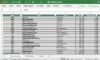
The Dividend Kings list includes recent additions such as Sonoco Products (SON), Pentair (PNR), and MGE Energy (MGEE).
Each Dividend King satisfies the primary requirement to be a Dividend Aristocrat (25 years of consecutive dividend increases) twice over.
Not all Dividend Kings are Dividend Aristocrats.
This unexpected result is because the ‘only’ requirement to be a Dividend Kings is 50+ years of rising dividends.
On the other hand, Dividend Aristocrats must have 25+ years of rising dividends, be a member of the S&P 500 Index, and meet certain minimum size and liquidity requirements.
Table of Contents
- How To Use The Dividend Kings List To Find Dividend Stock Ideas
- The 5 Best Dividend Kings Today
#5: Becton, Dickinson & Co. (BDX)
#4: H2O America (HTO)
#3: The Marzetti Company (MZTI)
#2: S&P Global (SPGI)
#1: Stepan Co. (SCL) - The Dividend Kings In Focus Series
- Performance Of The Dividend Kings
- Sector & Market Capitalization Overview
- Final Thoughts
How To Use The Dividend Kings List to Find Dividend Stock Ideas
The Dividend Kings list is a great place to find dividend stock ideas. However, not all the stocks in the Dividend Kings list make a great investment at any given time.
Some stocks might be overvalued. Conversely, some might be undervalued – making great long-term holdings for dividend growth investors.
For those unfamiliar with Microsoft Excel, the following walk-through shows how to filter the Dividend Kings list for the stocks with the most attractive valuation based on the price-to-earnings ratio.
Step 1: Download the Dividend Kings Excel Spreadsheet.
Step 2: Follow the steps in the instructional video below. Note that we screen for price-to-earnings ratios of 15 or below in the video. You can choose any threshold that best defines ‘value’ for you.
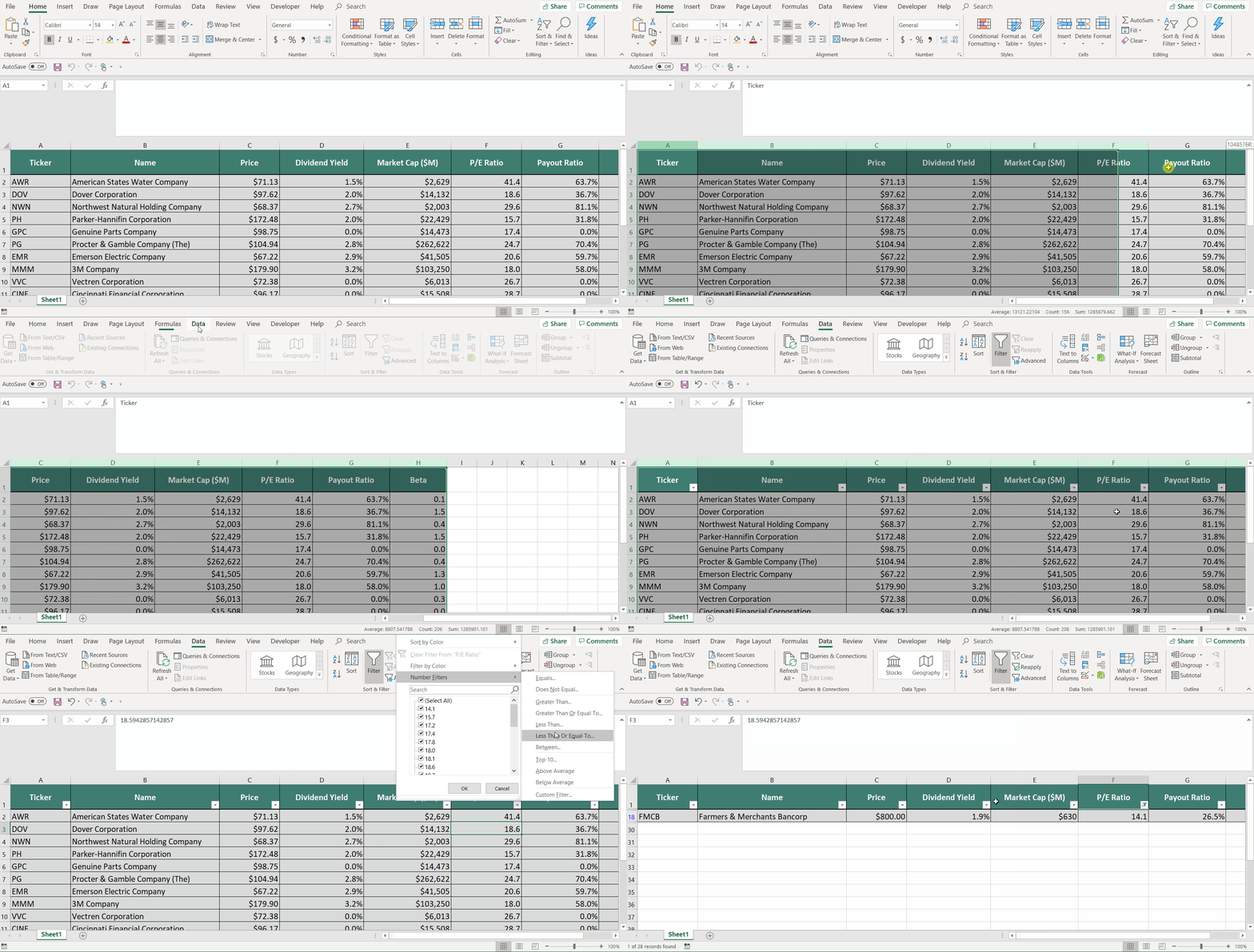
Alternatively, following the instructions above and filtering for higher dividend yield Dividend Kings (yields of 2% or 3% or higher) will show stocks with 50+ years of rising dividends and above-average dividend yields.
Looking for businesses that have a long history of dividend increases isn’t a perfect way to identify stocks that will increase their dividends every year in the future, but there is considerable consistency in the Dividend Kings.
The 5 Best Dividend Kings Today
The following 5 stocks are our top-ranked Dividend Kings today, based on expected annual returns over the next 5 years. Stocks are ranked in order of lowest to highest expected annual returns.
Total returns include a combination of future earnings-per-share growth, dividends, and any changes in the P/E multiple.
Dividend King #5: Becton, Dickinson & Co. (BDX)
- 5-Year Annual Expected Returns: 17.7%
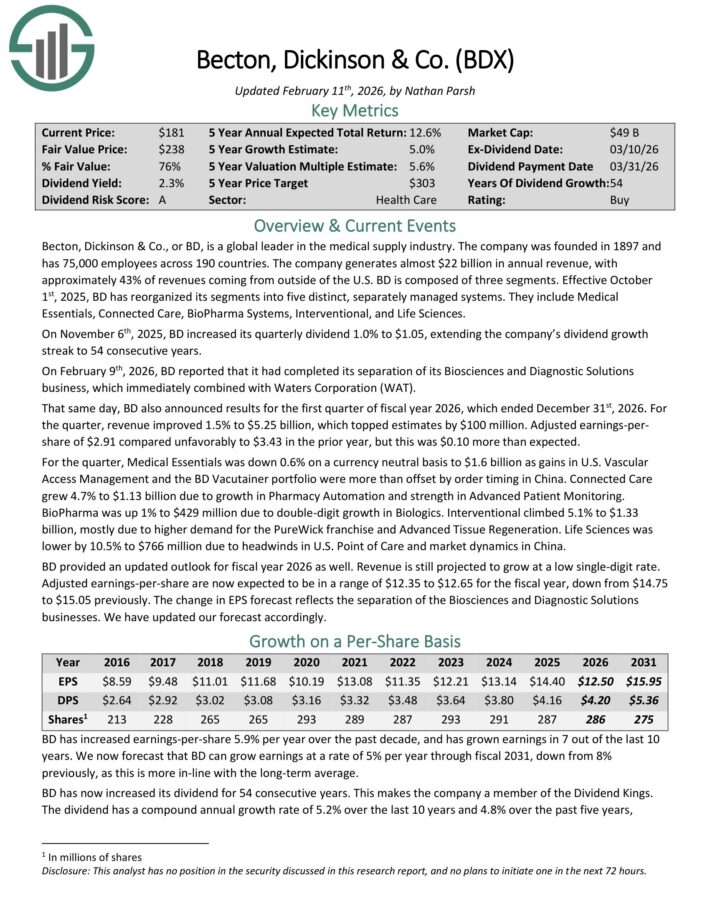
Becton, Dickinson & Co. is a global leader in the medical supply industry. The company was founded in 1897 and has 75,000 employees across 190 countries.
The company generates about $20 billion in annual revenue, with approximately 43% of revenues coming from outside of the U.S.
On November 6th, 2025, BD increased its quarterly dividend 1.0% to $1.05, extending the company’s dividend growth streak to 54 consecutive years.
BD also announced results for the first quarter of fiscal year 2026, which ended December 31st, 2026. For the quarter, revenue improved 1.5% to $5.25 billion, which topped estimates by $100 million.
Adjusted earnings-per-share of $2.91 compared unfavorably to $3.43 in the prior year, but this was $0.10 more than expected.
For the quarter, Medical Essentials was down 0.6% on a currency neutral basis to $1.6 billion as gains in U.S. Vascular Access Management and the BD Vacutainer portfolio were more than offset by order timing in China.
Connected Care grew 4.7% to $1.13 billion due to growth in Pharmacy Automation and strength in Advanced Patient Monitoring.
BioPharma was up 1% to $429 million due to double-digit growth in Biologics. Interventional climbed 5.1% to $1.33 billion, mostly due to higher demand for the PureWick franchise and Advanced Tissue Regeneration.
Click here to download our most recent Sure Analysis report on BDX (preview of page 1 of 3 shown below):
Dividend King #4: H2O America (HTO)
- 5-Year Annual Expected Returns: 18.2%
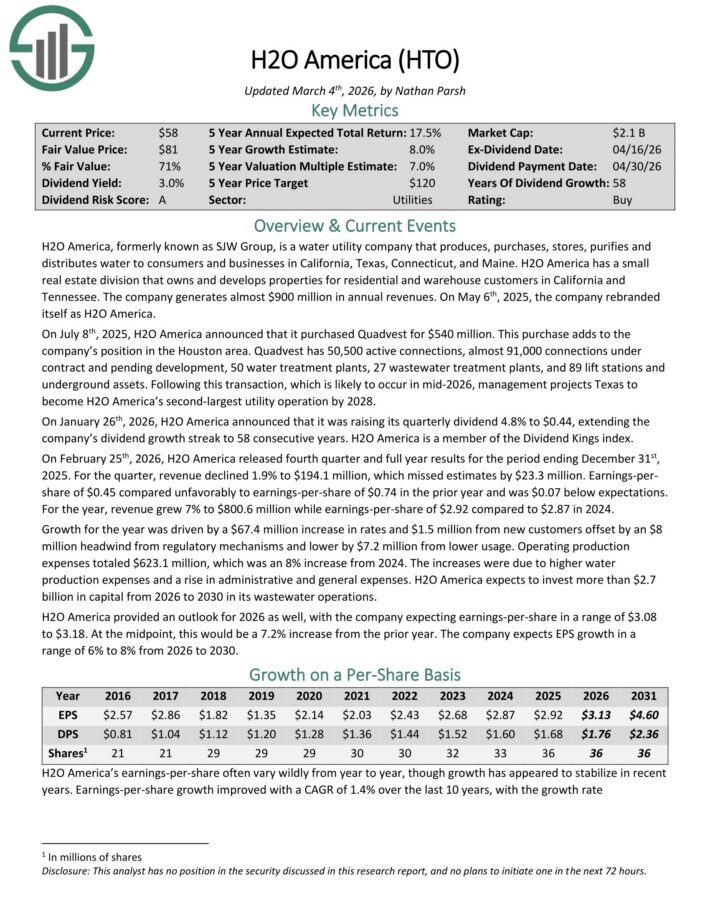
H2O America, formerly known as SJW Group, is a water utility company that produces, purchases, stores, purifies and distributes water to consumers and businesses in the Silicon Valley area of California, the area north of San Antonio, Texas, Connecticut, and Maine.
It also has a small real estate division that owns and develops properties for residential and warehouse customers in California and Tennessee. The company generates about $670 million in annual revenues.
On January 26th, 2026, H2O America raised its quarterly dividend 4.8% to $0.44, extending the company’s dividend growth streak to 58 consecutive years.
On February 25th, 2026, H2O America released fourth quarter and full year results for the period ending December 31st, 2025. For the quarter, revenue declined 1.9% to $194.1 million, which missed estimates by $23.3 million.
Earnings-per-share of $0.45 compared unfavorably to earnings-per-share of $0.74 in the prior year and was $0.07 below expectations.
For the year, revenue grew 7% to $800.6 million while earnings-per-share of $2.92 compared to $2.87 in 2024.
Growth for the year was driven by a $67.4 million increase in rates and $1.5 million from new customers offset by an $8 million headwind from regulatory mechanisms and lower by $7.2 million from lower usage.
H2O America provided an outlook for 2026 as well, with the company expecting earnings-per-share in a range of $3.08 to $3.18. At the midpoint, this would be a 7.2% increase from the prior year.
Click here to download our most recent Sure Analysis report on HTO (preview of page 1 of 3 shown below):
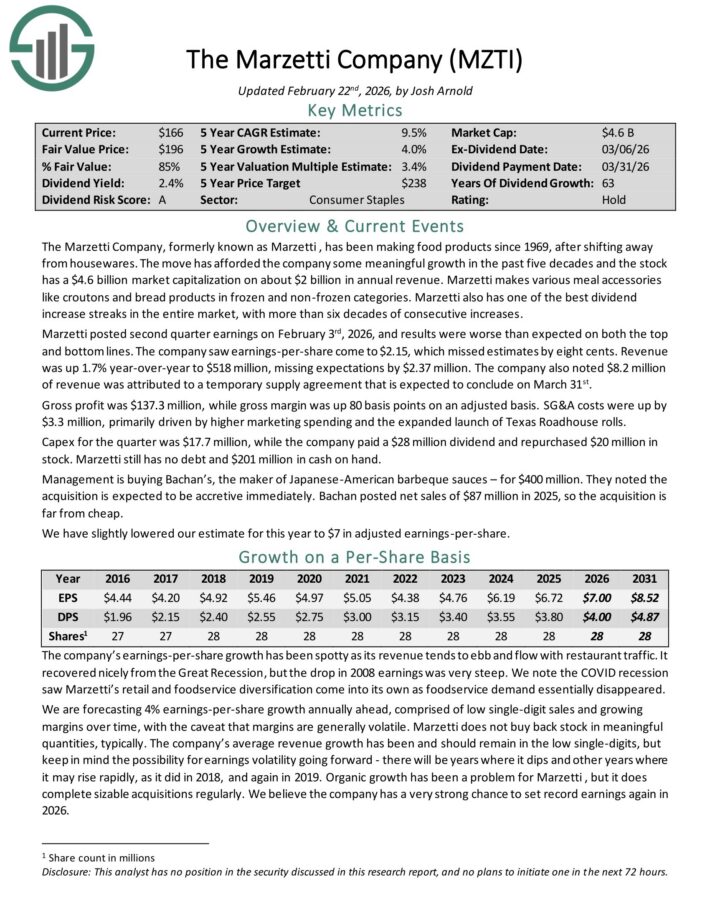
Dividend King #3: The Marzetti Company (MZTI)
- 5-Year Annual Expected Returns: 18.7%
The Marzetti Company has been making food products since 1969. Marzetti makes various meal accessories like croutons and bread products in frozen and non-frozen categories.
Marzetti also has one of the best dividend increase streaks in the entire market, with more than six decades of consecutive increases.
Marzetti posted second quarter earnings on February 3rd, 2026, and results were worse than expected on both the top and bottom lines. The company saw earnings-per-share come to $2.15, which missed estimates by eight cents.
Revenue was up 1.7% year-over-year to $518 million, missing expectations by $2.37 million. The company also noted $8.2 million of revenue was attributed to a temporary supply agreement that is expected to conclude on March 31st.
Gross profit was $137.3 million, while gross margin was up 80 basis points on an adjusted basis. SG&A costs were up by $3.3 million, primarily driven by higher marketing spending and the expanded launch of Texas Roadhouse rolls.
Capex for the quarter was $17.7 million, while the company paid a $28 million dividend and repurchased $20 million in stock. Marzetti still has no debt and $201 million in cash on hand.
Management is buying Bachan’s, the maker of Japanese-American barbeque sauces – for $400 million. They noted the acquisition is expected to be accretive immediately.
Click here to download our most recent Sure Analysis report on MZTI (preview of page 1 of 3 shown below):
Dividend King #2: S&P Global (SPGI)
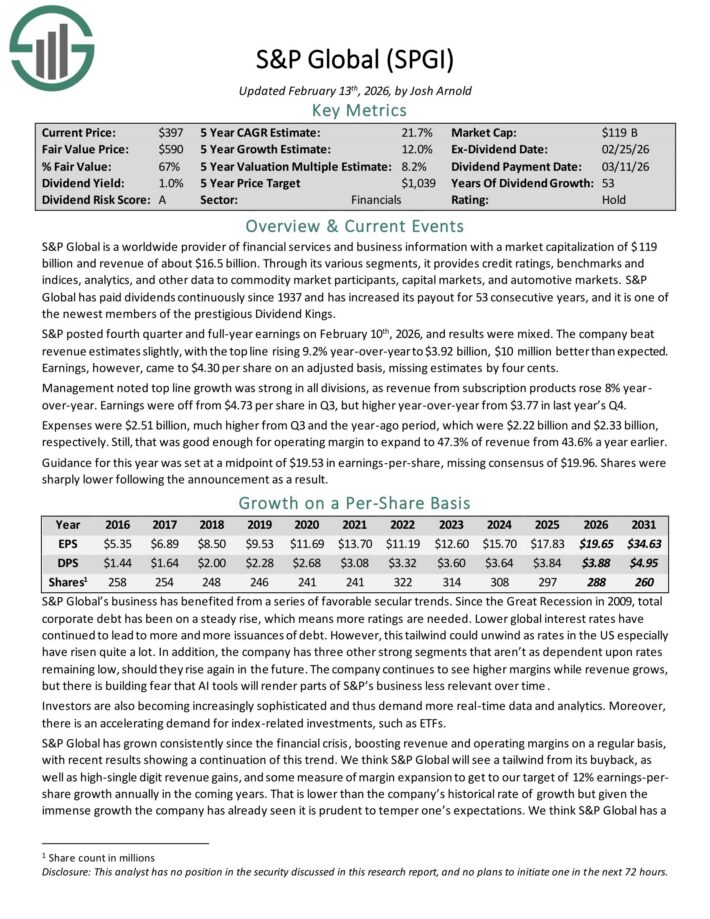
- 5-Year Annual Expected Returns: 21.9%
S&P Global is a worldwide provider of financial services and business information with revenue of about $16.5 billion.
Through its various segments, it provides credit ratings, benchmarks and indices, analytics, and other data to commodity market participants, capital markets, and automotive markets.
S&P Global has paid dividends continuously since 1937 and has increased its payout for 53 consecutive years.
S&P posted fourth quarter and full-year earnings on February 10th, 2026, and results were mixed. The company beat revenue estimates slightly, with the top line rising 9.2% year-over-year to $3.92 billion, $10 million better than expected.
Earnings, however, came to $4.30 per share on an adjusted basis, missing estimates by four cents. Management noted top line growth was strong in all divisions, as revenue from subscription products rose 8% year-over-year.
Earnings were off from $4.73 per share in Q3, but higher year-over-year from $3.77 in last year’s Q4.
Expenses were $2.51 billion, much higher from Q3 and the year-ago period, which were $2.22 billion and $2.33 billion, respectively. Still, that was good enough for operating margin to expand to 47.3% of revenue from 43.6% a year earlier.
Click here to download our most recent Sure Analysis report on SPGI (preview of page 1 of 3 shown below):
Dividend King #1: Stepan Co. (SCL)
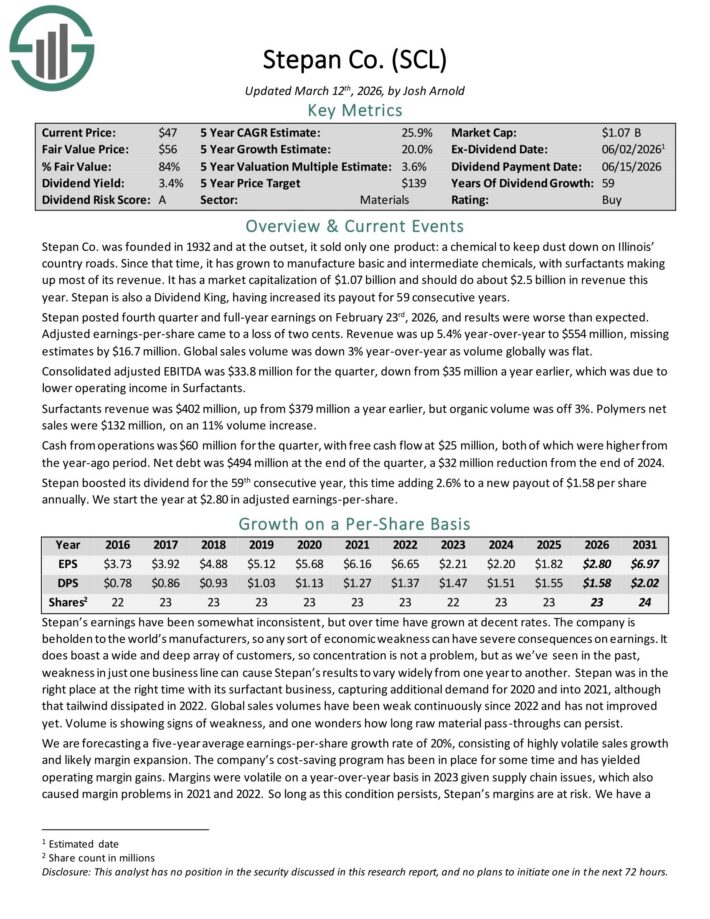
- 5-Year Annual Expected Returns: 23.6%
Stepan manufactures basic and intermediate chemicals, including surfactants, specialty products, germicidal and fabric softening quaternaries, phthalic anhydride, polyurethane polyols and special ingredients for the food, supplement, and pharmaceutical markets.
It is organized into three distinct business lines: surfactants, polymers, and specialty products. These businesses serve a wide variety of end markets, meaning that Stepan is not beholden to just a handful of industries.
The surfactants business is Stepan’s largest by revenue, accounting for ~68% of total sales in the most recent quarter. A surfactant is an organic compound that contains both water-soluble and water-insoluble components.
Stepan posted fourth quarter and full-year earnings on February 23rd, 2026. Adjusted earnings-per-share came to a loss of two cents.
Revenue was up 5.4% year-over-year to $554 million, missing estimates by $16.7 million. Global sales volume was down 3% year-over-year as volume globally was flat.
Consolidated adjusted EBITDA was $33.8 million for the quarter, down from $35 million a year earlier, which was due to lower operating income in Surfactants.
Surfactants revenue was $402 million, up from $379 million a year earlier, but organic volume was off 3%. Polymers net sales were $132 million, on an 11% volume increase.
Cash from operations was $60 million for the quarter, with free cash flow at $25 million, both of which were higher from the year-ago period. Net debt was $494 million at the end of the quarter, a $32 million reduction from the end of 2024.
Stepan boosted its dividend for the 59th consecutive year.
Click here to download our most recent Sure Analysis report on SCL (preview of page 1 of 3 shown below):
The Dividend Kings In Focus Series
You can see analysis on every single Dividend King below. The newest Sure Analysis Research Database report for each security is included as well.
Consumer Staples
- Altria Group (MO) | [See newest Sure Analysis report]
- Archer-Daniels-Midland (ADM) | [See newest Sure Analysis report]
- Colgate-Palmolive (CL) | [See newest Sure Analysis report]
- Coca-Cola (KO) | [See newest Sure Analysis report]
- Hormel Foods (HRL) | [See newest Sure Analysis report]
- Kimberly-Clark (KMB) | [See newest Sure Analysis report]
- Marzettig Company (MZTI) | [See newest Sure Analysis report]
- PepsiCo (PEP) | [See newest Sure Analysis report]
- Procter & Gamble (PG) [See newest Sure Analysis report]
- Sysco Corporation (SYY) | [See newest Sure Analysis report]
- Target Corporation (TGT) | [See newest Sure Analysis report]
- Tootsie Roll Industries (TR) | [See newest Sure Analysis report]
- Universal Corporation (UVV) | [See newest Sure Analysis report]
- Walmart (WMT) | [See newest Sure Analysis report]
Industrials
- ABM Industries (ABM) | [See newest Sure Analysis report]
- Automatic Data Processing (ADP) | [See newest Sure Analysis report]
- Dover (DOV) | [See newest Sure Analysis report]
- Emerson Electric (EMR) | [See newest Sure Analysis report]
- Gorman-Rupp Co. (GRC) | [See newest Sure Analysis report]
- Illinois Tool Works (ITW) | [See newest Sure Analysis report]
- MSA Safety (MSA) | [See newest Sure Analysis report]
- Nordson Corporation (NDSN) | [See newest Sure Analysis report]
- Parker-Hannifin (PH) | [See newest Sure Analysis report]
- Pentair (PNR) | [See newest Sure Analysis report]
- Stanley Black & Decker (SWK) | [See newest Sure Analysis report]
- Tennant Co. (TNC) | [See newest Sure Analysis report]
- W.W. Grainger (GWW) | [See newest Sure Analysis report]
Health Care
- Abbott Laboratories (ABT) | [See newest Sure Analysis report]
- AbbVie Inc. (ABBV) | [See newest Sure Analysis report]
- Becton, Dickinson & Company (BDX) | [See newest Sure Analysis report]
- Johnson & Johnson (JNJ) | [See newest Sure Analysis report]
- Kenvue Inc. (KVUE) | [See newest Sure Analysis report]
Consumer Discretionary
- Genuine Parts Company (GPC) | [See newest Sure Analysis report]
- Lowe’s Companies (LOW) | [See newest Sure Analysis report]
Financials
- Commerce Bancshares Inc. (CBSH) | [See newest Sure Analysis report]
- Cincinnati Financial (CINF) | [See newest Sure Analysis report]
- Farmers & Merchants Bancorp (FMCB) | [See newest Sure Analysis report]
- RLI Corp. (RLI) | [See newest Sure Analysis report]
- S&P Global (SPGI) | [See newest Sure Analysis report]
- United Bankshares (UBSI) | [See newest Sure Analysis report]
Materials
- H.B. Fuller (FUL) | [See newest Sure Analysis report]
- PPG Industries (PPG) | [See newest Sure Analysis report]
- Nucor (NUE) | [See newest Sure Analysis report]
- RPM International (RPM) | [See newest Sure Analysis report]
- Sonoco Products (SON) | [See newest Sure Analysis report]
- Stepan Co. (SCL) | [See newest Sure Analysis report]
Energy
Real Estate
Utilities
- American States Water (AWR) | [See newest Sure Analysis report]
- Black Hills Corp. (BKH) | [See newest Sure Analysis report]
- California Water Service Group (CWT) | [See newest Sure Analysis report]
- Canadian Utilities (CDUAF) | [See newest Sure Analysis report]
- Consolidated Edison (ED) | [See newest Sure Analysis report]
- Fortis Inc. (FTS) | [See newest Sure Analysis report]
- MGE Energy (MGEE) | [See newest Sure Analysis report]
- Middlesex Water Company (MSEX) | [See newest Sure Analysis report]
- Northwest Natural Holding (NWN) | [See newest Sure Analysis report]
- H2O America (HTO) | [See newest Sure Analysis report]
Performance Of The Dividend Kings
The Dividend Kings under-performed the S&P 500 ETF (SPY) in May 2026. Return data for the month is shown below:
- Dividend Kings monthly total return: 0.9%
- SPY monthly total return: 5.3%
Stable dividend growers like the Dividend Kings tend to underperform in bull markets and outperform on a relative basis during bear markets.
The Dividend Kings are not officially regulated and monitored by any one company. There’s no Dividend King ETF. This means that tracking the historical performance of the Dividend Kings can be difficult.
More specifically, performance tracking of the Dividend Kings often introduces significant survivorship bias.
Survivorship bias occurs when one looks at only the companies that ‘survived’ the time period in question. In the case of Dividend Kings, this means that the performance study does not include ex-Kings that reduced their dividend, were acquired, etc.
But with that said, there is something to be gained from investigating the historical performance of the Dividend Kings. Specifically, the performance of the Dividend Kings shows that ‘boring’ established blue-chip stocks that increase their dividend year-after-year can significantly outperform over long periods of time.
Notes: S&P 500 performance is measured using the S&P 500 ETF (SPY). The Dividend Kings performance is calculated using an equal weighted portfolio of today’s Dividend Kings, rebalanced annually. Due to insufficient data, Farmers & Merchants Bancorp (FMCB) returns are from 2000 onward. Performance excludes previous Dividend Kings that ended their streak of dividend increases which creates notable lookback/survivorship bias. The data for this study is from Ycharts.
In the next section of this article, we will provide an overview of the sector and market capitalization characteristics of the Dividend Kings.
Sector & Market Capitalization Overview
The sector and market capitalization characteristics of the Dividend Kings are very different from the characteristics of the broader stock market.
The following bullet points show the number of Dividend Kings in each sector of the stock market.
- Consumer Staples: 14
- Industrials: 13
- Utilities: 9
- Consumer Discretionary: 2
- Health Care: 5
- Financials: 6
- Materials: 5
- Real Estate: 1
- Energy: 1
- Communication Services: 0
The Dividend Kings are overweight in the Industrials, Consumer Staples, and Utilities sectors. Interestingly, The Dividend Kings have zero stocks from the Information Technology sector, which is the largest component of the S&P 500 index.
The Dividend Kings also have some interesting characteristics with respect to market capitalization. These trends are illustrated below.
- 6 Mega caps ($200 billion+ market cap; ABT, ABBV, JNJ, PG, KO, WMT)
- 27 Large caps ($10 billion to $200 billion market cap)
- 17 Mid caps ($2 billion to $10 billion)
- 8 Small caps ($300 million to $2 billion)
Interestingly, 26 out of the 58 Dividend Kings have market capitalizations below $10 billion. This shows that corporate longevity doesn’t have to be accompanied by massive size.
Final Thoughts
Screening to find the best Dividend Kings is not the only way to find high-quality dividend growth stock ideas.
Sure Dividend maintains similar databases on the following useful universes of stocks:
- The High Yield Dividend Kings List is comprised of the 20 Dividend Kings with the highest current yields.
- The Dividend Aristocrats: S&P 500 stocks with 25+ years of consecutive dividend increases.
- The Complete List of High Dividend Stocks: Stocks with 5%+ dividend yields.
- The Complete List of Monthly Dividend Stocks: our database currently contains over 100 stocks that pay dividends every month.
There is nothing magical about investing in the Dividend Kings. They are simply a group of high-quality businesses with shareholder-friendly management teams that have strong competitive advantages.
Purchasing businesses with these characteristics at fair or better prices and holding them for long periods of time will likely result in strong long-term investment performance.