Updated on October 14th, 2026 by Nikolaos Sismanis
The Dividend Kings are the best-of-the-best in dividend longevity.
What is a Dividend King? A stock with 50 or more consecutive years of dividend increases.
You can see the full downloadable spreadsheet of all 60 Dividend Kings below.
It includes metrics that matter: years of dividend growth, dividend yields, payout ratios, buy/hold/sell ratings, fair value prices, expected total returns, and much more.
This research report analyzes the 20 highest-yielding Dividend Kings today.
These stocks combine incredible dividend-growth longevity with solid, higher starting yields.
Table of Contents
- High-Yield Dividend King #20: H2O America (HTO)
- High-Yield Dividend King #19: Target Corporation (TGT)
- High-Yield Dividend King #18: McDonald’s Corporation (MCD)
- High-Yield Dividend King #17: Genuine Parts Company (GPC)
- High-Yield Dividend King #16: United Bankshares (UBSI)
- High-Yield Dividend King #15: Consolidated Edison (ED)
- High-Yield Dividend King #14: Fortis Inc. (FTS)
- High-Yield Dividend King #13: Black Hills Corporation (BKH)
- High-Yield Dividend King #12: Stanley Black & Decker (SWK)
- High-Yield Dividend King #11: Canadian Utilities (CDUAF)
- High-Yield Dividend King #10: The Marzetti Company (MZTI)
- High-Yield Dividend King #9: Northwest Natural Holding (NWN)
- High-Yield Dividend King #8: Federal Realty Investment Trust (FRT)
- High-Yield Dividend King #7: Sonoco Products (SON)
- High-Yield Dividend King #6: PepsiCo Inc. (PEP)
- High-Yield Dividend King #5: Kenvue Inc. (KVUE)
- High-Yield Dividend King #4: Kimberly-Clark Corporation (KMB)
- High-Yield Dividend King #3: Hormel Foods Corporation (HRL)
- High-Yield Dividend King #2: Altria Group (MO)
- High-Yield Dividend King #1: Universal Corporation (UVV)
High-Yield Dividend King #20: H2O America (HTO)
- Dividend Yield: 3.0%
- Dividend Risk Score: A
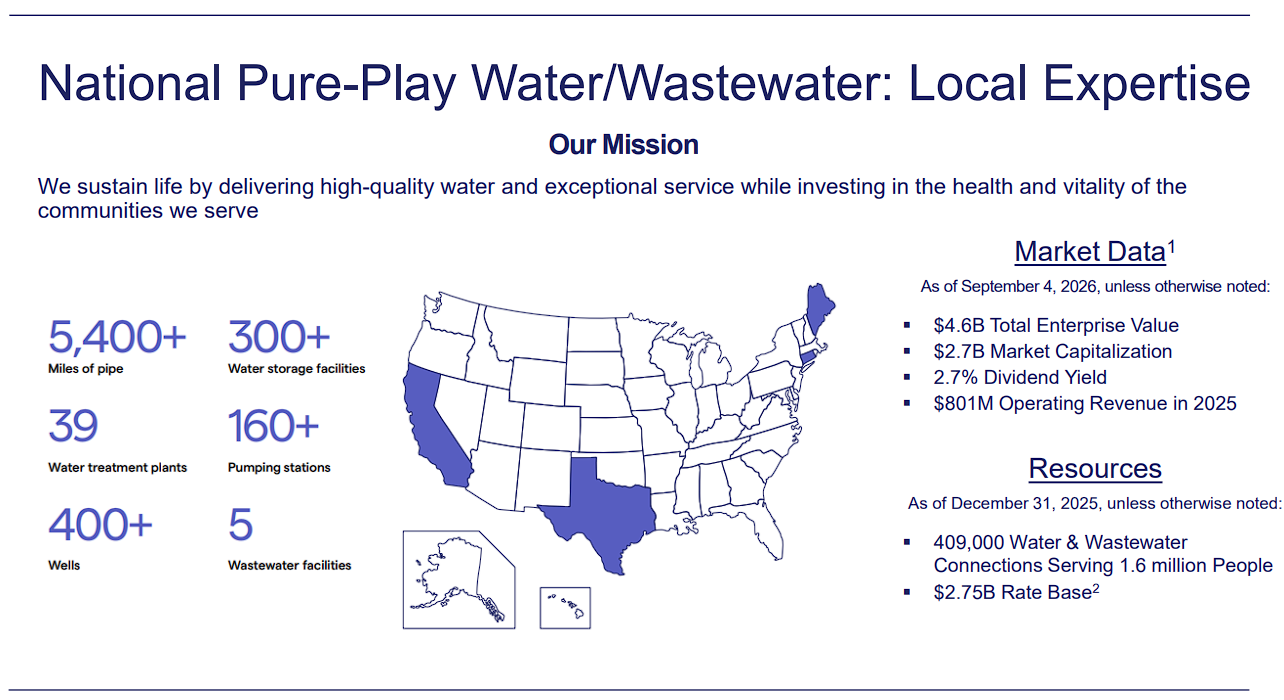
H2O America is a regulated water utility serving customers in California, Connecticut, Maine, and Texas.
The essential nature of water service, regulated rate recovery, and long-lived infrastructure make its earnings relatively predictable.
H2O America has paid dividends for more than 80 years and has increased the payout for 58 consecutive years.
Its quarterly dividend is $0.44, equivalent to $1.76 annually.
Second-quarter 2026 revenue increased 6% to $210.5 million, and adjusted net income rose 17% to $30.7 million.
Adjusted earnings per share declined to $0.72 from $0.75 because of a higher share count, while rate increases added $14.5 million of revenue.
Management maintained standalone 2026 adjusted earnings-per-share guidance of $3.08 to $3.18, excluding Quadvest and its financing.
The company invested $206.9 million in infrastructure during the first half and targets $483 million for the year within a $2.7 billion five-year capital plan.
On October 1st, H2O America completed its $540 million Quadvest acquisition, more than doubling its water and wastewater connections in Texas.
The deal expands its Houston-area presence, with Texas expected to represent 26% of total customers by 2029 versus 8% before closing.
Regulated investment and customer growth should support dividend increases, although financing, integration, and the timing of rate recovery remain important risks.
Deep Dive: Click here to download (for free) our most recent 3-Page Sure Analysis PDF report on H2O America.
High-Yield Dividend King #19: Target Corporation (TGT)
- Dividend Yield: 3.0%
- Dividend Risk Score: A
Target is a major U.S. discount retailer with roughly 2,000 stores, a national digital platform, and a merchandise mix spanning essentials, food, apparel, beauty, and home goods.
Stores also serve as fulfillment hubs, making the physical network central to Target’s same-day delivery and pickup strategy.
Second-quarter 2026 results extended the improvement seen earlier in the year.
Net sales increased 5.3% to $26.5 billion, comparable sales rose 3.8%, and comparable traffic grew 3.6%.
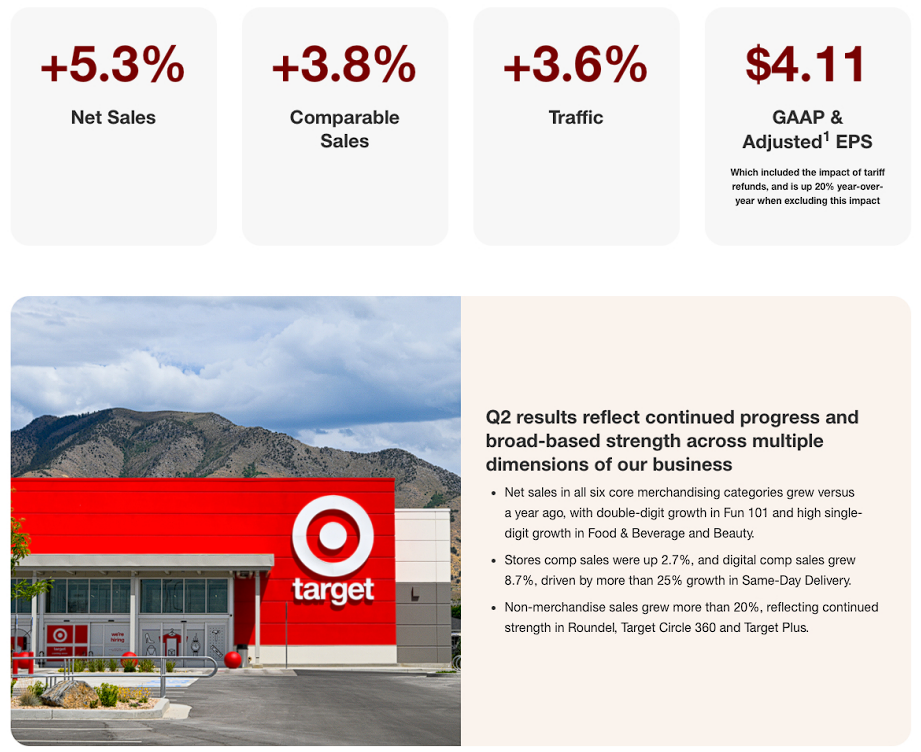
Store comparable sales advanced 2.7%, while digital comparable sales increased 8.7%, led by more than 25% growth in same-day delivery.
GAAP and adjusted earnings per share doubled to $4.11, including $1.65 per share of tariff-refund benefits.
Excluding those refunds, earnings per share still increased 20%, while gross margin expanded about 100 basis points from the prior year.
Management now expects full-year net sales growth around 5% and earnings per share of $9.90 to $10.90, including the second-quarter refund benefit.
Target raised its annualized dividend to $4.64 in 2026, continuing more than five decades of consecutive annual increases.
The projected payout ratio is about 46%, leaving meaningful coverage and supporting its A Dividend Risk Score, although the one-time refund should not be treated as recurring earnings power.
Deep Dive: Click here to download (for free) our most recent 3-Page Sure Analysis PDF report on Target.
High-Yield Dividend King #18: McDonald’s Corporation (MCD)
- Dividend Yield: 3.3%
- Dividend Risk Score: A
McDonald’s is a global restaurant company operating more than 46,000 locations, with approximately 95% franchised or licensed.
Royalties, rents, brand recognition, and valuable real estate support recurring cash generation while franchisees fund most restaurant operating costs.
On September 17th, McDonald’s raised its quarterly dividend 4% to $1.93, or $7.72 annually, marking its 50th consecutive year of increases and entry into the Dividend Kings.
The first payment at the new rate is scheduled for December 15th.
Second-quarter revenue increased 4% to $7.1 billion, while adjusted diluted earnings per share rose 6% to $3.38.
Global comparable sales grew 1.3%, including 0.8% in the United States, where higher average checks offset weaker guest counts.
At its September Investor Day, McDonald’s introduced NEXT targets focused on gaining share in chicken and beverages and improving restaurant productivity.
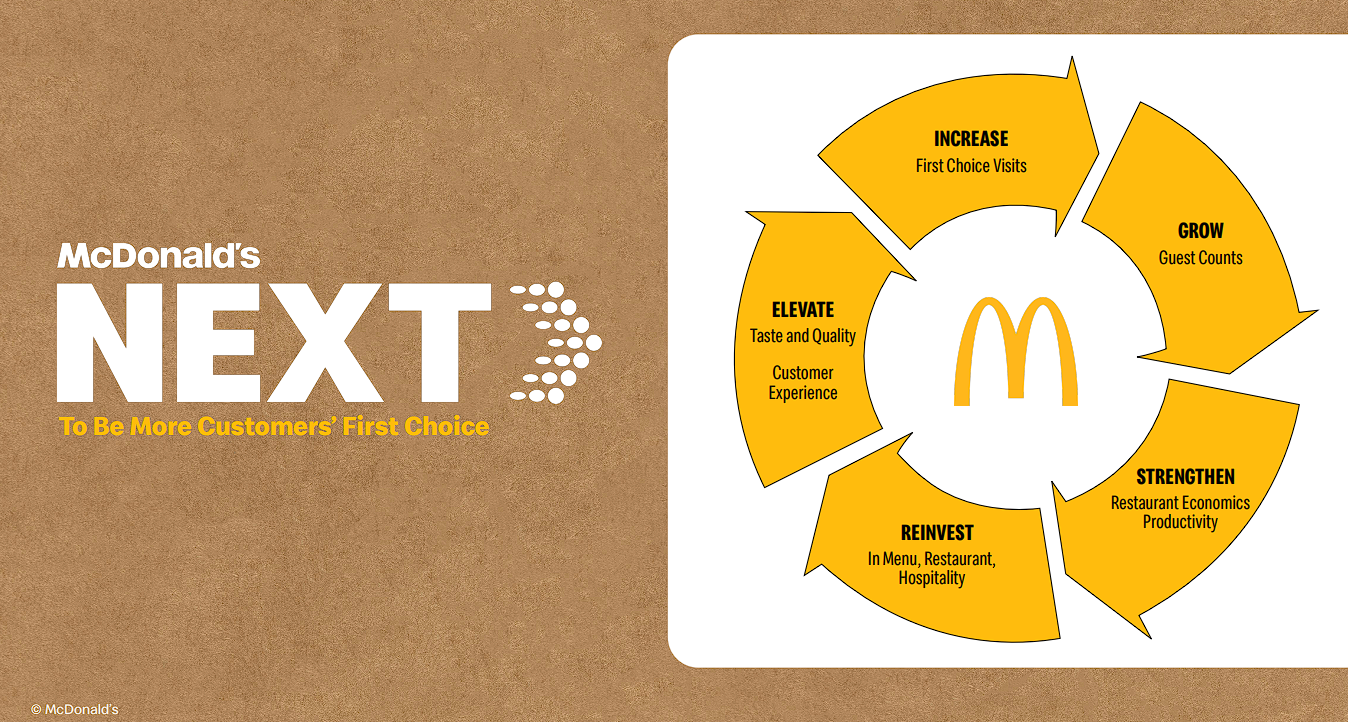
Management aims to reach operating margins in the low-to-mid 50% range by 2030 and deliver approximately 250 basis points of restaurant-level efficiency gains.
These are targets rather than assured results, with affordability and franchisee economics central to execution.
The annualized dividend represents approximately 60% of our earnings estimate, providing reasonable coverage.
McDonald’s franchised model supports its A Dividend Risk Score, although consumer spending pressure, debt, and investment requirements remain relevant risks.
Deep Dive: Click here to download (for free) our most recent 3-Page Sure Analysis PDF report on McDonald’s.
High-Yield Dividend King #17: Genuine Parts Company (GPC)
- Dividend Yield: 3.3%
- Dividend Risk Score: A
Genuine Parts Company distributes automotive and industrial replacement parts through businesses such as NAPA and Motion.
Demand is supported by the need to maintain an aging vehicle fleet and industrial equipment, although results still respond to manufacturing activity, consumer spending, and cost inflation.
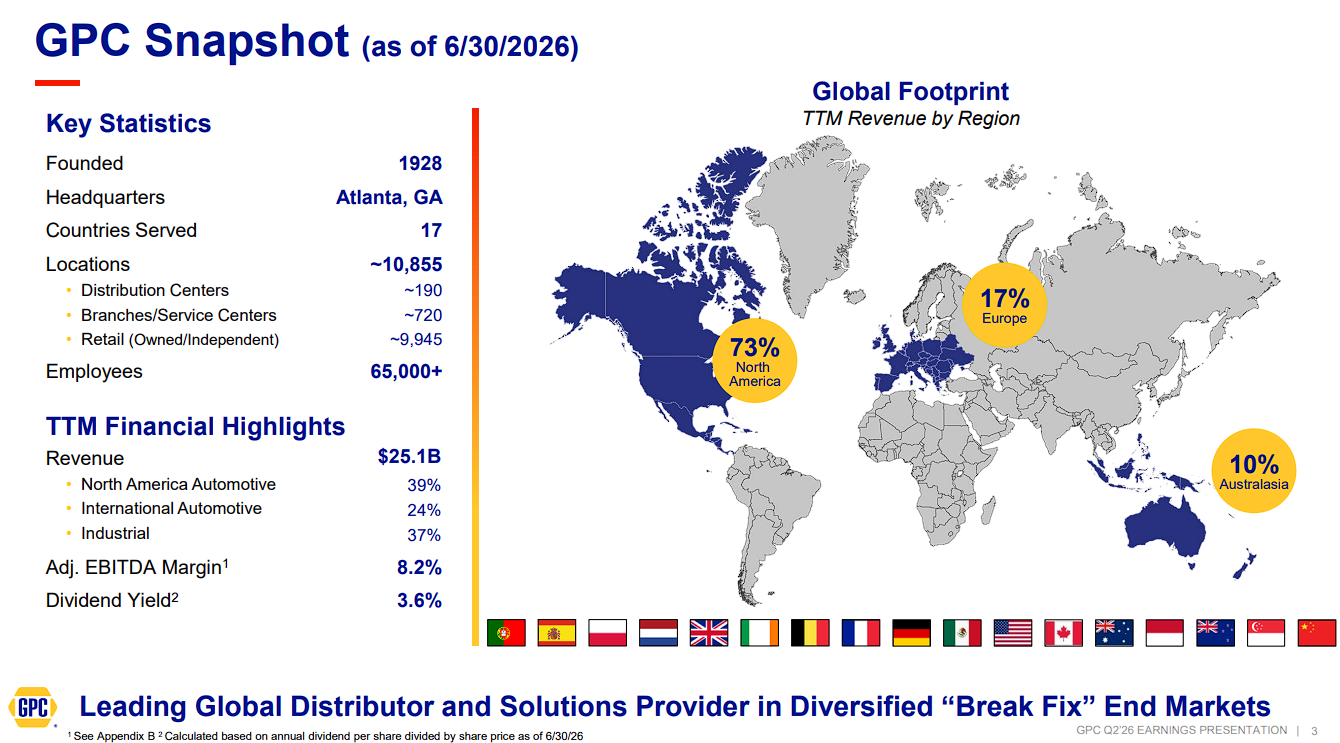
Second-quarter 2026 sales rose 6.0% to $6.5 billion, including 3.4% comparable growth, a 1.4% currency benefit, and a 1.2% contribution from acquisitions.
Adjusted earnings-per-share increased to $2.15 from $2.10.
North American Automotive sales grew 3.8%, while International Automotive sales advanced 8.2%.
Management reaffirmed adjusted earnings guidance of $7.50 to $8.00 per share for the year.
The major development is Genuine Parts’ plan to separate its global Automotive and Industrial businesses into two publicly traded companies, with completion targeted for the first quarter of 2027.
The separation could create sharper strategic focus, but execution costs and the future dividend policies of both companies deserve attention.
Genuine Parts has increased its dividend for 70 consecutive years, tying it for one of the longest streaks in the market.
The current annualized payout is $4.25, with a projected payout ratio near 55%, supporting its A Dividend Risk Score before the planned separation.
Deep Dive: Click here to download (for free) our most recent 3-Page Sure Analysis PDF report on Genuine Parts Company.
High-Yield Dividend King #16: United Bankshares (UBSI)
- Dividend Yield: 3.3%
- Dividend Risk Score: B
United Bankshares is a regional bank holding company operating primarily across the Mid-Atlantic and Southeast.
Decades of acquisitions have expanded the franchise to roughly $34 billion of assets, while its community-banking model remains centered on deposits, commercial and consumer lending, and wealth-management services.
Second-quarter 2026 earnings reached a record $131.4 million, or $0.95 per diluted share, up from $0.85 a year earlier and $0.89 in the first quarter.
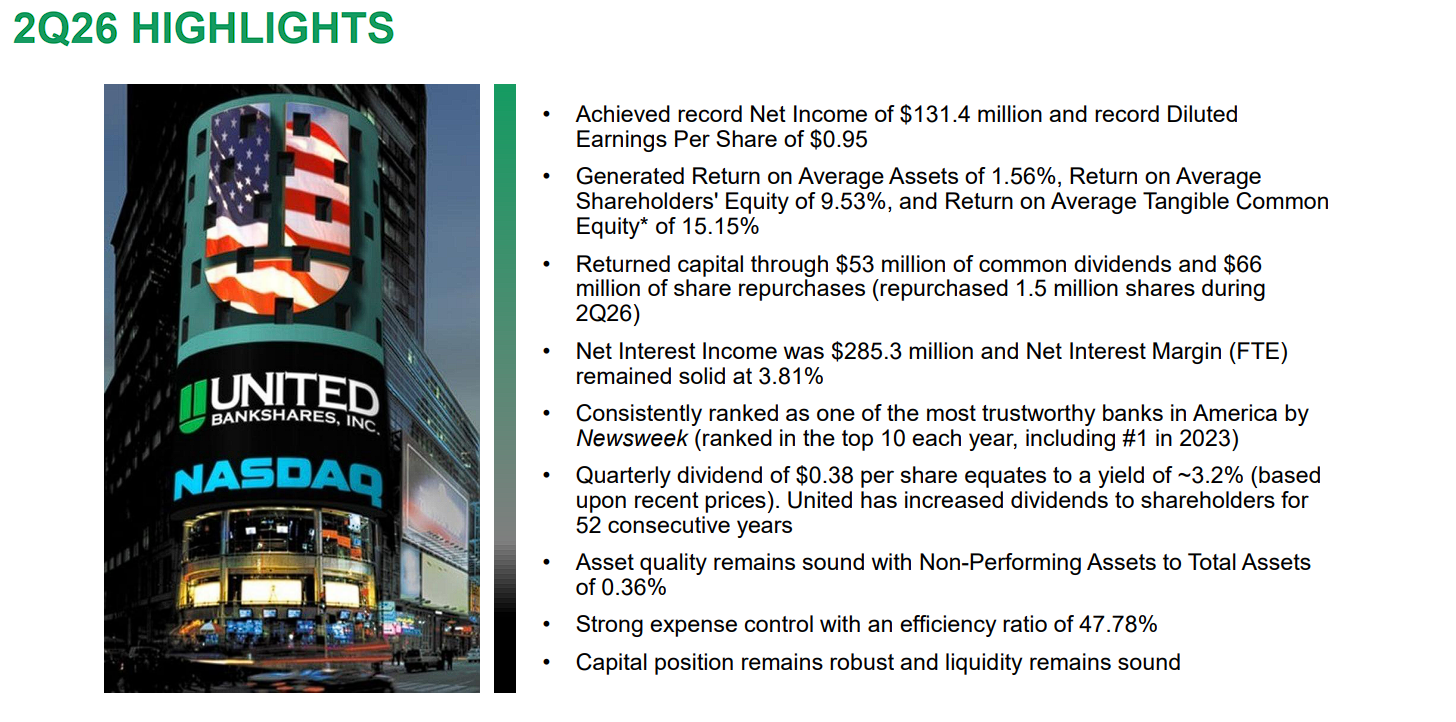
Net interest income increased sequentially to $285.3 million, and the net interest margin improved one basis point to 3.81%.
Lower funding costs helped offset a modest decline in loan yields, while asset quality remained an important support for profitability.
United Bankshares has raised its dividend for 52 consecutive years, a rare achievement for a bank given the industry’s repeated credit cycles.
The annualized payout is $1.52 per share, and the projected payout ratio is only about 41%, leaving meaningful coverage if credit costs normalize from favorable levels.
In August, United authorized repurchases of up to 6.8 million shares, approximately 5% of its outstanding stock.
Capital strength and disciplined underwriting support a B Dividend Risk Score and distinguish UBSI from many higher-yielding regional banks.
Deep Dive: Click here to download (for free) our most recent 3-Page Sure Analysis PDF report on United Bankshares.
High-Yield Dividend King #15: Consolidated Edison (ED)
- Dividend Yield: 3.3%
- Dividend Risk Score: B
Consolidated Edison is a regulated utility holding company serving New York City and surrounding areas with electricity, natural gas, and steam.
Its earnings are driven primarily by approved rate-base investment, making regulatory outcomes, financing costs, and project execution more important than short-term electricity demand.
Second-quarter 2026 revenue rose to $4.07 billion from $3.60 billion, while adjusted earnings-per-share increased to $0.83 from $0.68 and exceeded expectations.
Higher electric sales and continued recovery of infrastructure investment supported the quarter.
Management reaffirmed full-year adjusted earnings guidance of $6.00 to $6.20 per share.
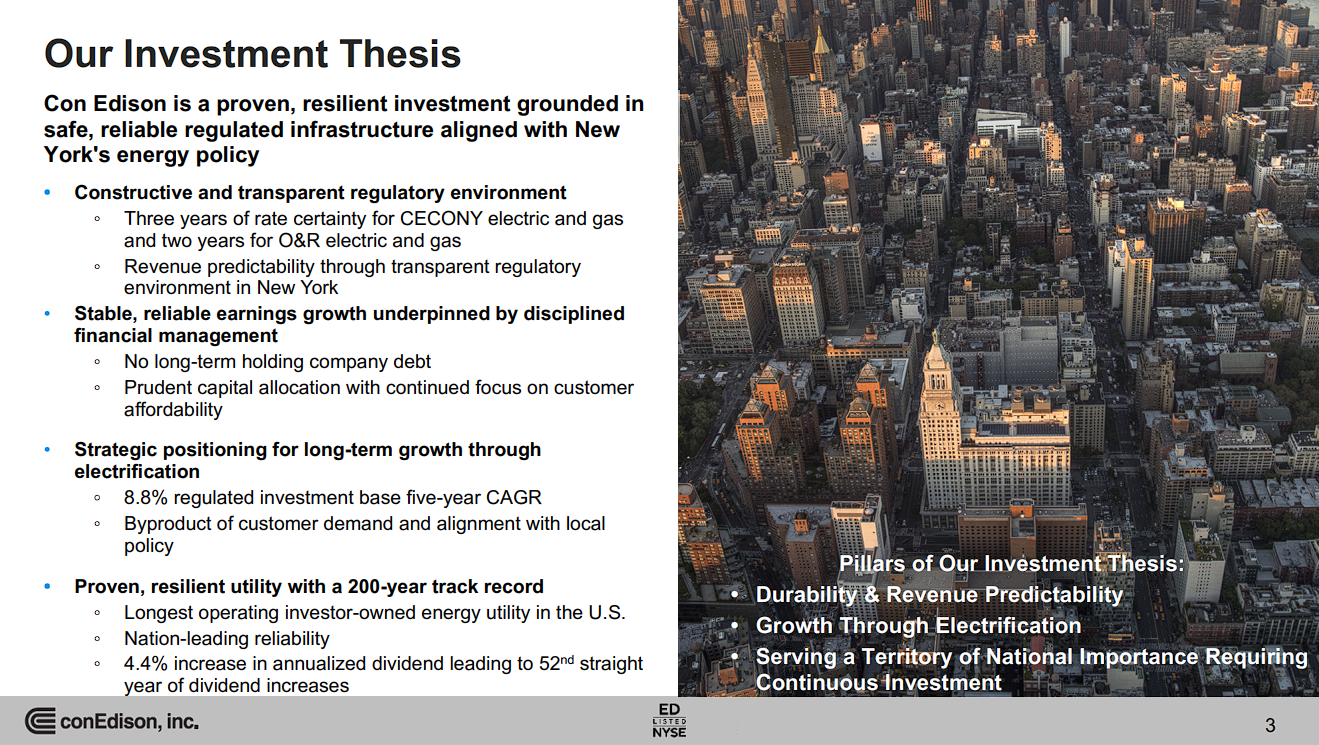
Its October investor update highlighted projected 8.7% annual growth in its investment earnings base through 2030, supported by electrification and infrastructure modernization.
The projection includes a September steam-rate joint proposal that still requires regulatory approval, while substantial capital needs require continued access to debt and equity markets.
The company raised its quarterly dividend 4.4% to $0.8875 in January 2026, extending its growth streak to 52 consecutive years.
That record is unusual among utilities with large urban infrastructure needs, while a projected payout ratio near 58% provides reasonable coverage and supports the B Dividend Risk Score.
Deep Dive: Click here to download (for free) our most recent 3-Page Sure Analysis PDF report on Consolidated Edison.
High-Yield Dividend King #14: Fortis Inc. (FTS)
- Dividend Yield: 3.4%
- Dividend Risk Score: A
Fortis is a North American regulated electric and gas utility with operations in Canada, the United States, and the Caribbean.
Approximately 95% of its assets are transmission and distribution infrastructure, giving the company predictable earnings while geographic and regulatory diversification reduces dependence on any single jurisdiction.
Second-quarter 2026 net earnings increased to C$396 million, or C$0.78 per share, from C$384 million, or C$0.76 per share, a year earlier.
Rate-base growth and higher retail electricity sales at UNS Energy supported the improvement.
Fortis invested C$2.7 billion during the first half and remains on track with its C$5.6 billion capital program for 2026.
The C$28.8 billion five-year capital plan is expected to grow the midyear rate base at a 7% annual rate through 2030.
British Columbia also approved the Tilbury LNG Phase 1B expansion, creating investment opportunities beyond the current plan.
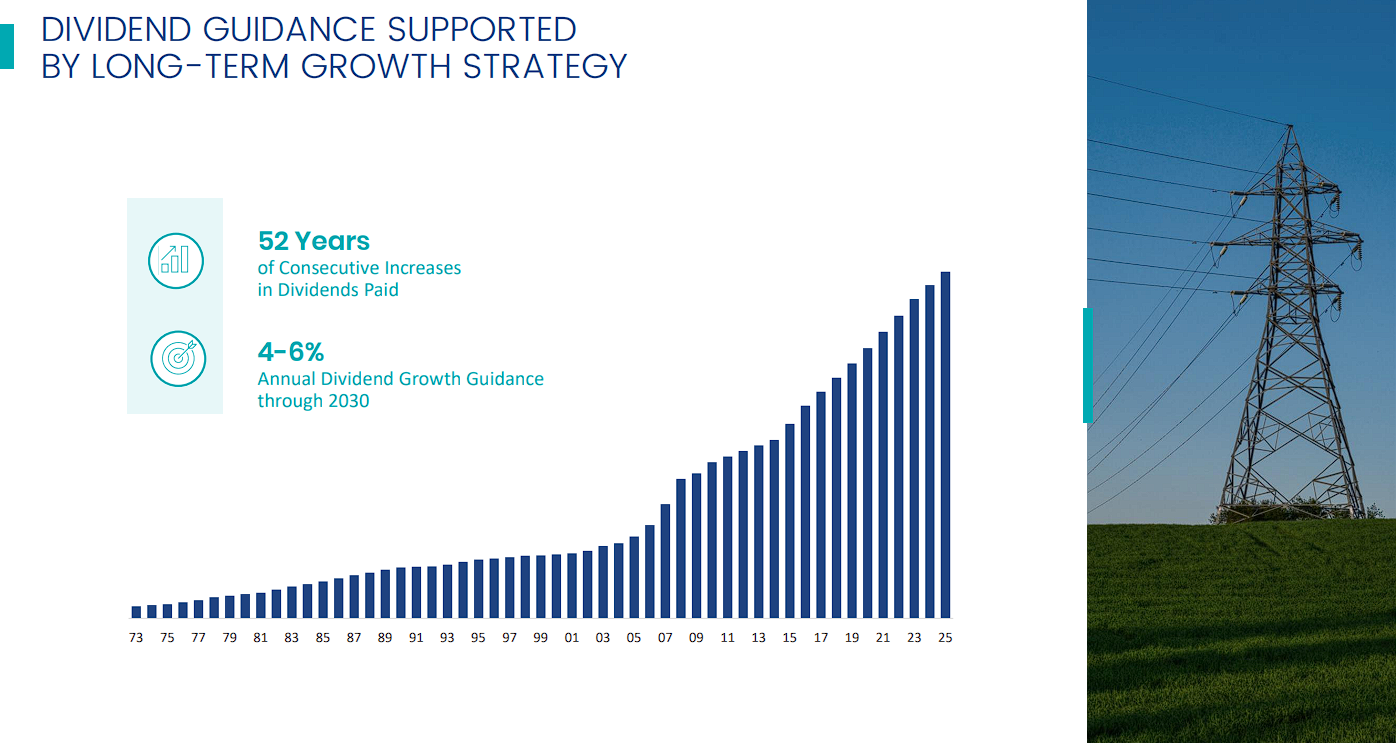
Fortis has increased its dividend for 52 consecutive years and targets 4% to 6% annual dividend growth through 2030.
U.S. investors should remember that the payout is declared in Canadian dollars, so the amount received in U.S. dollars moves with exchange rates.
In September, Fortis priced US$1 billion of junior subordinated notes, highlighting the financing required to support its capital program.
Deep Dive: Click here to download (for free) our most recent 3-Page Sure Analysis PDF report on Fortis.
High-Yield Dividend King #13: Black Hills Corporation (BKH)
- Dividend Yield: 3.7%
- Dividend Risk Score: A
Black Hills Corporation is a regulated electric and natural-gas utility serving approximately 1.37 million customers across eight states.
Rate-base investment supports earnings, while industrial and data-center demand creates growth opportunities in its Mountain West territories.
Second-quarter adjusted earnings per share increased to $0.54 from $0.38, excluding merger costs.
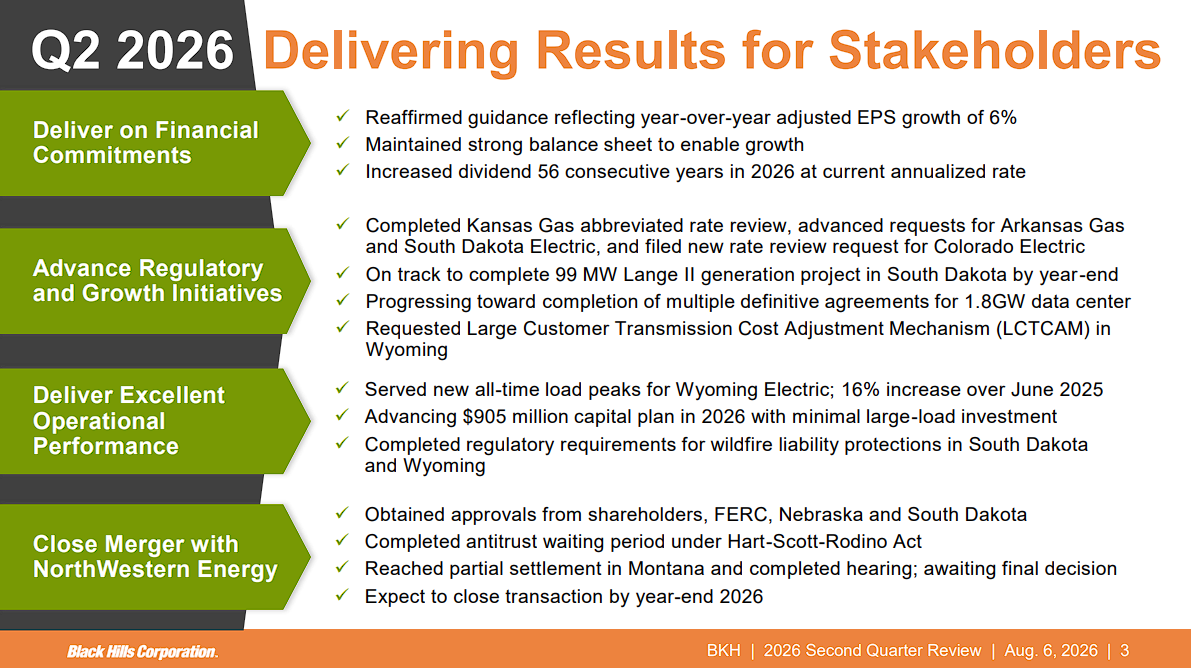
Management reaffirmed full-year adjusted earnings guidance of $4.25 to $4.45 per share.
On October 6th, Black Hills announced signed agreements to serve Google’s planned Cheyenne data center, replacing the earlier discussion of a potential project.
It plans $1.8 billion of company-owned natural-gas generation, providing up to 590 megawatts of grid-connected service while managing 2.1 gigawatts of third-party resources through a private microgrid.
The agreements run through 2048, with earnings contributions expected to begin in 2027 and reach approximately $150 million of annual net income by 2030.
Those projections depend on successful construction, financing, and customer deployment.
Black Hills’ proposed NorthWestern Energy merger also remains a separate regulatory and integration consideration.
The company has increased its dividend for 56 consecutive years.
Its quarterly payout is $0.703, equivalent to approximately $2.81 annually, or 65% of projected earnings.
That coverage supports its A Dividend Risk Score, although the expanded investment program makes capital discipline increasingly important.
Deep Dive: Click here to download (for free) our most recent 3-Page Sure Analysis PDF report on Black Hills Corporation.
High-Yield Dividend King #12: Stanley Black & Decker (SWK)
- Dividend Yield: 3.7%
- Dividend Risk Score: B
Stanley Black & Decker is a global manufacturer of tools and outdoor products under brands including DeWalt, Craftsman, Stanley, and Black+Decker.
Its earnings are cyclical because construction, home improvement, and industrial demand influence volumes, but the company has spent several years simplifying its portfolio and restoring margins.
Second-quarter 2026 revenue increased 1.3% to $4.0 billion, while organic sales grew 3%.
Adjusted earnings-per-share were $1.57, and adjusted gross margin expanded 620 basis points to 33.7%, although tariff refunds contributed about 250 basis points.
Free cash flow reached $698 million.
Stanley Black & Decker also reduced debt by $1.7 billion and repurchased $250 million of shares during the quarter.
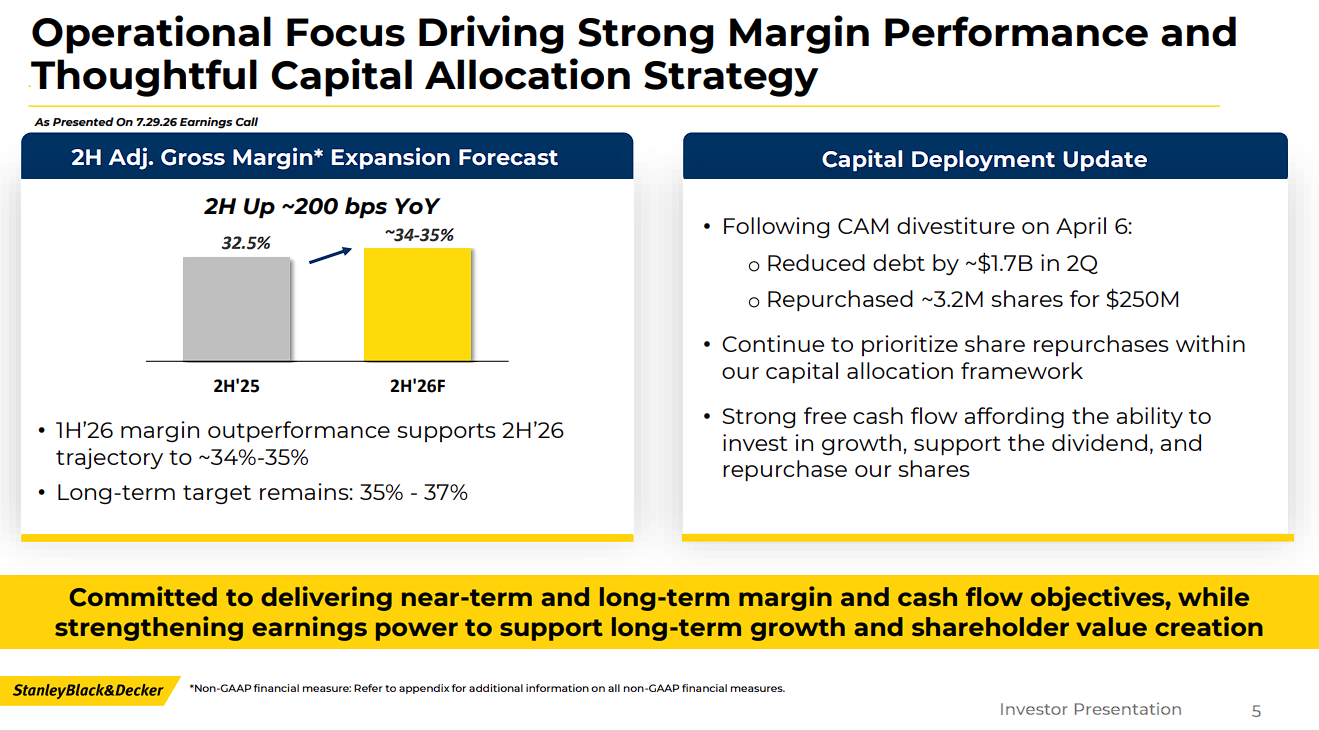
Management raised adjusted earnings guidance to $5.20 to $5.80 per share and increased its free-cash-flow outlook to $600 million to $800 million.
In September, the company agreed to sell Excel Industries to Bad Boy Mowers, further narrowing its portfolio toward its largest brands.
Stanley Black & Decker raised its quarterly dividend to $0.84 in July, bringing the declared annualized rate to $3.36 and continuing nearly six decades of increases.
Dividend growth has recently been modest, but recovering margins, lower debt, and stronger cash generation support its B Dividend Risk Score.
Deep Dive: Click here to download (for free) our most recent 3-Page Sure Analysis PDF report on Stanley Black & Decker.
High-Yield Dividend King #11: Canadian Utilities (CDUAF)
- Dividend Yield: 3.8%
- Dividend Risk Score: B
Canadian Utilities is an ATCO-controlled energy-infrastructure company with regulated electricity and natural-gas operations in Canada and Australia.
Regulated assets dominate investment, providing comparatively predictable earnings and a foundation for its 54-year dividend-growth record in Canadian dollars.
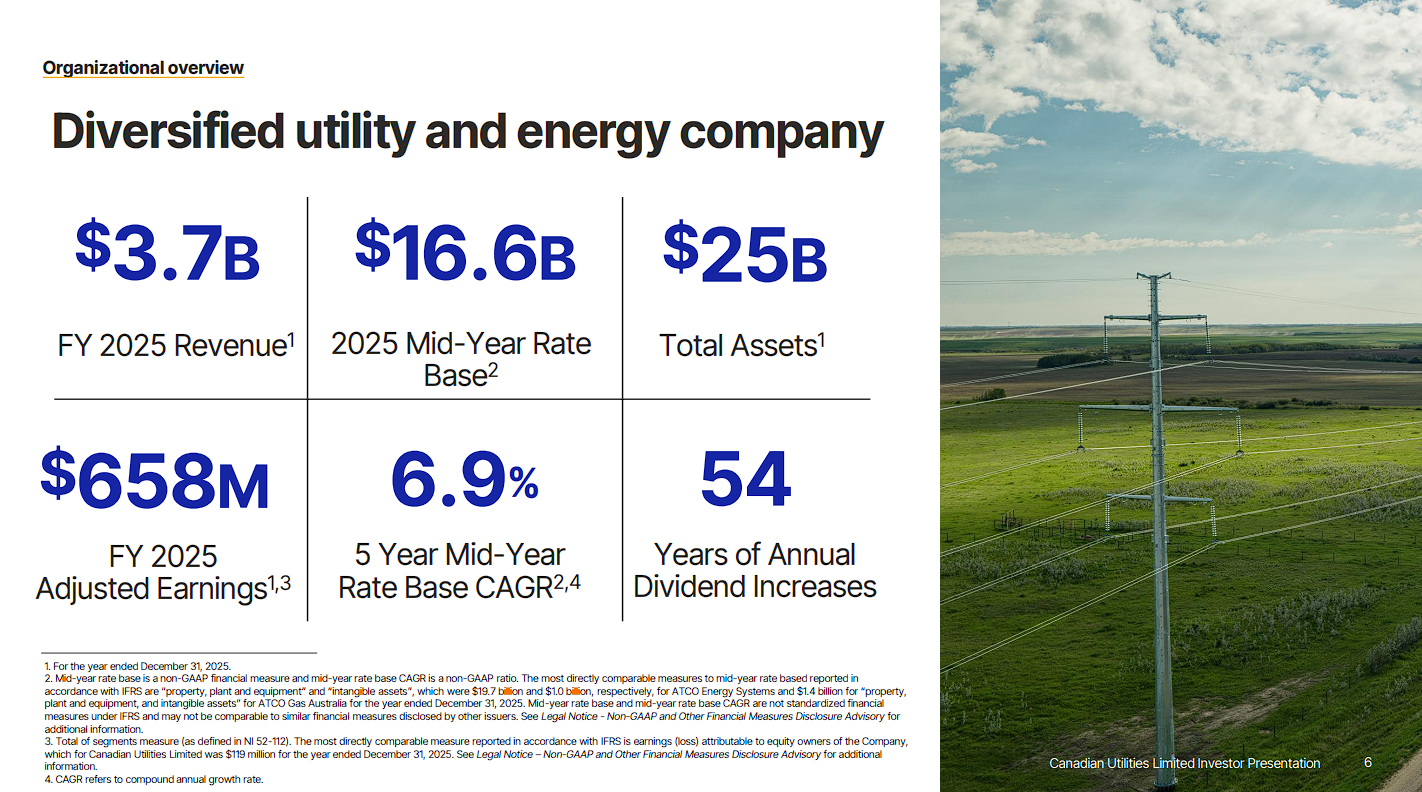
Second-quarter adjusted earnings increased 16% to C$140 million, or C$0.51 per share, while operating cash flow rose to C$557 million.
Capital investment totaled C$403 million, with 98% directed toward regulated utilities.
Its C$12 billion regulated capital plan through 2030 targets 6.9% annual rate-base growth, including the fully contracted Yellowhead Pipeline.
The major new development is the October 6th agreement to combine Canadian Utilities with Emera through an all-share transaction.
Canadian Utilities Class A shareholders would receive 0.755 Emera shares per share, with the combined company operating as Emera.
Closing is expected in the third or fourth quarter of 2027, subject to shareholder, court, and regulatory approvals.
The parties project approximately 20% higher dividend income for Class A holders, but future payouts will depend on Emera’s board.
Canadian Utilities currently pays C$0.4623 quarterly, and U.S.-dollar receipts fluctuate with exchange rates.
Its B Dividend Risk Score reflects capital requirements and dividend coverage, while the pending transaction adds a separate execution risk.
Deep Dive: Click here to download (for free) our most recent 3-Page Sure Analysis PDF report on Canadian Utilities.
High-Yield Dividend King #10: The Marzetti Company (MZTI)
- Dividend Yield: 3.9%
- Dividend Risk Score: A
The Marzetti Company, formerly Lancaster Colony, manufactures specialty food products for retail and foodservice customers.
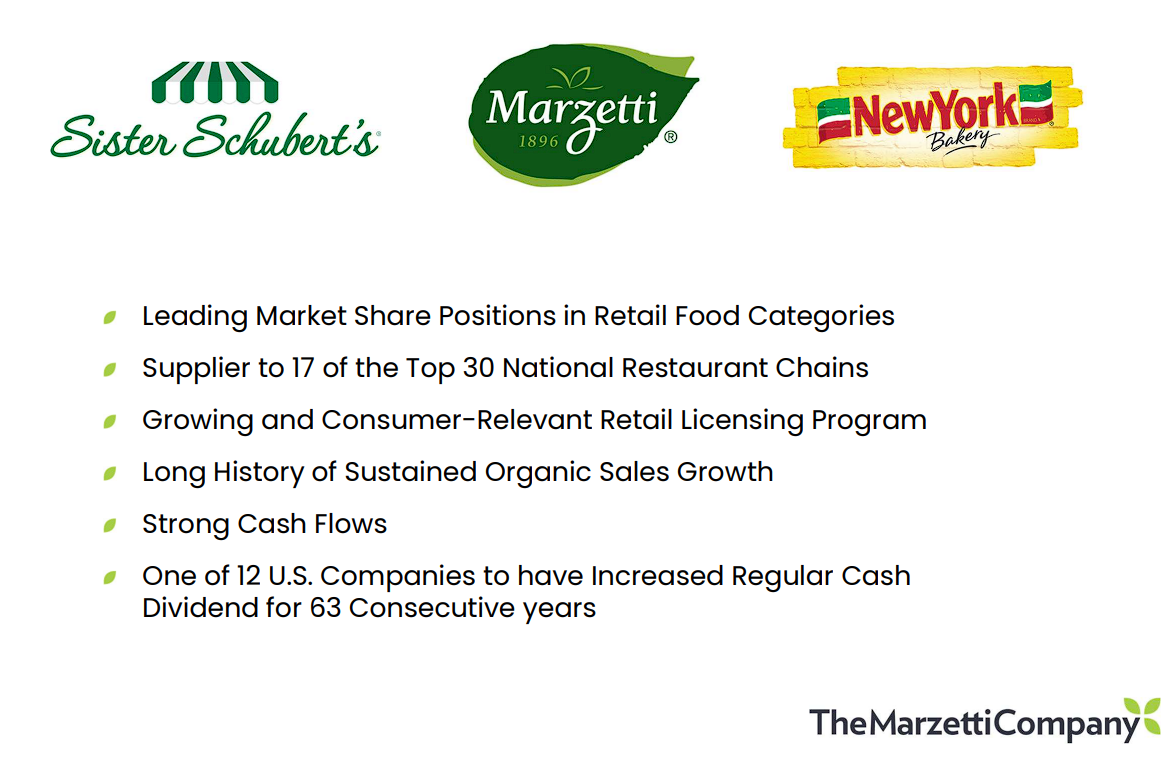
Its portfolio includes Marzetti dressings, New York Bakery products, Sister Schubert’s rolls, licensed restaurant sauces, and the recently acquired Bachan’s brand.
The company increased its regular cash dividend for the 63rd consecutive year in fiscal 2026, and the quarterly payout is $1.00 per share.
Fiscal fourth-quarter sales declined 2.2% to $465.0 million, but increased 0.4% after excluding non-core temporary supply-agreement revenue from the comparison.
Retail sales rose 0.9%, including $15.4 million from Bachan’s, while adjusted Foodservice sales were nearly flat.
Gross profit reached a fourth-quarter record of $114.0 million, gross margin expanded 220 basis points to 24.5%, and adjusted earnings per share increased 9% to $1.46.
For fiscal 2026, sales rose 1.1% to $1.93 billion, adjusted earnings per share increased to $6.83 from $6.72, and operating cash flow reached a record $283.8 million.
The $400 million Bachan’s acquisition adds a fast-growing sauce platform but also introduced a $200 million term loan and integration risk.
Successful brand expansion and further margin improvement are central to the outlook.
The projected payout ratio near 59% and steady food demand support Marzetti’s A Dividend Risk Score.
Deep Dive: Click here to download (for free) our most recent 3-Page Sure Analysis PDF report on The Marzetti Company.
High-Yield Dividend King #9: Northwest Natural Holding (NWN)
- Dividend Yield: 4.1%
- Dividend Risk Score: A
Northwest Natural Holding owns regulated natural-gas utilities in Oregon, Washington, and Texas, along with water and wastewater businesses across several states.
The acquisition of fast-growing SiEnergy and smaller Texas systems has broadened the company beyond its mature Pacific Northwest gas franchise.
Second-quarter 2026 adjusted earnings-per-share were $0.01, unchanged from the prior year but better than the expected seasonal loss.
Operating revenue increased to $243.6 million from $236.2 million.
First-half earnings-per-share reached $2.33, and management expects full-year earnings to finish in the upper half of its $2.95-to-$3.15 guidance range.
SiEnergy’s organic customer growth exceeded 15%, while water connections grew 3.4% over the past year.
NW Natural plans approximately $500 million to $550 million of capital spending in 2026 and continues to target 4% to 6% long-term earnings growth through 2030.
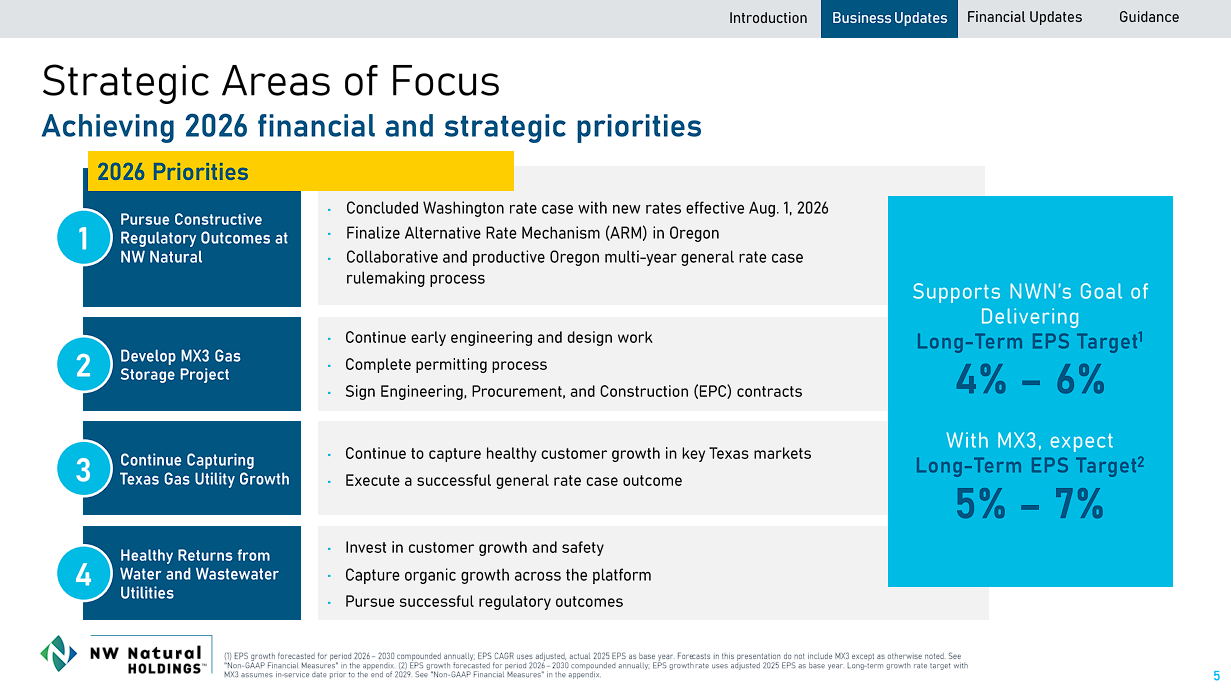
The proposed MX-3 gas-storage expansion could raise that range after a formal notice to proceed.
On October 8th, the company raised its quarterly dividend to $0.50, or $2.00 annually, marking its 71st consecutive year of increases.
Regulated cash flows and a projected payout ratio near 65% support an A Dividend Risk Score, although expansion still requires disciplined financing.
High-Yield Dividend King #8: Federal Realty Investment Trust (FRT)
- Dividend Yield: 4.4%
- Dividend Risk Score: A
Federal Realty Investment Trust owns high-quality open-air shopping centers and mixed-use properties in densely populated, affluent coastal markets.
The portfolio includes destinations such as Santana Row, Pike & Rose, and Assembly Row, where limited supply and strong tenant demand support above-average rents.
Second-quarter 2026 core funds from operations grew 6.8% to $1.88 per share.
Federal Realty signed 124 comparable retail leases covering 819,000 square feet, its highest quarterly leasing volume, with cash rent growth of 15%.
Adjusted comparable property operating income increased 4.2%, occupancy was 93.8%, and the leased rate reached 96.1%.
Management raised and narrowed full-year core FFO guidance to $7.48 to $7.56 per share.
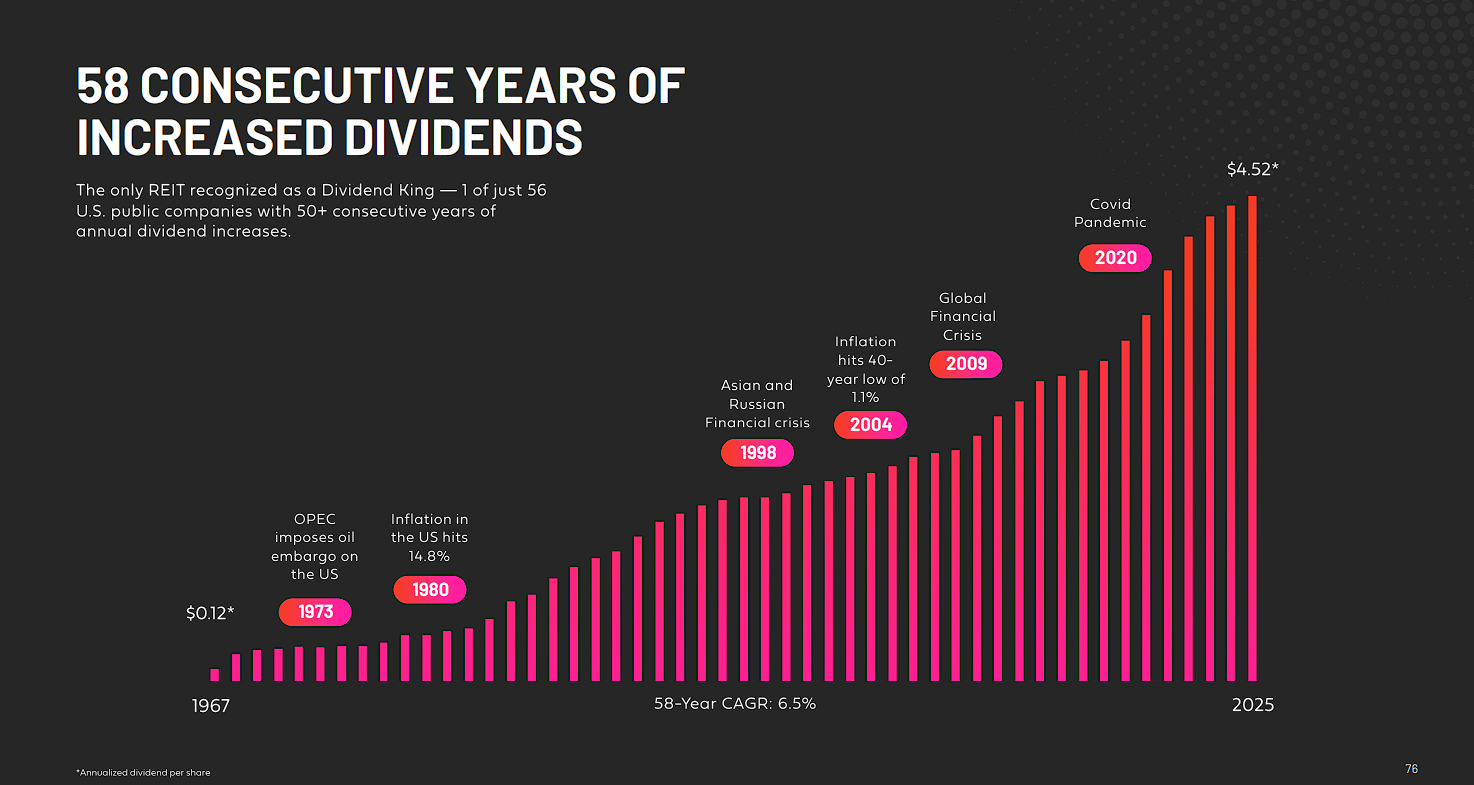
The REIT increased its quarterly dividend 2.7% to $1.16, producing an annualized payout of $4.64 and extending its growth streak to 59 consecutive years—the longest in the REIT sector.
On October 1st, Federal Realty acquired The Summit in Birmingham, Alabama, for $508 million, or $498 million net.
The approximately 870,000-square-foot property adds another dominant retail destination, with management expecting immediate accretion to FFO.
Premium locations, strong leasing spreads, and an FFO payout ratio near 62% support its A Dividend Risk Score, while acquisition financing and integration deserve attention.
High-Yield Dividend King #7: Sonoco Products (SON)
- Dividend Yield: 4.5%
- Dividend Risk Score: A
Sonoco Products is a global packaging company serving consumer and industrial customers.
Following several divestitures, the portfolio is more concentrated in Consumer Packaging and Industrial Paper Packaging, including metal and paper containers, rigid paper packaging, and uncoated recycled paperboard.
Second-quarter 2026 sales declined 1.3% to $1.9 billion, largely because of the November 2025 ThermoSafe divestiture.
Adjusted earnings-per-share increased 10.2% to $1.51, and adjusted net income rose 10.6% to $151 million.
Industrial Paper Packaging exceeded expectations as North American paperboard trade volume grew 6%, while company-wide productivity and cost controls offset inflation and a softer mix.
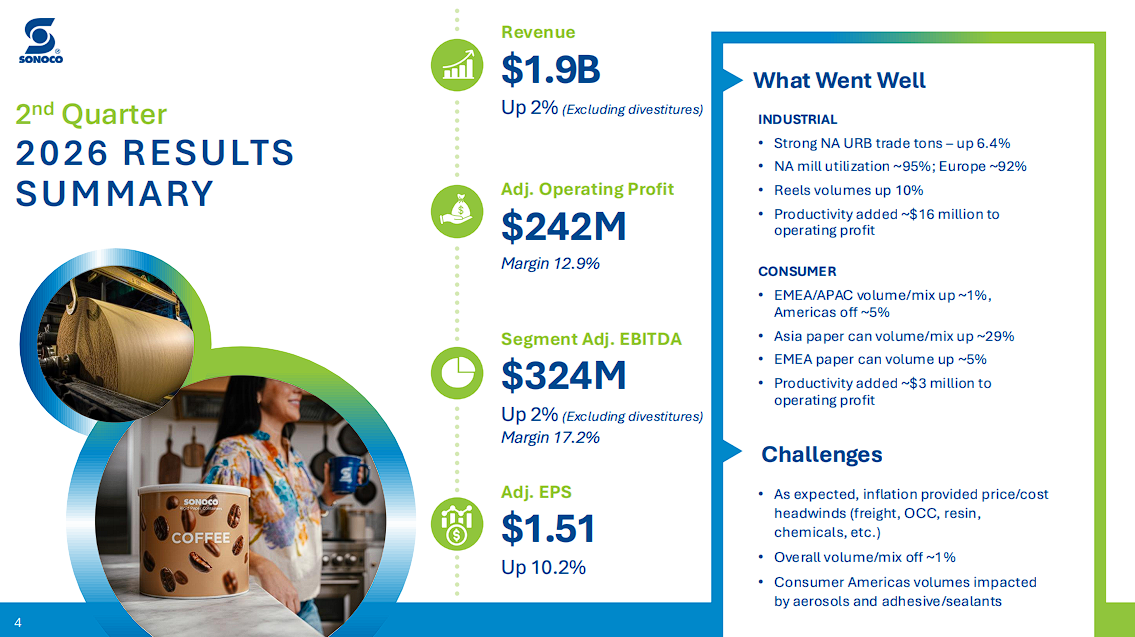
Operating cash flow reached a second-quarter record of $301 million.
Management reaffirmed adjusted earnings guidance of $5.80 to $6.20 per share, while indicating results are still likely to land toward the low end.
Sonoco’s metal-packaging expansion has increased leverage, making debt reduction and cash conversion important parts of the investment case.
The company raised its quarterly dividend to $0.54 in April 2026, extending its streak to exactly 50 consecutive years and qualifying it as a Dividend King.
The annualized $2.16 payout represents only about 37% of projected earnings, supporting an A Dividend Risk Score.
Deep Dive: Click here to download (for free) our most recent 3-Page Sure Analysis PDF report on Sonoco Products.
High-Yield Dividend King #6: PepsiCo Inc. (PEP)
- Dividend Yield: 4.7%
- Dividend Risk Score: A
PepsiCo combines a global beverage business with convenient-food brands such as Lay’s, Doritos, Cheetos, Gatorade, Quaker, and Pepsi-Cola.
Its diversified portfolio and distribution network support recurring demand, although North American consumers remain sensitive to prices.
On October 8th, PepsiCo reported third-quarter revenue of $25.27 billion, up 5.6%, with organic growth of 3.1%.
Core earnings per share increased 2% to $2.34, while core operating margin declined 35 basis points to 16.9%.
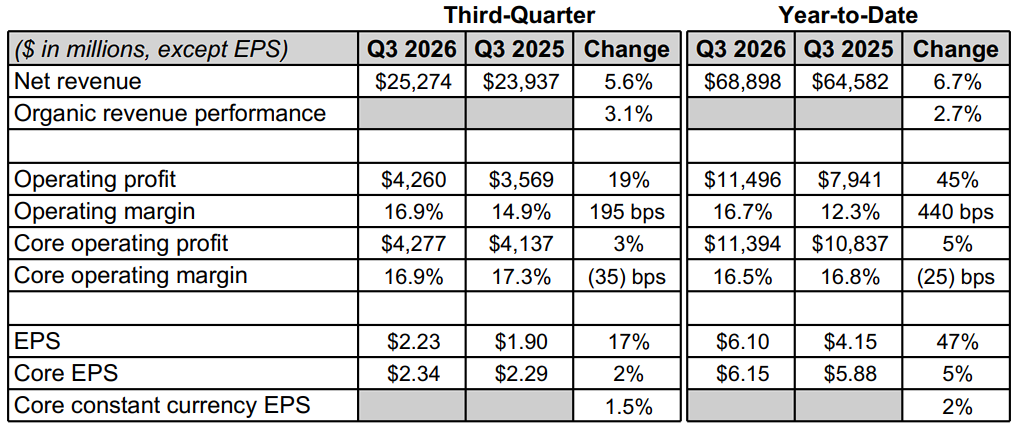
International operations remained strong and North American snack volumes improved, but cost inflation and additional marketing investment continued to pressure profitability.
Management cut its full-year core constant-currency earnings-growth outlook to 1% to 2%, versus the low end of the prior 4% to 6% range.
It now expects approximately 3% organic revenue growth and 2.5% to 3.5% core earnings-per-share growth.
Further structural cost reductions are intended to fund innovation, advertising, and stronger execution rather than simply defend near-term margins.
PepsiCo raised its annualized dividend 4% to $5.92 beginning with the June payment, extending its growth streak to 54 years.
The payout represents approximately 69% of our earnings estimate, leaving less room for rapid increases if growth remains subdued.
Its durable brands and cash generation support an A Dividend Risk Score, but restoring North American momentum remains important.
Deep Dive: Click here to download (for free) our most recent 3-Page Sure Analysis PDF report on PepsiCo.
High-Yield Dividend King #5: Kenvue Inc. (KVUE)
- Dividend Yield: 4.7%
- Dividend Risk Score: A
Kenvue is the world’s largest pure-play consumer-health company by revenue.
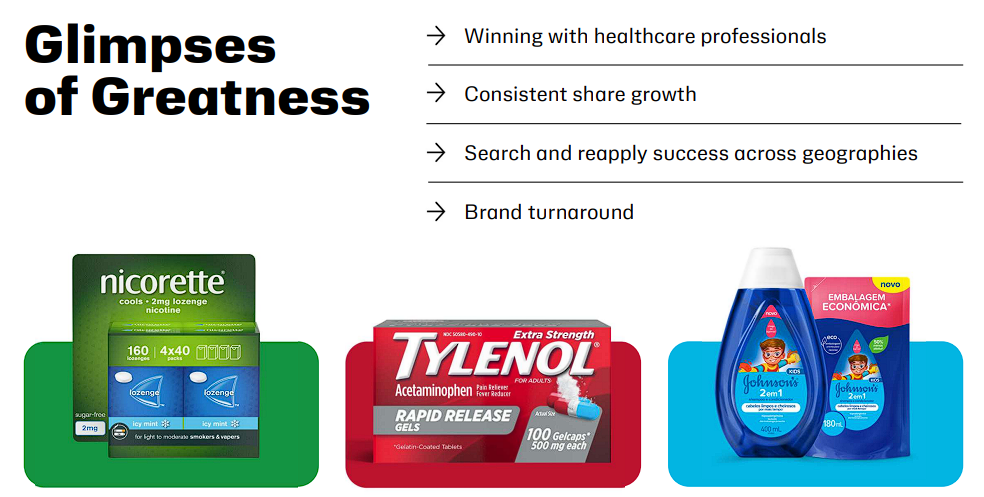
Its portfolio includes Tylenol, Listerine, Band-Aid, Neutrogena, Aveeno, Zyrtec, and Nicorette across Self Care, Skin Health and Beauty, and Essential Health.
Second-quarter 2026 net sales increased 3% to $3.96 billion, while organic sales rose 1.6% on a combination of pricing and volume growth.
Adjusted earnings-per-share were $0.31.
The results showed continued progress in the company’s operational reset, although earnings came in slightly below expectations and the Skin Health and Beauty portfolio still requires improvement.
Kenvue is preparing to be acquired by Kimberly-Clark in a transaction approved by shareholders in January and currently expected to close in the fourth quarter of 2026.
A workforce reduction of approximately 3.5% is part of its broader efficiency program, while consumer-health litigation remains a business risk.
Because the deal remains pending, Kenvue’s future dividend policy will ultimately depend on the combined company.
Kenvue’s stated 64-year growth streak includes the dividend history inherited from Johnson & Johnson before the 2023 separation.
The current annualized payout is $0.84 per share, and the consumer-health cash flows support an A Dividend Risk Score while the transaction is outstanding.
Deep Dive: Click here to download (for free) our most recent 3-Page Sure Analysis PDF report on Kenvue.
High-Yield Dividend King #4: Kimberly-Clark Corporation (KMB)
- Dividend Yield: 5.2%
- Dividend Risk Score: B
Kimberly-Clark sells essential personal-care and tissue products in more than 175 countries.
Its brands include Huggies, Kleenex, Cottonelle, Scott, Kotex, Poise, and Depend, many of which hold first- or second-place positions in their categories.
Second-quarter 2026 sales increased 0.6% to $4.19 billion, while organic sales declined 0.5%.
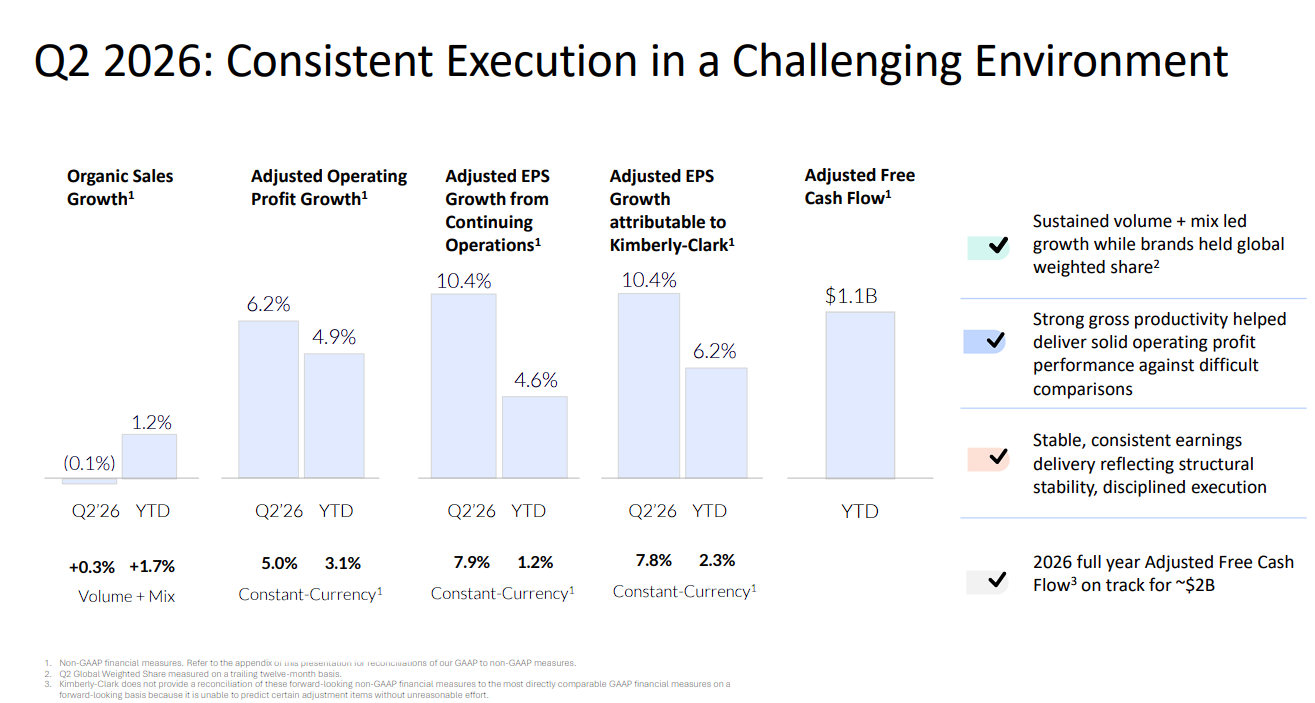
Adjusted earnings-per-share of $2.12 exceeded expectations as productivity savings, cost controls, and a tariff refund offset weaker revenue.
Results were pressured by U.S. retailer inventory reductions, a distribution-center fire, and a social-media controversy affecting Huggies demand in China.
Management lowered its full-year outlook to reflect the China disruption and higher oil-linked input costs.
Kimberly-Clark’s planned acquisition of Kenvue is expected to close in the fourth quarter, creating a much larger health-and-wellness company.
Management targets about $1.9 billion of cost synergies, but the purchase adds substantial integration and financing risk.
In September, Kimberly-Clark launched exchanges for up to $7 billion of Kenvue notes, conditional on the acquisition closing.
Kimberly-Clark has raised its dividend for 54 consecutive years and currently pays $5.12 annually.
The projected payout ratio is near 69%, providing adequate coverage, though deal execution and near-term cost pressure contribute to its B Dividend Risk Score.
Deep Dive: Click here to download (for free) our most recent 3-Page Sure Analysis PDF report on Kimberly-Clark.
High-Yield Dividend King #3: Hormel Foods Corporation (HRL)
- Dividend Yield: 6.1%
- Dividend Risk Score: B
Hormel Foods owns a broad collection of branded food products, including SPAM, Planters, Skippy, Applegate, Jennie-O, and Hormel Natural Choice.
Its brands and foodservice relationships provide durable demand, although commodity costs, consumer pressure, and retailer competition can weigh on margins.
Hormel increased its dividend for the 60th consecutive year, lifting the quarterly payout 1% to $0.2925 per share.
The August payment was its 392nd consecutive quarterly dividend.
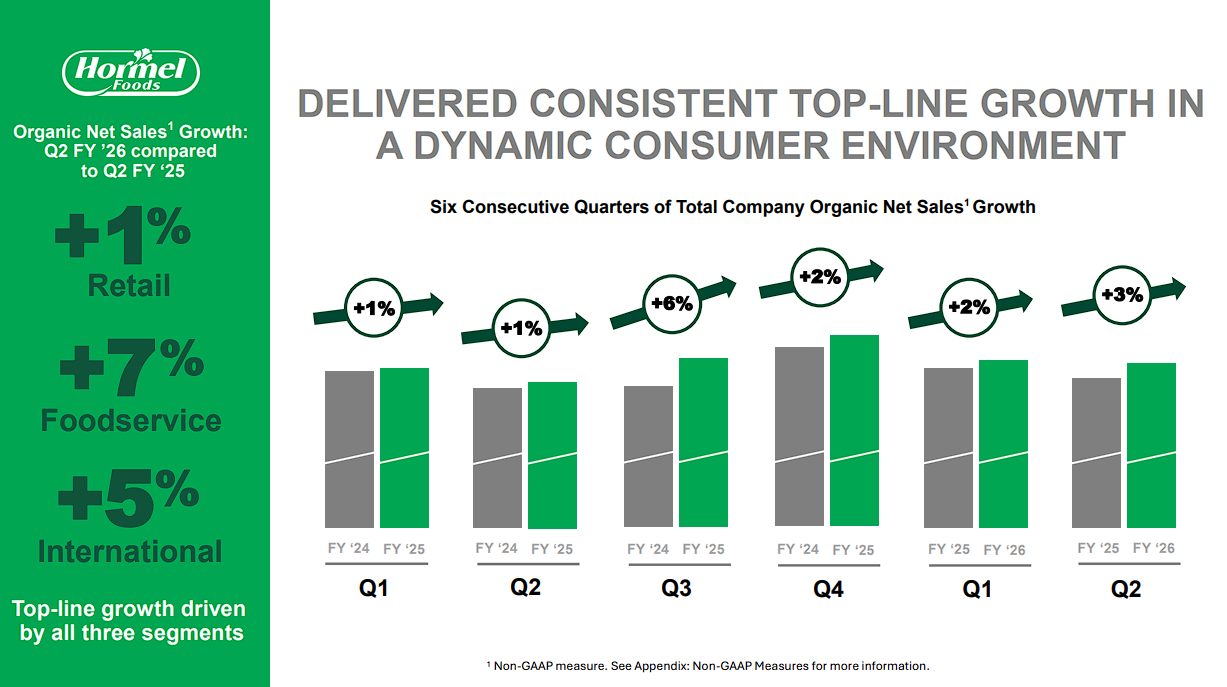
Fiscal third-quarter 2026 net sales were $2.96 billion, while organic net sales declined 2%.
Adjusted operating income increased to $266 million, adjusted earnings per share rose to $0.37 from $0.35, and cash flow from operations climbed 54% to $241 million.
Foodservice remained the strongest segment, with organic sales up 2% and segment profit up 3%, while Retail organic sales fell 3%.
Management raised and narrowed full-year adjusted earnings-per-share guidance to $1.45 to $1.51, while reducing its net-sales outlook to $12.1 billion to $12.2 billion.
Hormel also completed the sale of its Brazil operations early in the fourth quarter, simplifying the portfolio but creating one-time GAAP charges.
The unusually high yield comes with a projected payout ratio near 78%, leaving less room for error and contributing to its B Dividend Risk Score.
Improved brand execution, foodservice growth, and cost savings remain important to the investment case.
Deep Dive: Click here to download (for free) our most recent 3-Page Sure Analysis PDF report on Hormel Foods.
High-Yield Dividend King #2: Altria Group (MO)
- Dividend Yield: 6.2%
- Dividend Risk Score: B
Altria Group is the largest U.S. tobacco company, led by Marlboro cigarettes, Copenhagen smokeless tobacco, on! nicotine pouches, and NJOY e-vapor products.
The company’s strategy is to maximize cash flow from combustible tobacco while building a broader portfolio of smoke-free nicotine products.
Second-quarter 2026 net revenue was nearly flat at $6.11 billion, while revenue net of excise taxes increased 1.2% to $5.36 billion.
Adjusted earnings-per-share rose 2.8% to $1.48, but came in slightly below expectations.
Marlboro volume declined as pressured consumers shifted toward discount cigarettes, while on! pouch volume also faced stronger competition.
Altria nevertheless raised the lower end of its full-year adjusted earnings outlook to $5.61 to $5.72 per share.
Helix has resumed shipments and is expanding on! PLUS nationally, with additional flavors planned, while NJOY remains constrained by an import ban.
These issues make execution in smoke-free products the main long-term uncertainty.
On August 27th, 2026, Altria raised its quarterly dividend 4.7% to $1.11, its 61st increase in 57 years.
It continues to target mid-single-digit dividend growth through 2028.
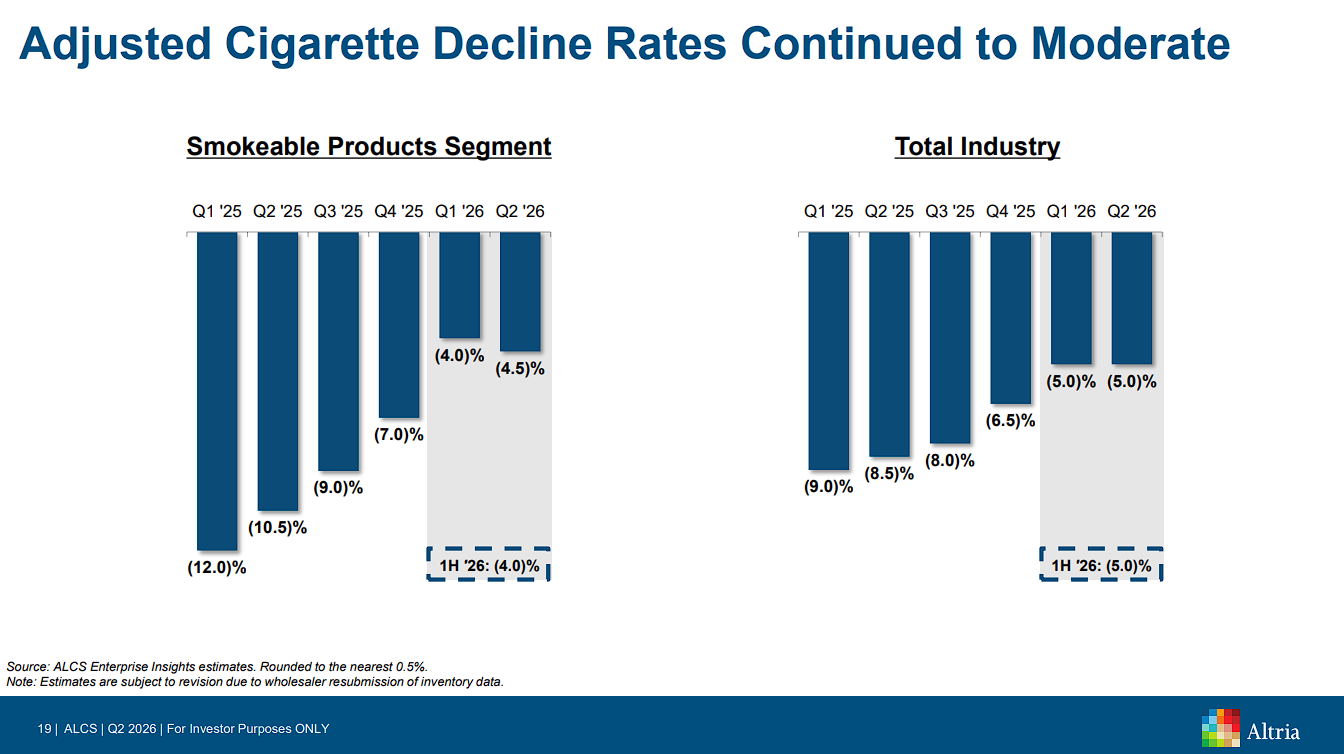
The annualized $4.44 payout represents approximately 78% of projected earnings, supporting a B Dividend Risk Score despite structural cigarette-volume declines.
Deep Dive: Click here to download (for free) our most recent 3-Page Sure Analysis PDF report on Altria Group.
High-Yield Dividend King #1: Universal Corporation (UVV)
- Dividend Yield: 7.9%
- Dividend Risk Score: D
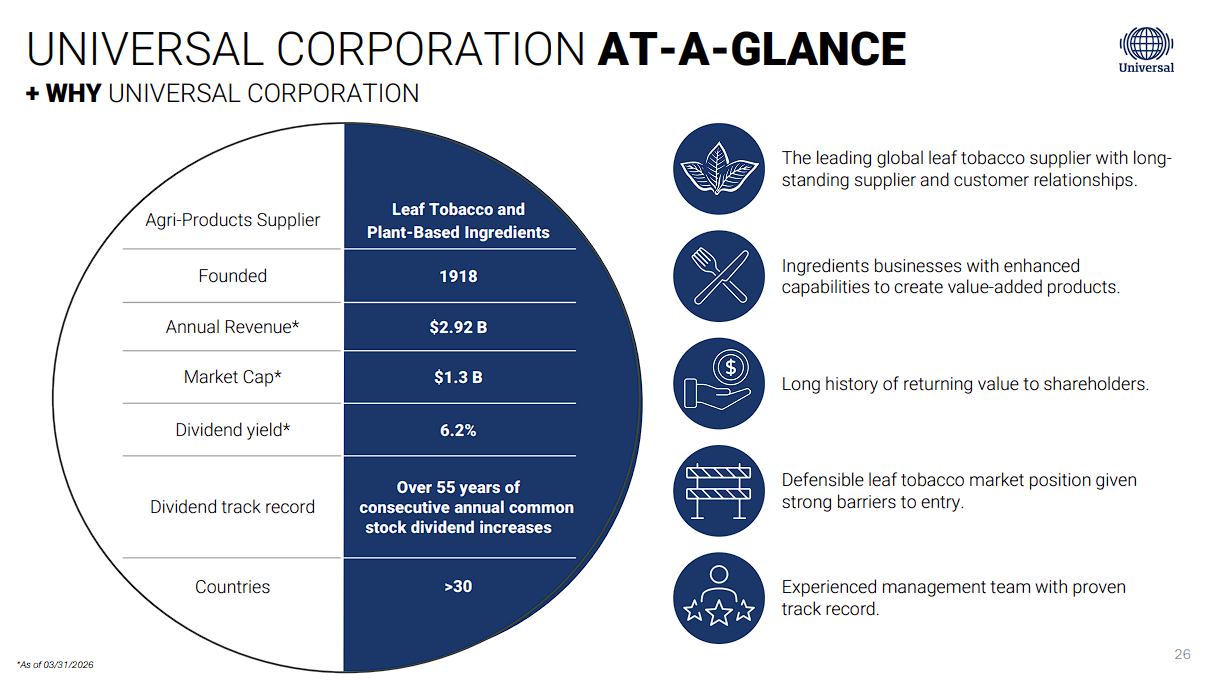
Universal Corporation is a global business-to-business agriproducts company and one of the largest independent leaf-tobacco merchants.
It sources, processes, and supplies tobacco to manufacturers worldwide, while its smaller Ingredients Operations segment provides plant-based food and flavor inputs.
Fiscal first-quarter 2027 revenue declined 11.8% to $524 million and fell well short of expectations.
Lower costs did not fully offset the revenue pressure, and Universal posted an adjusted loss of $0.20 per share.
The weak start followed fiscal 2026, when adjusted earnings per share declined 43% to $2.64 amid tobacco inventory write-downs and an impairment at the Shank’s ingredients operation.
Analysts nevertheless expect earnings to recover over the remaining quarters, with approximately $3.20 per share projected for fiscal 2027.
Universal raised its quarterly dividend by one cent to $0.83 in May 2026, extending its growth streak to 56 consecutive years.
The new annualized payout is $3.32.
That amount exceeds our current earnings estimate, producing a projected payout ratio above 100%, although free cash flow can differ materially from reported earnings in this inventory-heavy business.
Universal’s leading position and modest long-term capital requirements provide support, but tobacco-volume pressure, uneven ingredients results, and thin dividend coverage create meaningful risk.
The unusually high yield and slower dividend growth are reflected in its D Dividend Risk Score.
Deep Dive: Click here to download (for free) our most recent 3-Page Sure Analysis PDF report on Universal Corporation.
Final Thoughts
The Dividend Kings have passed an exceptional test of time, as every company here has raised its payout for at least 50 consecutive years, through recessions, inflation shocks, and major industry changes.
That history makes this list a strong starting point for income research, particularly when these companies offer yields well above the broader market.
Still, the highest yield is not automatically the strongest opportunity.
Universal and Altria provide the most income today, but Universal’s D Dividend Risk Score and Altria’s structural cigarette-volume pressure illustrate why yield must be weighed against coverage and business risk.
Farther down the ranking, companies such as Federal Realty, PepsiCo, H2O America, and new entrant McDonald’s offer lower starting yields but A Dividend Risk Scores and different growth profiles.
The most useful comparison is therefore yield alongside payout coverage, recent operating momentum, and any pending transaction that could reshape the business.
When a Dividend King combines a sound dividend with improving fundamentals and a reasonable valuation, its long record can become the foundation for attractive income and total returns.
Further Reading
If you are interested in finding high-quality dividend growth stocks and/or other high-yield securities and income securities, the following Sure Dividend resources will be useful:
Other Sure Dividend Resources
- Dividend Kings: 50+ years of rising dividends
- Dividend Champions: 25+ years of rising dividends
- Dividend Aristocrats: 25+ years of rising dividends and in the S&P 500
- High Dividend Stocks: 4%+ dividend yields
- Monthly Dividend Stocks: Individual securities that pay out every month
- Royalty Stocks: Detailed royalty stocks list
- MLPs: Detailed MLP list
- REITs: Detailed REIT list
- BDCs: Detailed BDC list