Updated on August 16th, 2026 by Nikolaos Sismanis
Utility stocks can make excellent investments for long-term dividend growth investors.
Durable, regulatory-based competitive advantages allow these companies to consistently raise their rates over time. In turn, this allows them to raise their dividend payments year in and year out.
Even better, many utility stocks have above-average dividend yields, providing a compelling combination of income now and growth later for long-term investors.
Because of these favorable industry characteristics, we’ve compiled a list of utility stocks. The list is derived from the major utility sector exchange-traded funds JXI and XLU.
You can download your utility stocks spreadsheet (along with important financial ratios such as dividend yields and payout ratios) by clicking on the link below:
Keep reading this article to learn more about the benefits of investing in utility stocks.
Table Of Contents
The following table of contents provides for easy navigation:
- Why Utility Dividend Stocks Make Attractive Investments
- The Top 10 Utility Stocks Now
- Top Utility Stock #10: Eversource Energy (ES)
- Top Utility Stock #9: Brookfield Infrastructure Partners L.P. (BIP)
- Top Utility Stock #8: Vistra Corp. (VST)
- Top Utility Stock #7: CMS Energy Corp. (CMS)
- Top Utility Stock #6: NextEra Energy Inc. (NEE)
- Top Utility Stock #5: Edison International (EIX)
- Top Utility Stock #4: Portland General Electric (POR)
- Top Utility Stock #3: RGC Resources, Inc. (RGCO)
- Top Utility Stock #2: H2O America (HTO)
- Top Utility Stock #1: The AES Corporation (AES)
Why Utility Dividend Stocks Make Attractive Investments
The word “utility” describes a wide variety of business models but is usually used as a reference to electric utilities — companies that engage in the generation, transmission, and distribution of electricity.
Other types of utilities include propane utilities and water utilities.
So why do these businesses make for attractive investments?
Utilities usually conduct business in highly regulated markets, complying with rules set by federal, state, and municipal governments.
While this sounds highly unattractive on the surface, what it means in practice is that utilities are basically legal monopolies.
The strict regulatory environment that utility businesses operate in creates a strong and durable competitive advantage for existing industry participants.
For this reason, electric utilities are among the most popular stocks for long-term dividend growth investors — especially because they tend to offer above-average dividend yields.
Indeed, the regulatory-based competitive advantages available to utility stocks give them the consistency to raise their dividends regularly.
Simply put, utility stocks are some of the most dependable dividend stocks around.
The long streak of consecutive dividend increases is possible only because of their unique industry-specific competitive advantages.
Clearly, the utility sector is very stable. People are going to need electricity and water in ever-increasing amounts for the foreseeable future.
One characteristic that does not describe utility stocks is high growth. One of the regulatory constraints imposed upon utility companies is the pace at which they can increase the fees paid by their customers.
These rate increases are usually in the low-single-digits, which provides a cap on the revenue growth experienced by these companies.
Utility stocks typically don’t offer strong total returns, but there are exceptions.
The Top 10 Utility Stocks Now
Taking all of the above into consideration, the following section discusses the 10 utility securities in the Sure Analysis Research Database with the highest expected annual returns over the next five years.
The stocks are ranked from the lowest expected total return at #10 to the highest expected total return at #1. Expected returns reflect the combination of the current dividend yield, expected business growth, and any projected change in valuation.
Related: Watch the video below to learn how to calculate expected total return for any stock.
Only securities classified in the Utilities sector with a Dividend Risk Score of ‘C’ or better were eligible for inclusion.
Top Utility Stock #10: Eversource Energy (ES)
- Dividend Risk Score: C
- Dividend Yield: 4.4%
- Expected Total Return: 11.4%
Eversource Energy is a regulated electric and natural-gas utility serving more than four million customers across Connecticut, Massachusetts, and New Hampshire.
Its electric distribution and transmission networks account for most of its earnings, while the June 2026 sale of Aquarion Water completed the company’s shift toward a simpler, pure-play regulated utility profile.
Eversource reported second-quarter 2026 operating revenue of $2.90 billion, up 2.3% year-over-year.
New electric and gas distribution rates and a larger transmission rate base supported revenue, but recurring earnings-per-share declined 9.4% to $0.87.
The main pressure was a Federal Energy Regulatory Commission decision that lowered the allowed base return on equity for New England transmission owners.
Management nevertheless reaffirmed 2026 adjusted EPS guidance of $4.57 to $4.72.
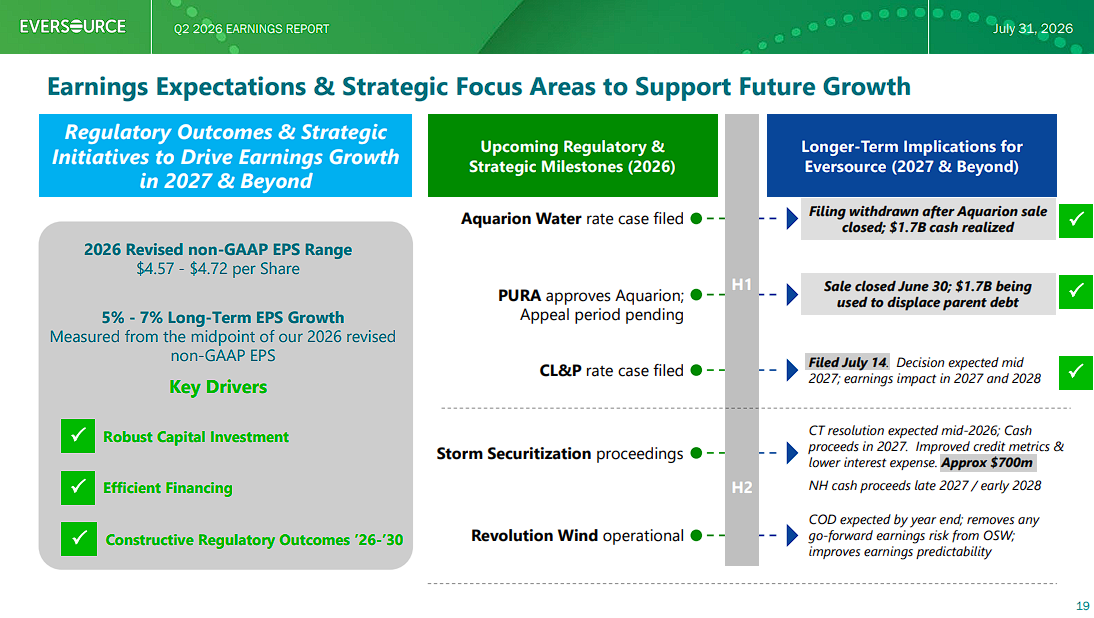
The investment case now centers on Eversource’s $26.5 billion 2026-to-2030 capital plan, rate-base growth, and the balance-sheet benefit from the $1.7 billion Aquarion sale.
The company raised its quarterly dividend 4.7% to $0.7875 in 2026, extending its dividend growth streak to 28 years.
The projected payout ratio is in the upper-60% range, leaving a reasonable, though not unusually wide, margin of safety.
Deep Dive: Click here to download (for free) our most recent 3-Page Sure Analysis PDF report on Eversource Energy (ES).
Top Utility Stock #9: Brookfield Infrastructure Partners L.P. (BIP)
- Dividend Risk Score: C
- Dividend Yield: 4.6%
- Expected Total Return: 11.4%
Brookfield Infrastructure Partners L.P. owns essential infrastructure across utilities, transport, midstream, and data operations.
It is a Bermuda-based limited partnership rather than a conventional U.S. corporation, and investors should understand the associated tax reporting.
Its geographically diversified assets typically benefit from regulated or contracted revenue and inflation-linked pricing.
Second-quarter 2026 funds from operations rose 10% to $702 million, while FFO per unit increased 9.9% to $0.89.
Data and midstream FFO grew 36% and 17%, respectively, with stable results from utilities and transport.
Organic growth reflected inflation-linked rate increases, higher volumes and utilization, and the commissioning of more than $1.5 billion of projects since the prior-year quarter.
First-half FFO per unit increased 9.8% to $1.79.
Brookfield continues to recycle capital, generating nearly $1.2 billion from asset sales year-to-date while deploying or committing more than $800 million to new investments. Its capital backlog was about $8.1 billion at quarter-end.
The planned combination of BIP and BIPC is expected to simplify the structure in the fourth quarter of 2026 without changing the underlying business.
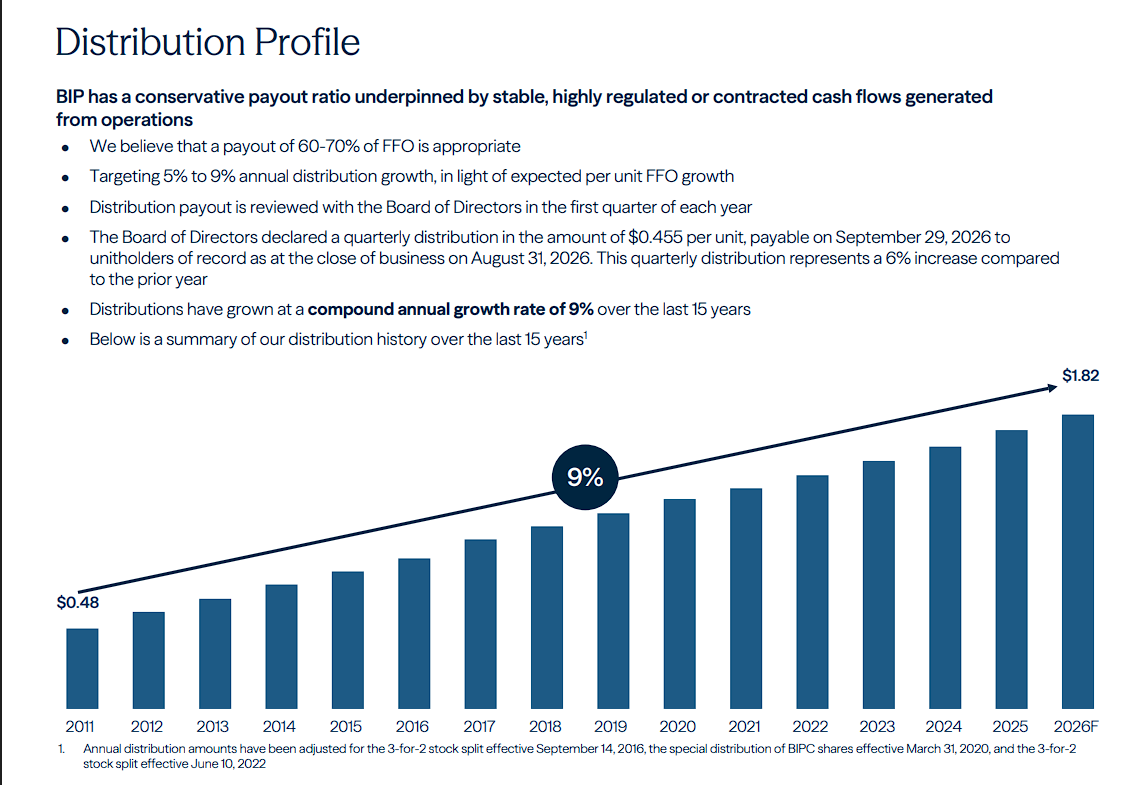
BIP has increased its distribution for 16 consecutive years and targets 5% to 9% annual distribution growth, supported by its 60% to 70% FFO payout objective.
Top Utility Stock #8: Vistra Corp. (VST)
- Dividend Risk Score: A
- Dividend Yield: 0.6%
- Expected Total Return: 11.7%
Vistra Corp. is an integrated retail electricity and power-generation company with approximately 44 gigawatts of capacity and roughly five million customer accounts.
Its portfolio spans natural gas, nuclear, solar, and battery storage, while its retail operations help offset some of the commodity exposure inherent in wholesale generation.
Vistra reported second-quarter 2026 net income of $305 million.
More important for evaluating the operating business, adjusted EBITDA from ongoing operations climbed more than 30% to $1.77 billion from $1.35 billion in the prior-year period.
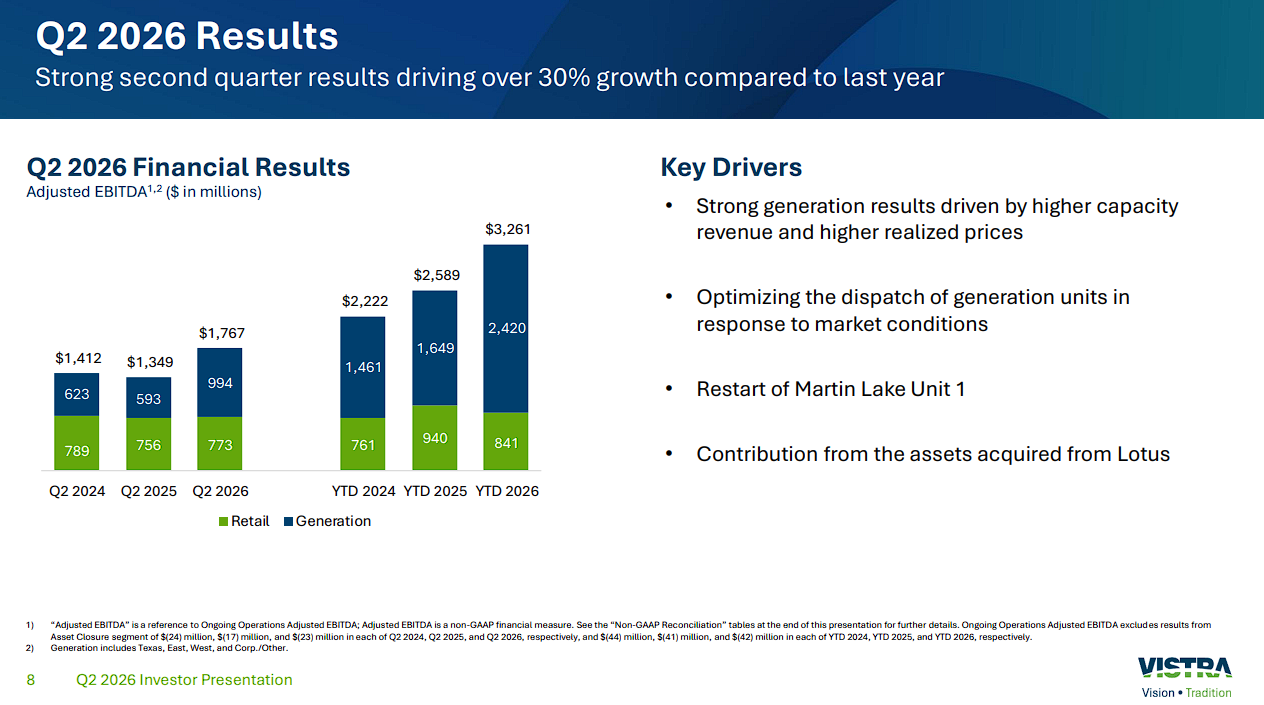
Management reaffirmed its 2026 adjusted EBITDA guidance of $6.8 billion to $7.6 billion and adjusted free cash flow before growth guidance of $3.93 billion to $4.73 billion.
The pending $4 billion Cogentrix acquisition would add about 5.5 gigawatts of natural-gas generation and broaden Vistra’s exposure to several attractive power markets.
This expansion, rising electricity demand, and disciplined share repurchases underpin the growth case, although power prices and integration execution remain meaningful variables.
Vistra declared a $0.23 quarterly dividend in July 2026.
The yield is modest, but the company has increased its dividend for six consecutive years, and the low payout ratio helps explain its A Dividend Risk Score.
Deep Dive: Click here to download (for free) our most recent 3-Page Sure Analysis PDF report on Vistra Corp. (VST).
Top Utility Stock #7: CMS Energy Corp. (CMS)
- Dividend Risk Score: C
- Dividend Yield: 3.2%
- Expected Total Return: 12.0%
CMS Energy Corp. is a Michigan-focused energy company whose principal subsidiary, Consumers Energy, provides electric and natural-gas service across much of the state.
CMS also owns NorthStar Clean Energy, although the regulated utility supplies the core of its earnings and planned investment.
Second-quarter 2026 operating revenue slipped 0.5% to $1.83 billion.
Adjusted earnings-per-share declined from $0.71 to $0.37, reflecting milder weather, restoration costs, and the timing of operating and maintenance expenses.
Despite the weak quarterly comparison, management reaffirmed full-year adjusted EPS guidance of $3.83 to $3.90 and continued to express confidence in the high end of its long-term 6% to 8% growth target.
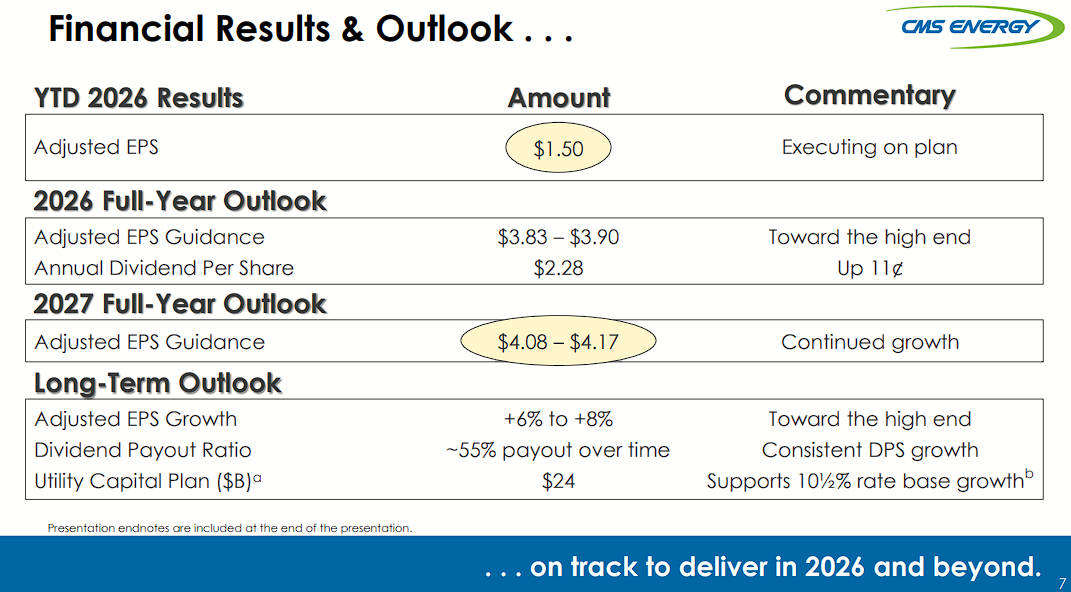
CMS completed a strategic review of NorthStar and is exiting non-utility renewable development while retaining selected Michigan assets.
The decision concentrates capital on regulated opportunities, including the company’s $24 billion 2026-to-2030 investment plan and demand from data centers and other large customers.
Management expects this spending to support approximately 10.5% annual rate-base growth through 2030.
CMS raised its annualized dividend to $2.28 for 2026, marking its 20th consecutive annual increase.
Its targeted payout ratio near 55% should preserve more internally generated capital for the expanded spending program.
Deep Dive: Click here to download (for free) our most recent 3-Page Sure Analysis PDF report on CMS Energy Corp. (CMS).
Top Utility Stock #6: NextEra Energy Inc. (NEE)
- Dividend Risk Score: B
- Dividend Yield: 2.9%
- Expected Total Return: 12.4%
NextEra Energy Inc. combines Florida Power & Light, the largest U.S. electric utility by retail megawatt-hour sales, with NextEra Energy Resources, a major developer and operator of renewable energy and storage.
This mix gives NextEra the stability of regulated operations and a larger growth runway than many traditional utilities.
Second-quarter 2026 revenue increased 12% to $7.5 billion, while adjusted earnings rose 11% to $2.4 billion.
Adjusted earnings-per-share advanced 9.5% to $1.15. NextEra added 3.6 gigawatts of renewables and storage projects to its backlog during the quarter, bringing the total to approximately 35.1 gigawatts.
Management maintained 2026 adjusted EPS guidance of $3.92 to $4.02.
The proposed all-stock combination with Dominion Energy is the most important current development.
If completed in 2027, the transaction would create a company with more than 80% of its business in regulated utilities.
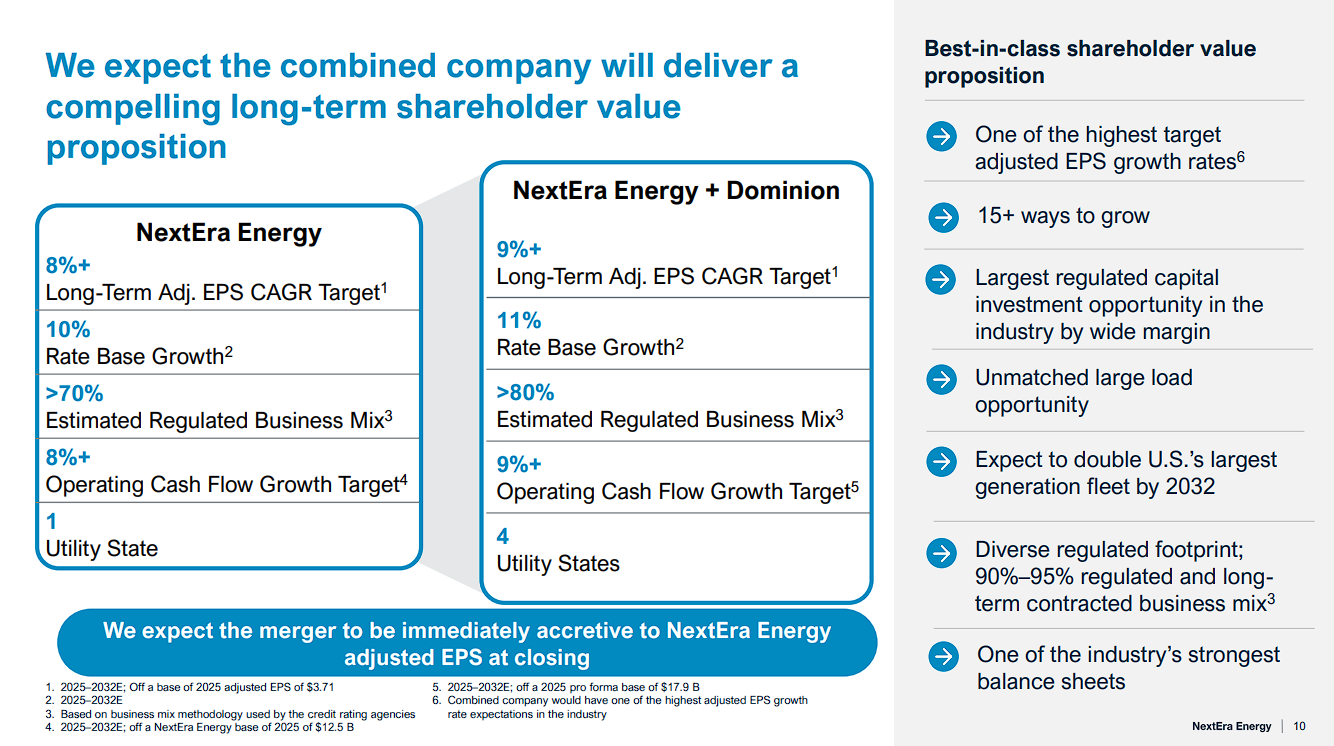
It would also form a combined rate base of roughly $138 billion, and a targeted long-term adjusted EPS growth rate above NextEra’s current stand-alone outlook.
Regulatory approval and integration are still required, so these benefits are not guaranteed.
NextEra has increased its dividend for 32 consecutive years and expects approximately 6% annual dividend growth through 2028.
The quarterly dividend stands at $0.6232 per share.
Top Utility Stock #5: Edison International (EIX)
- Dividend Risk Score: C
- Dividend Yield: 4.9%
- Expected Total Return: 12.4%
Edison International owns Southern California Edison, a regulated electric utility serving about 15 million people across a 50,000-square-mile territory.
SCE primarily owns transmission and distribution infrastructure, while the much smaller Trio business provides sustainability and energy advisory services.
Second-quarter 2026 operating revenue declined 4.1% to $4.35 billion, largely because of lower pass-through costs rather than deterioration in the underlying regulated business.
Core earnings-per-share increased 58.8% to $1.54, helped by the final 2025 General Rate Case decision and lower operating and maintenance expenses.
The result exceeded the analyst consensus by $0.33.
Edison’s growth plan calls for $38 billion to $41 billion of capital spending from 2026 through 2030, primarily for grid hardening, reliability, and electrification.
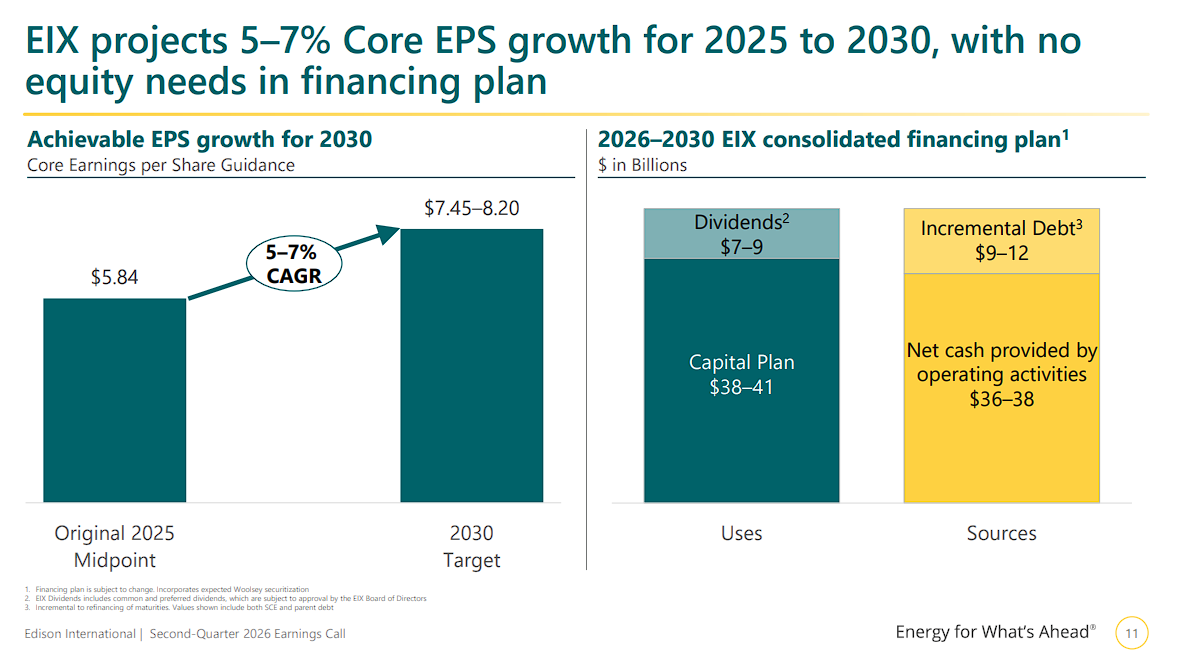
Management expects to fund the plan without issuing new equity through 2030, an important point for per-share growth.
The principal risk remains California wildfire liability and the possibility that insufficient legislative reform could pressure SCE’s credit profile and financing costs.
Edison pays a quarterly dividend of $0.8775 and has increased it for 23 consecutive years.
The expected 2026 payout ratio is in the high-50% range, providing reasonable coverage despite the company’s elevated regulatory and wildfire exposure.
Top Utility Stock #4: Portland General Electric (POR)
- Dividend Risk Score: C
- Dividend Yield: 4.4%
- Expected Total Return: 12.7%
Portland General Electric supplies electricity to more than 950,000 customers across 51 Oregon cities and towns.
Its owned and contracted generation portfolio exceeds 3.5 gigawatts and includes natural gas, coal, wind, solar, and hydroelectric resources.
Industrial customers account for a meaningful portion of electricity deliveries, making regional data-center and manufacturing demand especially relevant.
Portland General reported second-quarter 2026 GAAP net income of $68 million, or $0.59 per diluted share, compared with $0.56 in the prior-year quarter.
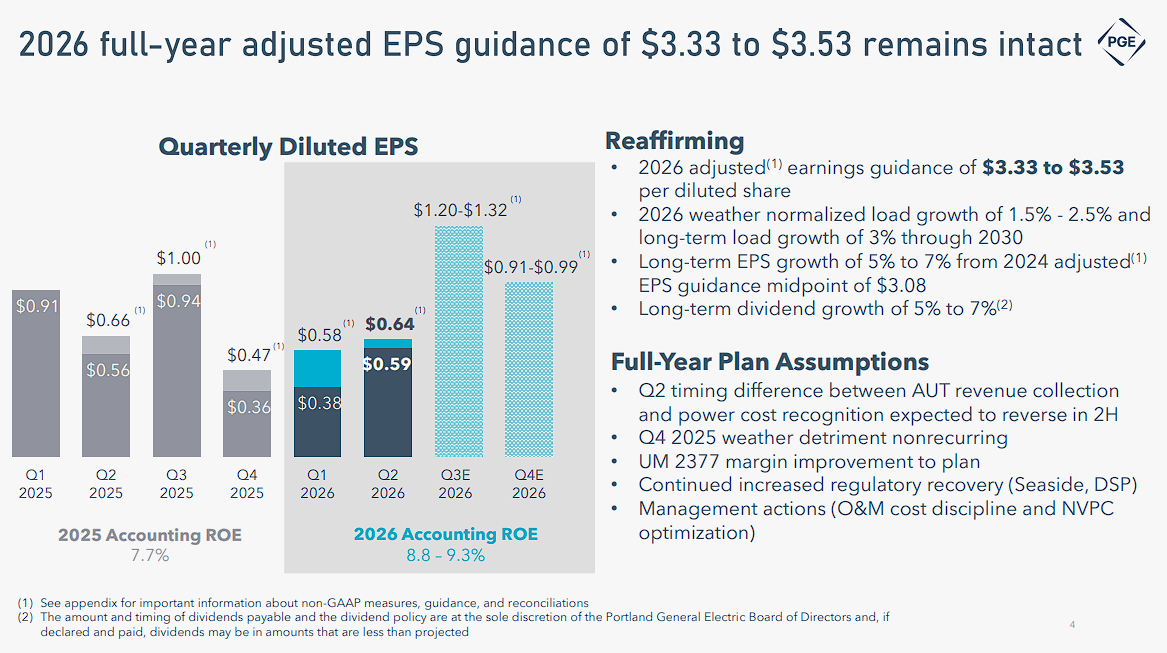
Adjusted EPS was $0.64 versus $0.66 one year earlier.
Residential and industrial deliveries grew 1.3% and 15.3%, respectively, while commercial deliveries declined 1.1%.
Management reaffirmed adjusted EPS guidance of $3.33 to $3.53 and expects about 2% annual energy-delivery growth.
The pending $1.9 billion acquisition of PacifiCorp’s Washington utility operations could add roughly 140,000 customers and create a second regulated growth platform near Portland General’s existing territory.
The transaction, which includes minority investment from Manulife affiliates, is expected to close in 2027.
Portland General raised its quarterly dividend 5% to $0.5513 in April 2026, extending its dividend growth streak to 20 years.
Management’s long-term target of 5% to 7% annual dividend growth broadly matches its earnings-growth objective.
Top Utility Stock #3: RGC Resources, Inc. (RGCO)
- Dividend Risk Score: C
- Dividend Yield: 4.0%
- Expected Total Return: 14.5%
RGC Resources, Inc. distributes natural gas through Roanoke Gas and also owns midstream interests, including an investment related to the Mountain Valley Pipeline.
The regulated gas utility generates the overwhelming majority of revenue, with residential customers representing its largest customer group.
RGC is much smaller than the other companies in this ranking, with a market capitalization near $225 million.
For its fiscal third quarter of 2026, RGC reported revenue of $17.1 million, down 0.9% year-over-year, and earnings of $559,000 versus $538,000 in the prior-year period.
Operating margin improved by $757,000, supported by higher non-gas base rates effective January 2026, returns on SAVE infrastructure investments, and residential customer growth.
Higher operating costs and mixed industrial demand absorbed most of that improvement.
Through the first nine months, net income rose 5.2% to $14.2 million, helped by stronger margins and lower interest expense.
The central question is whether rate relief and infrastructure investment can continue to outpace inflationary costs.
RGC’s long dividend record provides some reassurance: it has made regular cash dividend payments for 78 years and raised the dividend for 22 consecutive years.
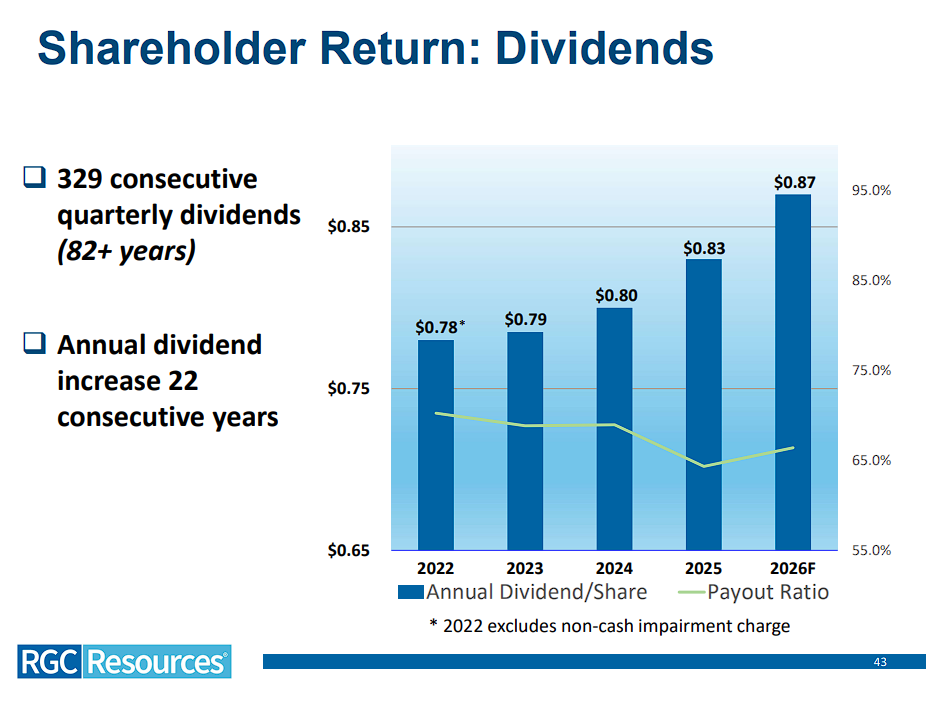
The annualized dividend is $0.87 per share, and the projected payout ratio is about 63%, which is manageable but leaves less room for setbacks than the strongest utility balance sheets.
Top Utility Stock #2: H2O America (HTO)
- Dividend Risk Score: A
- Dividend Yield: 2.8%
- Expected Total Return: 15.2%
H2O America (HTO), formerly SJW Group, owns regulated water and wastewater utilities in California, Texas, Connecticut, and Maine.
Its exposure to growing markets in Silicon Valley and Texas supports a long runway for infrastructure investment, while regulated rate increases provide a mechanism to earn returns on that spending.
Second-quarter 2026 revenue increased 6.2% to $210.5 million.
Adjusted earnings-per-share edged up to $0.72 from $0.71 and exceeded expectations by $0.02.
Rate increases added $14.5 million to revenue, although regulatory mechanism adjustments and 9% growth in operating expenses limited profit growth.
Management reaffirmed 2026 EPS guidance of $3.08 to $3.18 and its 6% to 8% long-term EPS growth objective.
The pending $540 million acquisition of Quadvest would expand H2O America’s Texas footprint into the Houston area and add more than 50,000 active connections, plus a substantial contracted development pipeline.
The company expects to invest more than $2.7 billion from 2026 through 2030, including the acquired operations.
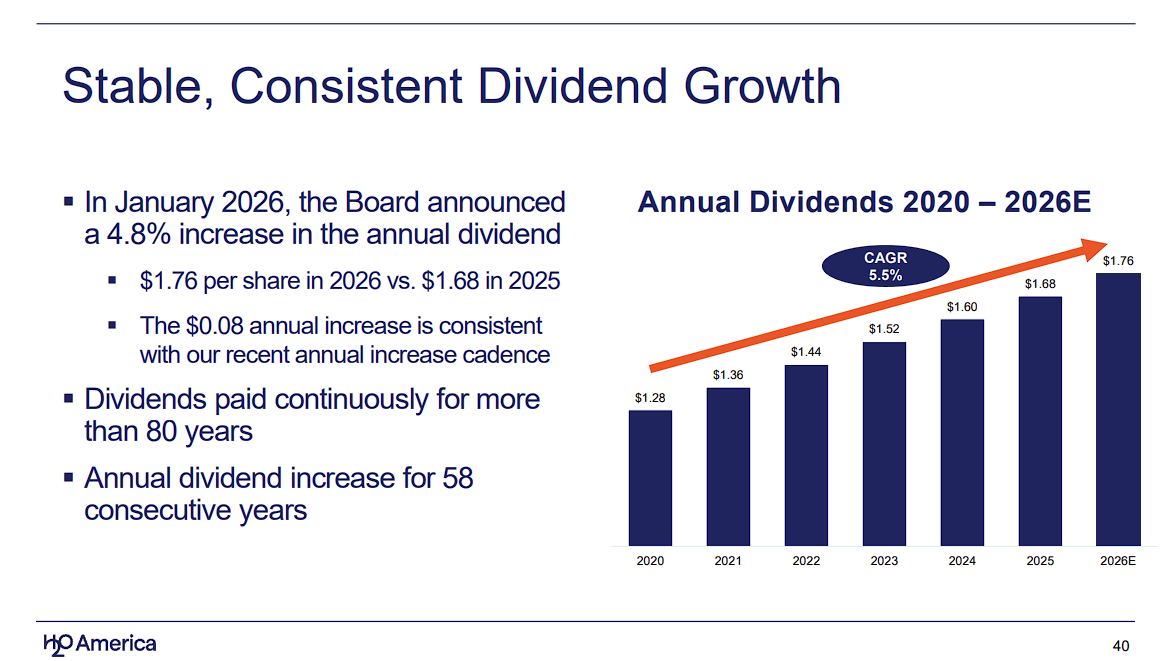
H2O America raised its quarterly dividend 4.8% to $0.44 in January 2026.
That marked its 58th consecutive annual dividend increase, qualifying the company as a Dividend King and giving it the longest growth streak in this ranking.
Deep Dive: Click here to download (for free) our most recent 3-Page Sure Analysis PDF report on H2O America (HTO).
Top Utility Stock #1: The AES Corporation (AES)
- Dividend Risk Score: C
- Dividend Yield: 4.8%
- Expected Total Return: 15.8%
The AES Corporation is a global power company with approximately 35 gigawatts of generation across 14 countries.
Its portfolio includes natural gas, renewables, coal, energy storage, and regulated U.S. utilities.
AES also has a sizable renewable-development backlog, although the pending acquisition now dominates the near-term investment case.
For the second quarter of 2026, revenue increased to $3.42 billion from $2.86 billion.
Diluted earnings-per-share were $0.60, compared with a loss of $0.15 in the prior-year quarter.
AES continues to develop renewable and storage projects while recycling capital through asset sales, and its U.S. utility rate-base investments provide a more predictable source of growth.
Global Infrastructure Partners and EQT Infrastructure VI Fund have agreed to acquire AES for $15 per share in cash.
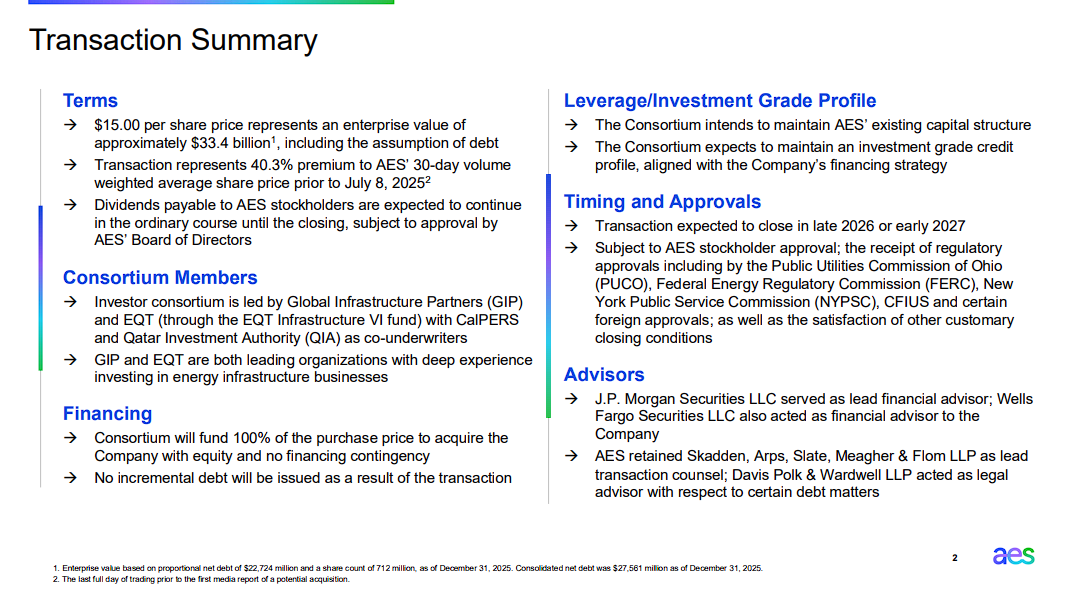
Shareholders approved the transaction in June 2026, and closing is expected in late 2026 or early 2027, subject to remaining approvals.
Therefore, the 15.8% expected total return shown above is the SARD stand-alone five-year estimate and would not be realized if the transaction closes on its current terms.
Practical upside would instead be limited to the cash offer and any dividends received before closing.
AES pays $0.17595 quarterly and has increased its dividend for 12 consecutive years.
Final Thoughts
Utilities can still offer attractive total-return potential when durable rate-base growth is paired with a reasonable valuation.
This ranking highlights several distinct drivers. For example, H2O America and RGC Resources combine long dividend histories with regulated infrastructure growth, while NextEra Energy and CMS Energy are investing heavily to meet rising power demand.
Edison International and Portland General Electric offer higher yields alongside company-specific regulatory and execution risks.
Vistra adds more power-market exposure, while Brookfield Infrastructure provides a diversified global infrastructure model through a partnership structure.
Our ranking should not replace a review of the underlying risks. In particular, AES’s projected return is a stand-alone SARD estimate, while its pending $15 cash acquisition would cap the outcome if completed.
You should also weigh payout coverage, financing needs, regulatory relationships, and valuation—not simply expected return.
The strongest candidates are those whose dividend and capital-spending plans remain supportable even if interest rates stay elevated or project timelines slip.