Updated on October 1st, 2026 by Nikolaos Sismanis
Dividend Kings are stocks with an incredible 50 or more consecutive years of dividend increases. They are the best-of-the-best in dividend longevity.
This research report includes the following valuable free Dividend Kings resources.
Resource #1: The Dividend Kings Spreadsheet List
This spreadsheet contains important metrics, including: years of dividend growth, dividend yields, payout ratios, buy/hold/sell ratings, fair value prices, expected total returns, and much more.
Resource #2: The 10 Best Dividend Kings Today
This research report analyzes the 10 best Dividend Kings now as ranked by expected total return. Expected total returns include estimated earnings-per-share growth, dividends, and the impact of any valuation multiple changes.
This ranking is best used as a research shortlist rather than an automatic buy list.
- #10: Lowe’s Companies (LOW)
- #9: Hormel Foods (HRL)
- #8: Pentair (PNR)
- #7: H2O America (HTO)
- #6: PPG Industries (PPG)
- #5: The Marzetti Company (MZTI)
- #4: Automatic Data Processing (ADP)
- #3: S&P Global (SPGI)
- #2: PepsiCo (PEP)
- #1: Stepan Company (SCL)
Resource #3: Sure Analysis Reports On All Dividend Kings
We cover all 60 Dividend Kings in the Sure Analysis Research Database. All are updated quarterly. This resource has links to our most recent stand-alone analysis on each of the Dividend Kings.
Dividend King #10: Lowe’s Companies (LOW)
- 5-Year Expected Total Return: 14.8%
- Dividend Yield: 2.7%
Lowe’s Companies is the second-largest home improvement retailer in the United States, with more than 1,700 stores and a growing professional-customer business.
Its scale, supplier relationships, omnichannel capabilities, and large installed base of homes support long-term demand, although results remain sensitive to housing turnover and big-ticket discretionary spending.
Lowe’s has increased its dividend for 63 consecutive years.
The quarterly payout is $1.25 per share, or $5.00 annualized, and the payout ratio remains manageable.
Second-quarter 2026 sales increased to $26.0 billion, while comparable sales rose 0.2%.
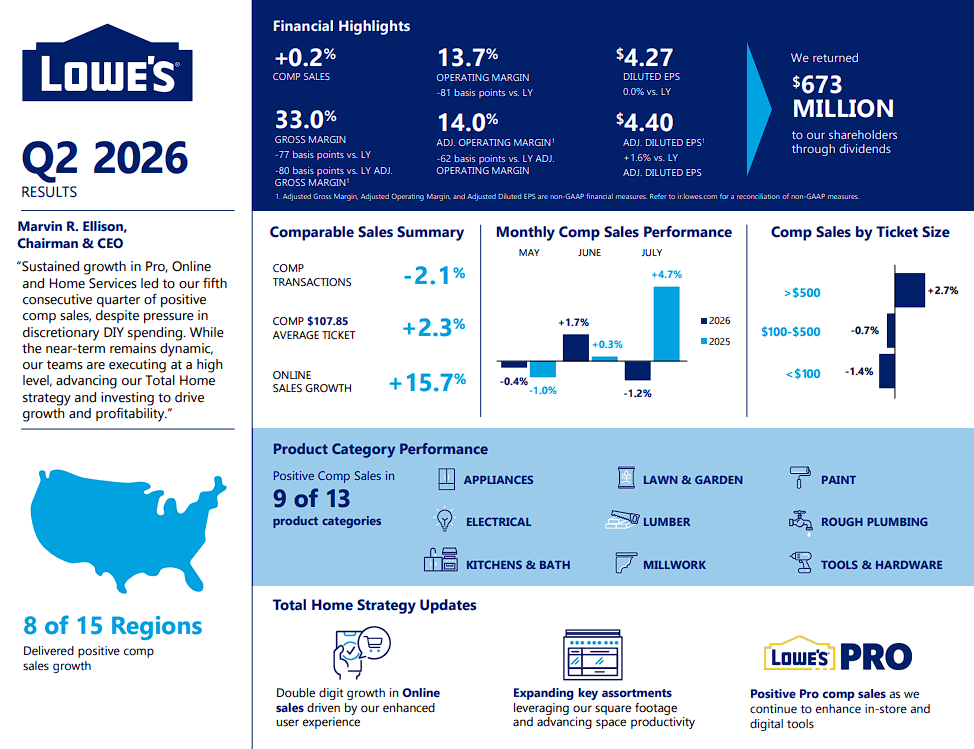
Adjusted earnings per share increased 1.6% to $4.40.
Growth in Pro sales, Home Services, and a 15.7% increase in online sales offset continued pressure on do-it-yourself demand.
Lowe’s paid $673 million in dividends during the quarter and did not repurchase shares.
Management now expects full-year sales of about $92 billion, flat comparable sales, an adjusted operating margin of 11.6%, and adjusted earnings per share of about $12.25.
Recent acquisitions expand Lowe’s reach with professional customers, but integration costs, elevated debt, and a sluggish housing market add risk.
The expected return combines the 2.7% yield, long-term earnings growth, and possible valuation expansion from a currently discounted multiple.
Deep Dive: Click here to download (for free) our most recent 3-Page Sure Analysis PDF report on Lowe’s Companies (LOW).
Dividend King #9: Hormel Foods (HRL)
- 5-Year Expected Total Return: 15.5%
- Dividend Yield: 5.9%
Hormel Foods owns a broad collection of branded food products, including SPAM, Planters, Skippy, Applegate, Jennie-O, and Hormel Natural Choice.
Its brands and foodservice relationships provide durable demand, although commodity costs, consumer pressure, and retailer competition can weigh on margins.
Hormel increased its dividend for the 60th consecutive year, lifting the quarterly payout 1% to $0.2925 per share.
The August payment was its 392nd consecutive quarterly dividend.
Fiscal third-quarter 2026 net sales were $2.96 billion, while organic net sales declined 2%.
Adjusted operating income increased to $266 million, adjusted earnings per share rose to $0.37 from $0.35, and cash flow from operations climbed 54% to $241 million.
Foodservice remained the strongest segment, with organic sales up 2% and segment profit up 3%, while Retail organic sales fell 3%.
Management raised and narrowed full-year adjusted earnings-per-share guidance to $1.45 to $1.51, while reducing the net-sales outlook to $12.1 billion to $12.2 billion.
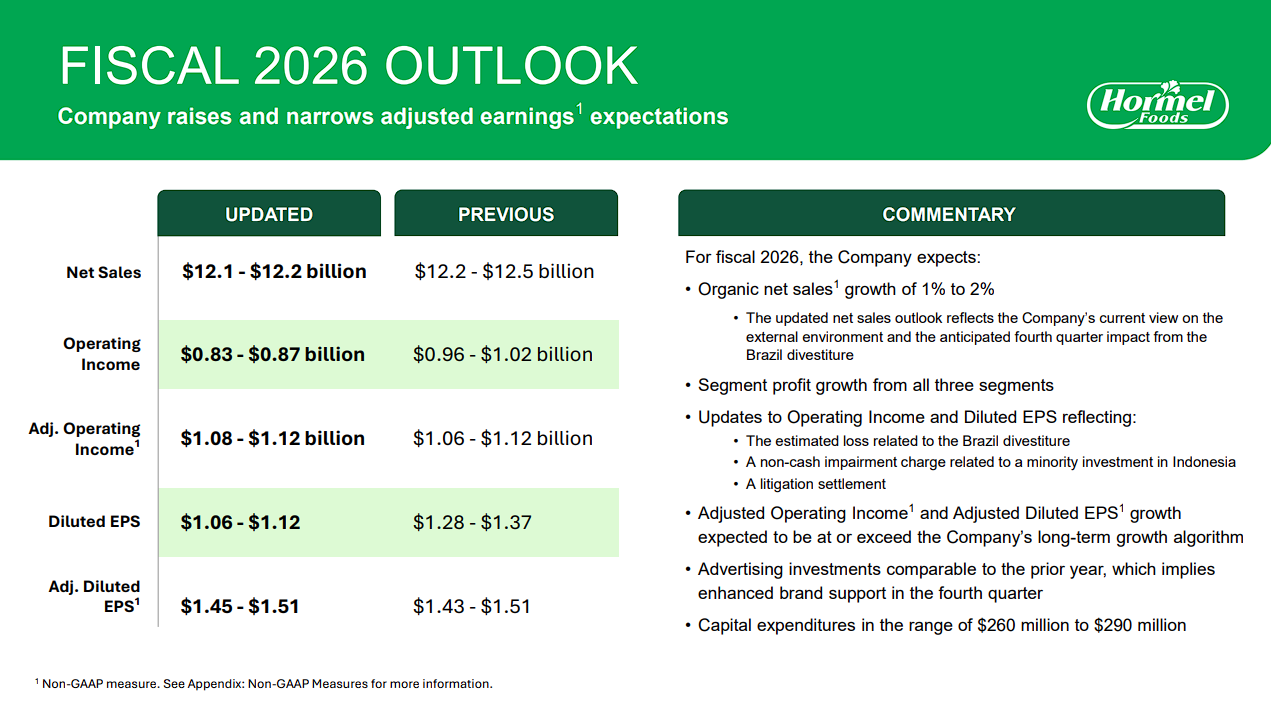
Hormel also completed the sale of its Brazil operations early in the fourth quarter, simplifying the portfolio but creating one-time GAAP charges.
The 5.9% yield is unusually high for Hormel, but the elevated payout ratio leaves less room for error.
Improved brand execution, foodservice growth, and cost savings are therefore essential to realizing the projected return.
Deep Dive: Click here to download (for free) our most recent 3-Page Sure Analysis PDF report on Hormel Foods (HRL).
Dividend King #8: Pentair (PNR)
- 5-Year Expected Total Return: 15.9%
- Dividend Yield: 2.0%
Pentair is a water solutions company serving residential, commercial, municipal, and industrial customers through its Aquatic Systems, Filtration Solutions, and Flow Technologies businesses.
Its installed base, dealer relationships, and exposure to repair-and-replacement demand support recurring revenue, although Pool sales can fluctuate with weather and channel inventory.
Pentair has increased its dividend for 50 consecutive years when adjusted for the nVent spin-off.
The current annualized dividend is $1.08 per share, and the payout ratio remains modest.
Second-quarter 2026 sales declined 15% to $933 million, while core sales fell 17%, mainly because Pool customers reduced inventory.
Adjusted earnings per share declined 18% to $1.14 but still exceeded the analyst estimate by $0.02.
Management expects full-year sales to decline about 5% and adjusted earnings per share of approximately $4.70.
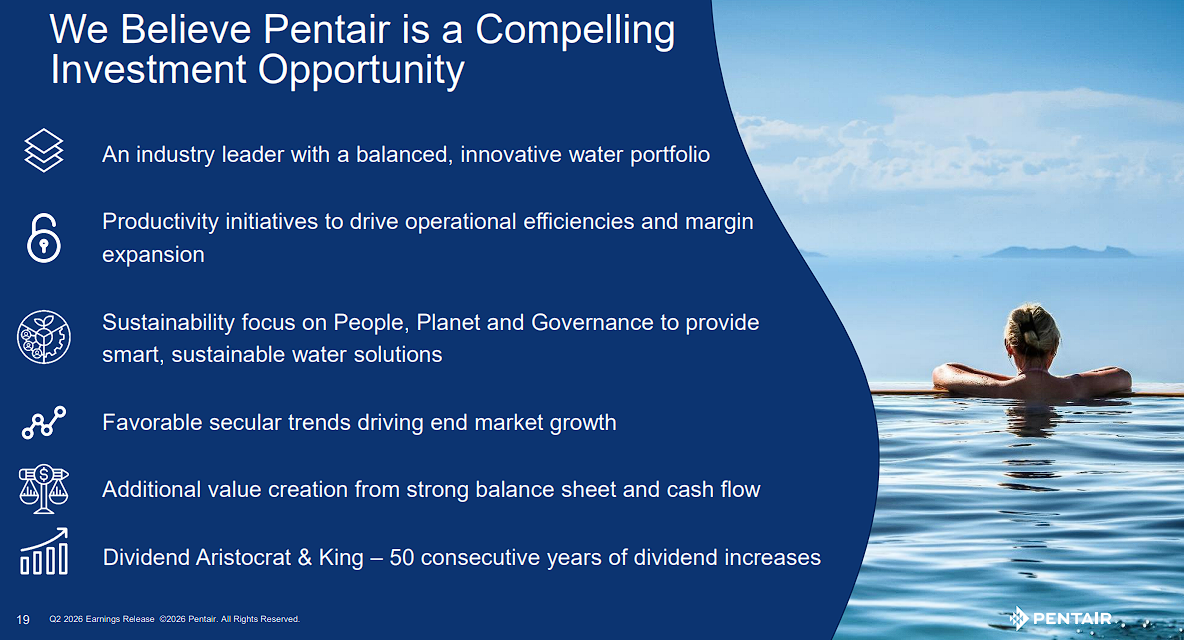
The near-term outlook is soft, but Pentair continues to benefit from productivity initiatives, price discipline, and long-term demand for water treatment and pool equipment.
The shares trade at roughly 11 times expected earnings, leaving room for valuation expansion if results stabilize.
The projected return combines a 2.0% yield, estimated earnings growth, and a potential recovery in the valuation multiple.
Inventory normalization, housing activity, and execution on margin initiatives are the key factors to watch.
Deep Dive: Click here to download (for free) our most recent 3-Page Sure Analysis PDF report on Pentair (PNR).
Dividend King #7: H2O America (HTO)
- 5-Year Expected Total Return: 16.0%
- Dividend Yield: 2.9%
H2O America is a regulated water utility serving customers in California, Connecticut, Maine, and Texas.
The essential nature of water service, regulated rate recovery, and long-lived infrastructure make its earnings relatively predictable.
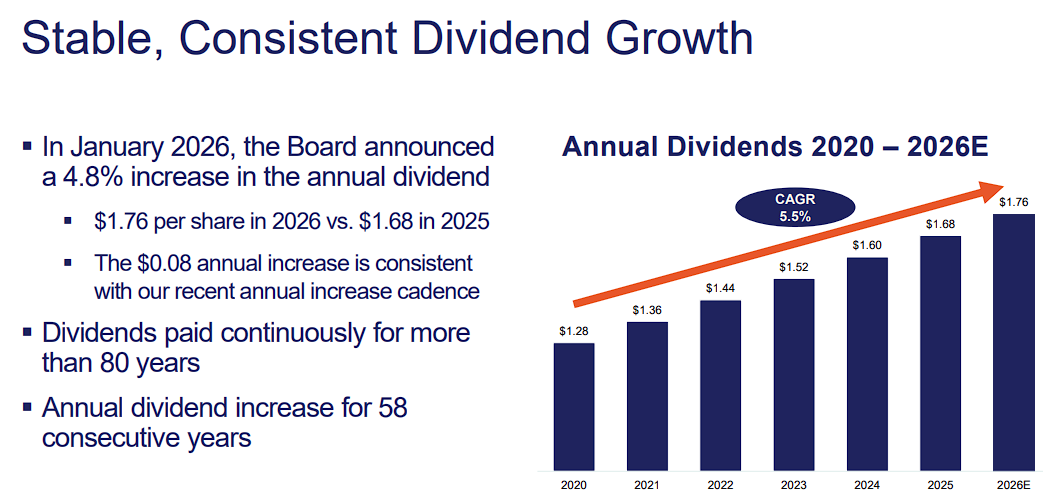
H2O America has paid dividends for more than 80 years and has increased the payout for 58 consecutive years.
Its quarterly dividend is $0.44, equivalent to $1.76 annually.
Second-quarter 2026 revenue increased 6% to $210.5 million, and adjusted net income rose 17% to $30.7 million.
Adjusted earnings per share declined to $0.72 from $0.75 because of a higher share count, while rate increases added $14.5 million of revenue.
Management maintained standalone 2026 adjusted earnings-per-share guidance of $3.08 to $3.18.
The company invested $206.9 million in infrastructure during the first half and targets $483 million for the year within a $2.7 billion five-year capital plan.
In August, H2O America received the remaining approvals for its $540 million acquisition of Quadvest, with closing expected October 1st.
The deal expands its presence in the fast-growing Houston market, but financing and the timing of rate recovery could create near-term dilution.
Longer term, regulated investment and customer growth should support earnings and dividend increases.
Deep Dive: Click here to download (for free) our most recent 3-Page Sure Analysis PDF report on H2O America (HTO).
Dividend King #6: PPG Industries (PPG)
- 5-Year Expected Total Return: 16.6%
- Dividend Yield: 2.8%
PPG Industries is one of the world’s largest coatings companies, serving aerospace, automotive, industrial, packaging, and architectural customers.
Its technology, customer relationships, and global manufacturing footprint provide competitive advantages, although results remain exposed to industrial activity and raw-material costs.
PPG has increased its dividend for 55 consecutive years.
In July, the board raised the quarterly payout by $0.03 to $0.74, while also marking the company’s 512th consecutive dividend payment.
Second-quarter 2026 net sales increased 7% to $4.50 billion, with organic sales growth of 4% split evenly between volume and pricing.
Adjusted earnings per share were $2.23 compared with $2.22 a year earlier, while year-to-date operating cash flow improved by more than $220 million to approximately $600 million.
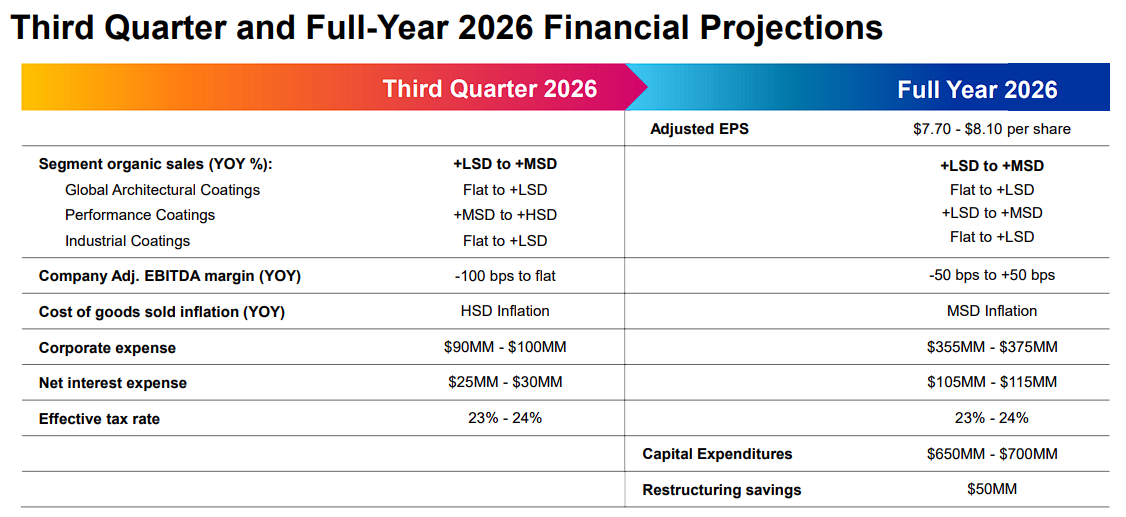
Management reaffirmed full-year adjusted earnings-per-share guidance of $7.70 to $8.10.
Aerospace, packaging coatings, and Latin America led performance, and eight of nine businesses generated organic growth.
Pricing recovered about 90% of inflation during the quarter, with full recovery targeted by the fourth quarter.
That margin progress is central to the investment case.
The moderate payout ratio and above-average yield should support further dividend growth as earnings recover.
Deep Dive: Click here to download (for free) our most recent 3-Page Sure Analysis PDF report on PPG Industries (PPG).
Dividend King #5: The Marzetti Company (MZTI)
- 5-Year Expected Total Return: 16.8%
- Dividend Yield: 4.0%
The Marzetti Company, formerly Lancaster Colony, manufactures specialty food products for retail and foodservice customers.
Its portfolio includes Marzetti dressings, New York Bakery products, Sister Schubert’s rolls, licensed restaurant sauces, and the recently acquired Bachan’s brand.
The company increased its regular cash dividend for the 63rd consecutive year in fiscal 2026, and the current quarterly payout is $1.00 per share.
Fiscal fourth-quarter sales declined 2.2% to $465.0 million, but increased 0.4% after excluding non-core temporary supply-agreement revenue from the comparison.
Retail sales rose 0.9%, including $15.4 million from Bachan’s, while adjusted Foodservice sales were nearly flat.
Gross profit reached a fourth-quarter record of $114.0 million, gross margin expanded 220 basis points to 24.5%, and adjusted earnings per share increased 9% to $1.46.
For fiscal 2026, sales rose 1.1% to $1.93 billion, adjusted earnings per share increased to $6.83 from $6.72, and operating cash flow reached a record $283.8 million.
The $400 million Bachan’s acquisition adds a fast-growing sauce platform but also introduced a $200 million term loan and integration risk.
Successful brand expansion and further margin improvement are the main drivers behind the high expected return.
Dividend King #4: Automatic Data Processing (ADP)
- 5-Year Expected Total Return: 16.9%
- Dividend Yield: 2.6%
Automatic Data Processing is a leading provider of payroll, human-capital management, benefits, and compliance solutions.
Its software and services are embedded in customers’ daily operations, supporting recurring revenue, high retention, and substantial free cash flow.
More than 1.1 million clients across over 140 countries use ADP’s platforms.
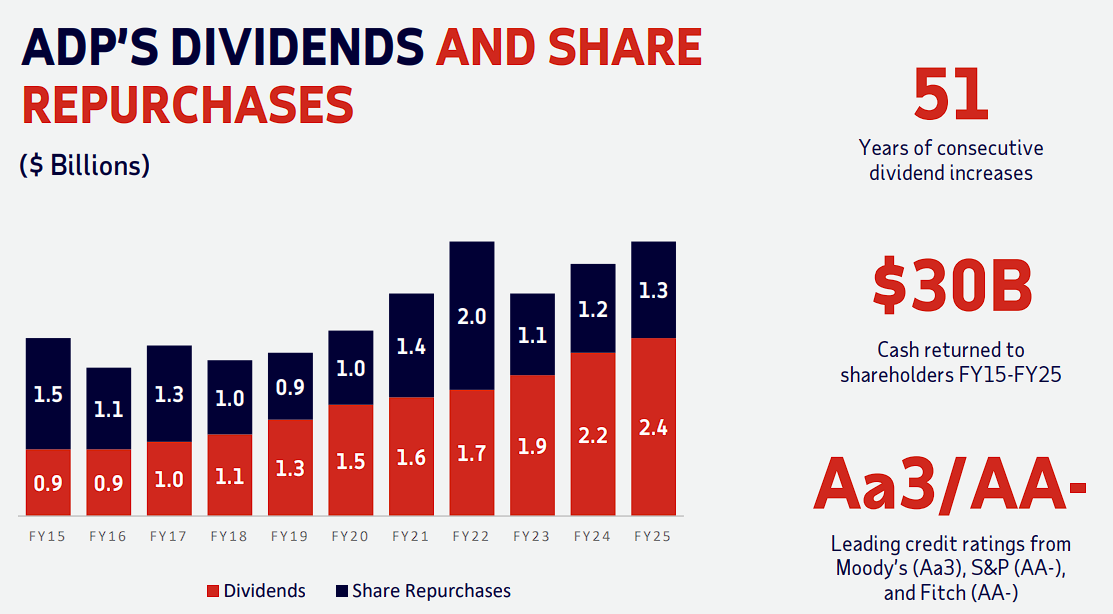
The company has raised its dividend for 51 consecutive years, including a 10% increase to $1.70 per quarter, or $6.80 annualized.
For fiscal 2026, revenue increased 7% to $21.9 billion, while adjusted net earnings rose 10% to $4.5 billion.
Adjusted earnings per share increased 11% to $11.12, and adjusted EBIT margin expanded 80 basis points to 26.8%.
Management expects fiscal 2027 revenue growth of 5% to 6%, another 70 to 90 basis points of adjusted EBIT-margin expansion, and adjusted earnings-per-share growth of 9% to 11%.
Product development increasingly centers on AI-enabled insights and the ADP Lyric platform, while the WorkForce Software acquisition expands global workforce-management capabilities.
Employment levels and interest earned on client funds can affect results, but the subscription-heavy model remains resilient.
The expected return is supported by earnings growth, dividend growth, and a more attractive valuation than ADP has often carried.
Dividend King #3: S&P Global (SPGI)
- 5-Year Expected Total Return: 17.1%
- Dividend Yield: 1.0%
S&P Global provides credit ratings, financial data, indices, benchmarks, and commodity-market intelligence.
Its trusted brands, embedded workflows, recurring subscriptions, and network effects create high switching costs and attractive margins.
The company has paid a dividend every year since 1937 and has increased it for 53 consecutive years.
Its quarterly payout rose 1% to $0.97 in January, equal to $3.88 annualized.
Second-quarter 2026 revenue increased 10% to $4.15 billion, operating profit rose 17% to $1.81 billion, and diluted earnings per share increased 18% to $4.12.
On a pro forma basis excluding Mobility, revenue grew 11% to $3.68 billion and adjusted earnings per share advanced 23% to $4.83.
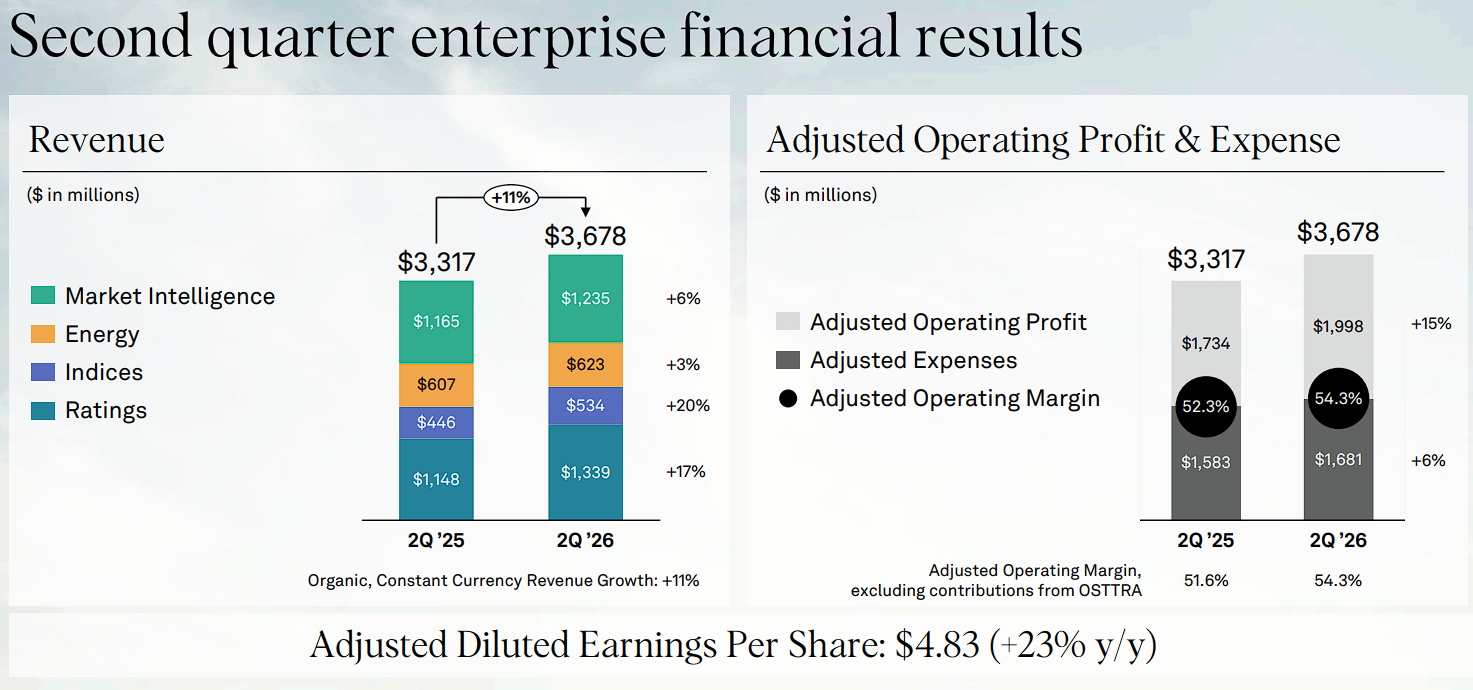
S&P Global completed the spin-off of Mobility Global on July 1st, leaving a more focused portfolio centered on data, analytics, ratings, and benchmarks.
Management now expects adjusted earnings per share of $17.50 to $17.75 for 2026, although the guidance is not directly comparable with the pre-spin outlook.
Capital-markets activity can make Ratings cyclical, but recurring revenue across the other divisions provides stability.
With a low yield, the return case depends primarily on earnings growth, repurchases, and valuation recovery.
Deep Dive: Click here to download (for free) our most recent 3-Page Sure Analysis PDF report on S&P Global (SPGI).
Dividend King #2: PepsiCo (PEP)
- 5-Year Expected Total Return: 17.4%
- Dividend Yield: 4.6%
PepsiCo owns a diversified portfolio of global snack and beverage brands, including Pepsi, Gatorade, Doritos, Lay’s, Quaker, and Cheetos.
Its brand strength, distribution network, and geographic reach have produced durable cash flow across economic cycles.
PepsiCo has paid consecutive quarterly dividends since 1965 and marked its 54th consecutive annual increase in 2026.
The quarterly dividend is now $1.48, or $5.92 annualized, following a 4% increase.
Second-quarter 2026 net revenue rose 6.4% to $24.18 billion, while reported earnings per share were $2.18 and core earnings per share were $2.20.
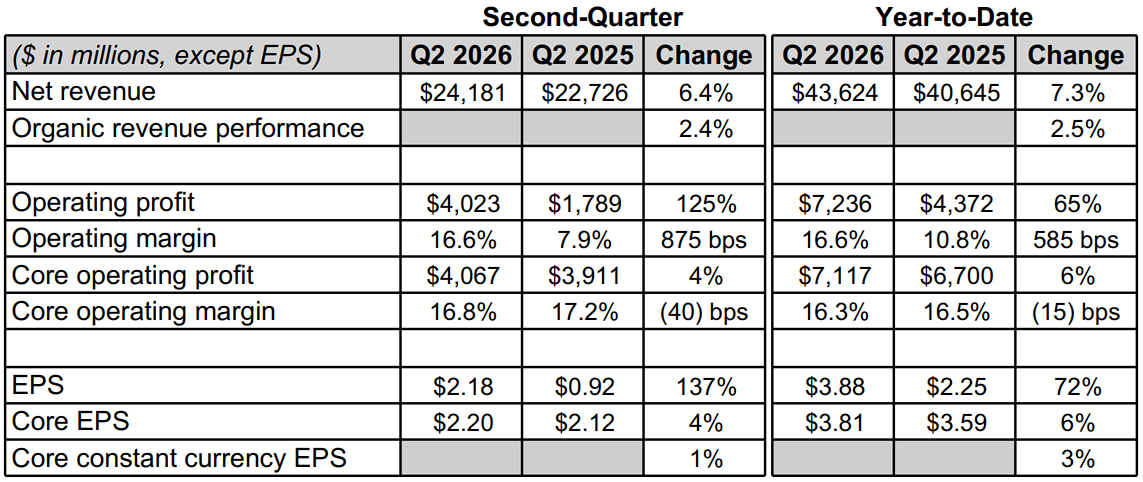
Productivity benefits, pricing, and foreign-exchange tailwinds supported results, but consumer value-seeking and cost inflation continued to pressure parts of the North American business.
Management maintained its 2026 outlook for 2% to 4% organic revenue growth and 4% to 6% core constant-currency earnings-per-share growth.
PepsiCo is using automation, artificial intelligence, portfolio simplification, and productivity initiatives to support margins and fund commercial investment.
The current yield is the second highest in this Top 10, giving investors meaningful income while management works to restore stronger volume growth.
The main risks are prolonged category weakness and stubborn input costs, but the company’s scale and brand portfolio remain major strengths.
Deep Dive: Click here to download (for free) our most recent 3-Page Sure Analysis PDF report on PepsiCo (PEP).
Dividend King #1: Stepan Company (SCL)
- 5-Year Expected Total Return: 19.4%
- Dividend Yield: 2.5%
Stepan Company manufactures surfactants, polymers, and specialty products used in cleaning, agriculture, oilfield services, insulation, construction, food, and pharmaceutical applications.
Its broad end markets provide diversification, but earnings remain sensitive to raw-material costs, industrial demand, and capacity utilization.
Stepan has raised its dividend for nearly six decades, and the current quarterly payout is $0.395 per share.
Second-quarter 2026 net sales increased 15% to $684.1 million, while global sales volume rose 3% and organic volume increased 6%.
Adjusted earnings per share more than doubled to $1.18 from $0.52, and adjusted EBITDA increased 45% to $74.4 million.
Free cash flow remained negative $15 million because of working-capital requirements, although cash generation improved sharply before that use of working capital.
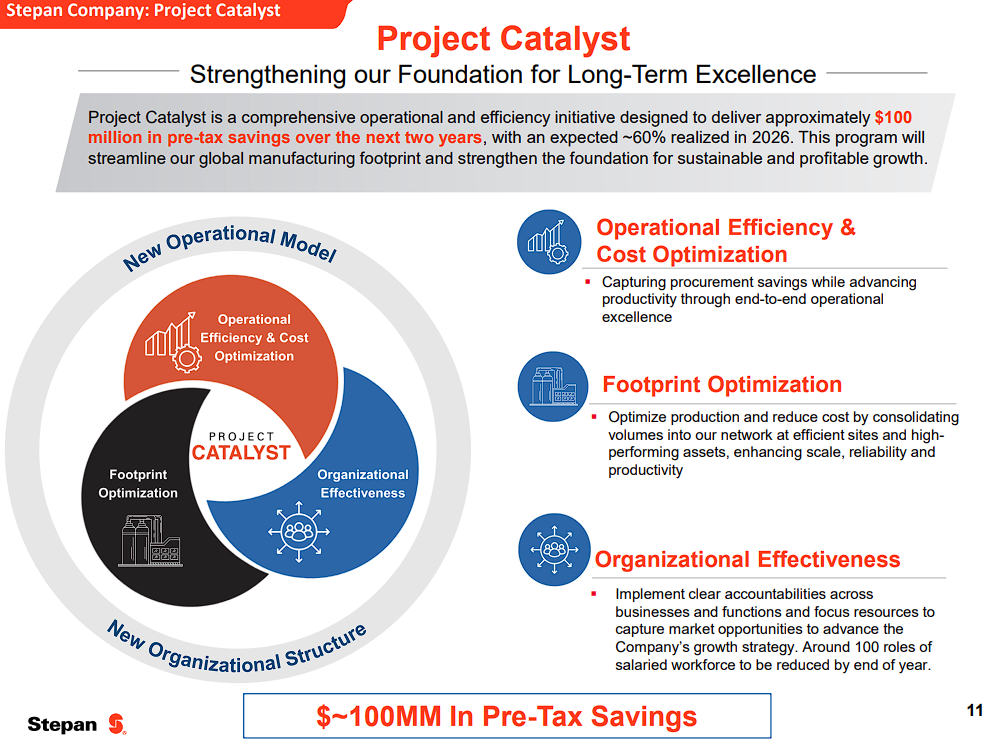
Project Catalyst is central to the recovery plan, combining facility closures, asset rationalization, organizational changes, and a target of $100 million in annual pre-tax savings over two years.
The company expects $75 million to $80 million of restructuring charges in 2026, highlighting that the turnaround is not costless.
The 19.4% projected return is the highest in the group, but it depends heavily on margin recovery and successful execution rather than simply collecting the dividend.
The A Dividend Risk Score and conservative payout ratio provide support while the restructuring progresses.
Deep Dive: Click here to download (for free) our most recent 3-Page Sure Analysis PDF report on Stepan Company (SCL).
Detailed Analysis On All 60 Dividend Kings
You can download (for free) the most recent 3-page PDF Sure Analysis Research Database report for every Dividend King at the links below. The Dividend Kings are organized by sector for easy access.
Consumer Staples
- Altria Group (MO)
- Archer-Daniels-Midland (ADM)
- Colgate-Palmolive (CL)
- Coca-Cola (KO)
- Hormel Foods (HRL)
- Kimberly-Clark (KMB)
- The Marzetti Company (MZTI)
- PepsiCo (PEP)
- Procter & Gamble (PG)
- Sysco Corporation (SYY)
- Target Corporation (TGT)
- Tootsie Roll Industries (TR)
- Universal Corporation (UVV)
- Walmart (WMT)
Industrials
- ABM Industries (ABM)
- Automatic Data Processing (ADP)
- Carlisle Companies (CSL)
- Dover (DOV)
- Emerson Electric (EMR)
- Gorman-Rupp Co. (GRC)
- Illinois Tool Works (ITW)
- MSA Safety (MSA)
- Nordson Corporation (NDSN)
- Parker-Hannifin (PH)
- Pentair (PNR)
- Stanley Black & Decker (SWK)
- Tennant Co. (TNC)
- W.W. Grainger (GWW)
Health Care
- Abbott Laboratories (ABT)
- AbbVie Inc. (ABBV)
- Becton, Dickinson & Company (BDX)
- Johnson & Johnson (JNJ)
- Kenvue Inc. (KVUE)
Consumer Discretionary
Financials
- Commerce Bancshares Inc. (CBSH)
- Cincinnati Financial (CINF)
- Farmers & Merchants Bancorp (FMCB)
- RLI Corp. (RLI)
- S&P Global (SPGI)
- United Bankshares (UBSI)
Materials
- H.B. Fuller (FUL)
- PPG Industries (PPG)
- Nucor (NUE)
- RPM International (RPM)
- Sonoco Products (SON)
- Stepan Co. (SCL)
Energy
Real Estate
Utilities
- American States Water (AWR)
- Black Hills Corp. (BKH)
- California Water Service Group (CWT)
- Canadian Utilities (CDUAF)
- Consolidated Edison (ED)
- Fortis Inc. (FTS)
- MGE Energy (MGEE)
- Middlesex Water Company (MSEX)
- Northwest Natural Holding (NWN)
- H2O America (HTO)
Final Thoughts
The Dividend Kings are already a highly selective group.
Each company has raised its dividend for at least 50 consecutive years, navigating recessions, inflation, rising interest rates, and major changes within its industry.
Dividend Kings satisfy the 25+ years dividend-increase requirement for a Dividend Aristocrat twice over.
Note: Not all Dividend Kings are Dividend Aristocrats because Dividend Aristocrats must also belong to the S&P 500 and meet minimum size and liquidity requirements.
The ten stocks highlighted above pair exceptional dividend longevity with the highest expected returns in the current Dividend Kings universe.
However, the return drivers differ considerably.
- Hormel Foods and PepsiCo offer the highest starting yields, but both must manage pressured consumer demand and cost inflation.
- S&P Global and ADP rely more heavily on recurring revenue, earnings growth, and valuation recovery.
- Stepan, PPG Industries, and Pentair provide greater margin-recovery or valuation-expansion potential.
- H2O America, The Marzetti Company, and Lowe’s add regulated utility, branded-food, and home-improvement exposure.
The unusually high projected returns should not be interpreted as equal risk across the group.
Stepan’s estimate depends on restructuring success, Hormel’s high yield comes with an elevated payout ratio, and H2O America’s acquisition adds financing and execution considerations.
Lowe’s and Pentair also face cyclical demand risks, so a discounted valuation alone does not guarantee a favorable outcome.
As a result, the ranking is most useful as a starting point for further research, with investors matching each company’s income, growth, and risk profile to their own objectives.
Other Sure Dividend Resources
- Dividend Champions: 25+ years of rising dividends
- Dividend Aristocrats: 25+ years of rising dividends and in the S&P 500
- High Dividend Stocks: 4%+ dividend yields
- Monthly Dividend Stocks: Individual securities that pay out every month
- Royalty Stocks: Detailed royalty stocks list
- MLPs: Detailed MLP list
- REITs: Detailed REIT list
- BDCs: Detailed BDC list